By Eric Andrew Kristof, RN, CAHIMS | Healthcare IT Professional | HIMSS Arkansas Chapter Member
About This Series: The HIMSS Word of the Day is a running blog series drawing from the HIMSS Dictionary of Health Information and Technology Terms, Acronyms, and Organizations, 6th Edition (2025) — the authoritative reference for healthcare IT professionals and the primary study resource for CAHIMS and CPHIMS certification. Each post paraphrases the term in plain language, grounds it in real-world healthcare IT context, and adds a bedside nursing perspective you won’t find in a textbook.
📖 The Term: National Drug Code (NDC)
Source: HIMSS Dictionary of Health Information and Technology Terms, Acronyms, and Organizations, 6th Edition (2025)
🔍 Plain-Language Definition
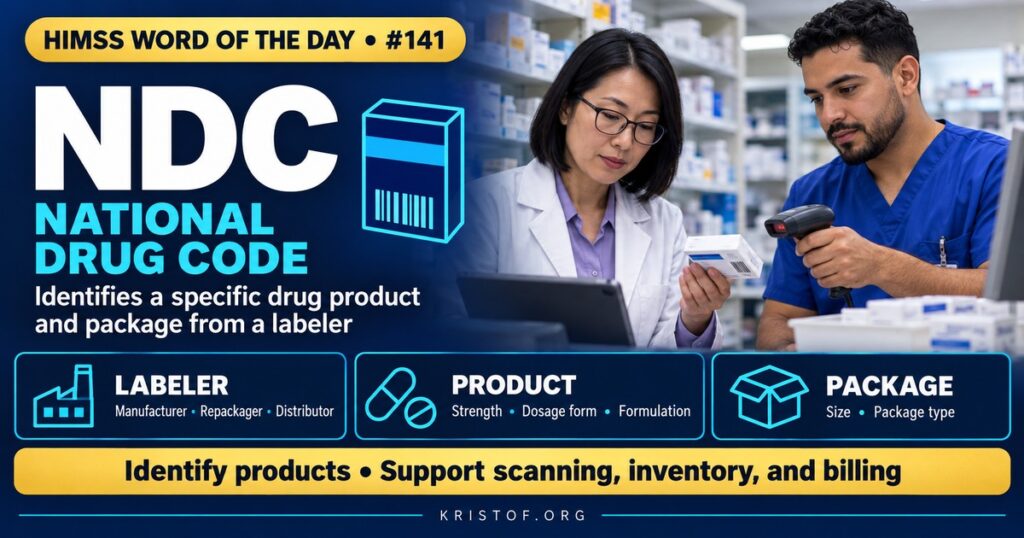
The National Drug Code (NDC) is a unique product identifier for drugs in the United States, assigned through the Food and Drug Administration’s drug listing process. Each NDC identifies the labeler, the specific product, and the package size and type.
The HIMSS Dictionary explains that, under the Drug Listing Act of 1972, registered drug establishments must give the FDA a current list of the drugs they make or process for commercial distribution, citing Section 510 of the Federal Food, Drug, and Cosmetic Act. It notes that these drug products are identified and reported with a unique three-segment number, the NDC, which serves as a universal product identifier for human drugs.
| NDC Segment | What It Identifies | Notes |
|---|---|---|
| Labeler Code | The firm that manufactures, repackages, or distributes the drug | Assigned by the FDA |
| Product Code | Strength, dosage form, and formulation for that labeler | Assigned by the labeler |
| Package Code | Package size and type | Assigned by the labeler |
| Current 10-Digit Formats | 4-4-2, 5-3-2, or 5-4-1 segment configurations | The variation causes confusion across systems |
| 11-Digit Billing Format | A 5-4-2 format created by adding a leading zero | Common in claims and pharmacy systems |
| 12-Digit Format (Final Rule) | A uniform 6-4-2 format | Effective March 7, 2033 under the FDA’s 2026 final rule |
⚠️ Exam Alert: An NDC identifies a specific drug package from a specific labeler. RxNorm provides normalized clinical drug names that link many NDCs for the same drug. Listing in the NDC Directory does not mean the FDA has approved the drug. The same drug from different manufacturers has different NDCs.
🌐 Why It Matters: Real-World Healthcare IT Context
NDCs are everywhere in medication workflows. They appear on drug packages and barcodes, in pharmacy inventory and dispensing systems, on pharmacy and medical claims, in drug databases, and in supply chain tracking. HIPAA adopted the NDC as the standard code set for drugs in retail pharmacy transactions.
Formatting has long caused problems. Because current NDCs are 10 digits arranged in three different segment patterns, systems often convert them to an 11-digit format by inserting a leading zero in a specific segment for billing. Mistakes in conversion can cause mismatches between scanned barcodes, pharmacy records, and claims.
The FDA has finalized a change. In March 2026, the FDA published a final rule establishing a uniform 12-digit NDC with a 6-digit labeler code, 4-digit product code, and 2-digit package code, effective March 7, 2033. Existing NDCs will be converted by adding leading zeros. The FDA explained that the change is needed because the supply of available labeler codes is running out, and the rule also updates drug label barcode requirements. Health IT systems, databases, interfaces, and barcode scanners will need to support the new format.
NDCs are not ideal for clinical decision-making on their own. Each manufacturer and package size has a different NDC, so a single medication may have dozens of NDCs. Clinical systems use terminologies such as RxNorm, maintained by the National Library of Medicine, which maps NDCs to normalized drug concepts. That mapping allows prescribing, allergy checking, and decision support to work across products.
Barcode medication administration depends on NDCs. When a nurse scans a medication package, the system typically reads the NDC from the barcode and matches it to the order. If the NDC is missing from the pharmacy system’s product file, the scan fails, prompting workarounds that undermine safety.
Supply chain security also relies on NDCs. The Drug Supply Chain Security Act requires product identifiers on many prescription drug packages, which include the NDC along with serial numbers, lot numbers, and expiration dates, enabling tracing and verification.
Drug shortages make NDC management harder. When products are substituted, new NDCs must be added to pharmacy systems quickly so that scanning, billing, and inventory continue to work.
Common NDC-related problems:
- Conversion errors between 10- and 11-digit formats
- New products missing from pharmacy system files
- Barcode scan failures leading to manual overrides
- Outdated drug database mappings
- Claims rejected for invalid or mismatched NDCs
- Confusion between NDCs and clinical drug concepts
Practices that support NDC accuracy:
- Timely updates of drug databases and product files
- Mapping NDCs to RxNorm for clinical use
- Monitoring and investigating scan failures
- Planning for the 12-digit NDC transition
- Coordination between pharmacy, nursing, and IT on substitutions
- Validation of NDCs in billing and claims processes
🏥 The Nurse’s Perspective: Clinical, Bedside, & Workflow
Nurses interact with NDCs most directly through barcode scanning at the bedside.
At the Bedside
When a scan fails, the cause is often an NDC that has not been added to the pharmacy system, such as a new package from a different manufacturer. Contacting pharmacy rather than overriding the scan helps fix the problem for every nurse who encounters the same product.
Overrides should be used only according to policy, with careful verification of the medication, dose, and patient. Frequent overrides on a unit may signal an NDC or barcode problem that pharmacy and informatics teams need to know about.
In Clinical Workflow
During drug shortages, pharmacies may substitute products with different NDCs, packaging, or concentrations. Nurses should watch for changes in appearance or labeling and confirm that scanning and documentation match the substituted product.
Patients’ home medications may be recorded with NDCs from pharmacy claims or outside records. Nurses reconciling medications should focus on the drug, strength, and dose, recognizing that different NDCs can represent the same medication.
Reporting barcode problems with specific details, such as the product name, lot, and the error message, helps pharmacy resolve them quickly.
In EHR Implementation (Go-Live Perspective)
During an Epic Go-Live, pharmacy teams build medication records linked to NDCs and test barcode scanning across units. Missing NDCs often surface in the first days, so rapid reporting and resolution processes are essential.
At-the-elbow support analysts frequently help nurses with scanning issues. Tracking which products fail to scan and routing them to pharmacy helps prevent unsafe override habits from forming early.
🎓 CAHIMS / CPHIMS & HIMSS Perspective
CAHIMS Exam Domain Mapping
The NDC appears in medication, standards, and safety questions:
| CAHIMS Domain | How the NDC Appears |
|---|---|
| Healthcare & Technology Environments | FDA drug listing; HIPAA code sets; the 12-digit NDC final rule; DSCSA |
| Clinical Informatics | Barcode medication administration, medication reconciliation, substitutions |
| Healthcare Information & Systems Management | Drug databases, RxNorm mapping, product files, format conversion |
| Management & Leadership | Transition planning, shortages, revenue cycle impacts |
Key Terms to Know Alongside NDC
- RxNorm — the National Library of Medicine terminology for normalized clinical drug names
- NDC Directory — the FDA’s public database of listed drug products
- Barcode Medication Administration (BCMA) — scanning patients and medications before administration
- Drug Supply Chain Security Act (DSCSA) — federal law requiring product tracing for prescription drugs
- Labeler — the firm that manufactures, repackages, or distributes a drug
- HCPCS Level II — codes used for many drugs administered in outpatient settings
HIMSS Organizational Position
HIMSS supports standardized medication data and barcode technology as foundations for medication safety and interoperability through its education and policy work. Members can find related education and research through the HIMSS Resource Center.
🔗 Explore Further: External References
- FDA — National Drug Code Directory https://www.fda.gov/drugs/drug-approvals-and-databases/national-drug-code-directory
- Federal Register — Revising the National Drug Code Format and Drug Label Barcode Requirements (Final Rule) https://www.federalregister.gov/documents/2026/03/05/2026-04368/revising-the-national-drug-code-format-and-drug-label-barcode-requirements
- National Library of Medicine — RxNorm https://www.nlm.nih.gov/research/umls/rxnorm/index.html
- FDA — Drug Supply Chain Security Act (DSCSA) https://www.fda.gov/drugs/drug-supply-chain-integrity/drug-supply-chain-security-act-dscsa
- NCPDP — National Council for Prescription Drug Programs https://www.ncpdp.org/
- HIMSS — Nursing Informatics Community https://www.himss.org/networking/communities/nursing-informatics/
Term source: HIMSS Dictionary of Health Information and Technology Terms, Acronyms, and Organizations, 6th Edition (2025). All definitions in this series are paraphrased for editorial purposes. Readers are encouraged to consult the primary source for exact language.
Eric Andrew Kristof, RN, CAHIMS is a Healthcare IT professional and HIMSS Arkansas Chapter member based in Hot Springs Village, AR, with hands-on Epic Go-Live experience and a diverse healthcare and IT background. He writes at kristof.org at the intersection of clinical care and healthcare technology.
Leave a Reply