By Eric Andrew Kristof, RN, CAHIMS | Healthcare IT Professional | HIMSS Arkansas Chapter Member
About This Series: The HIMSS Word of the Day is a running blog series drawing from the HIMSS Dictionary of Health Information and Technology Terms, Acronyms, and Organizations, 6th Edition (2025) — the authoritative reference for healthcare IT professionals and the primary study resource for CAHIMS and CPHIMS certification. Each post paraphrases the term in plain language, grounds it in real-world healthcare IT context, and adds a bedside nursing perspective you won’t find in a textbook.
📖 The Term: Disease Registry
Source: HIMSS Dictionary of Health Information and Technology Terms, Acronyms, and Organizations, 6th Edition (2025)
🔍 Plain-Language Definition
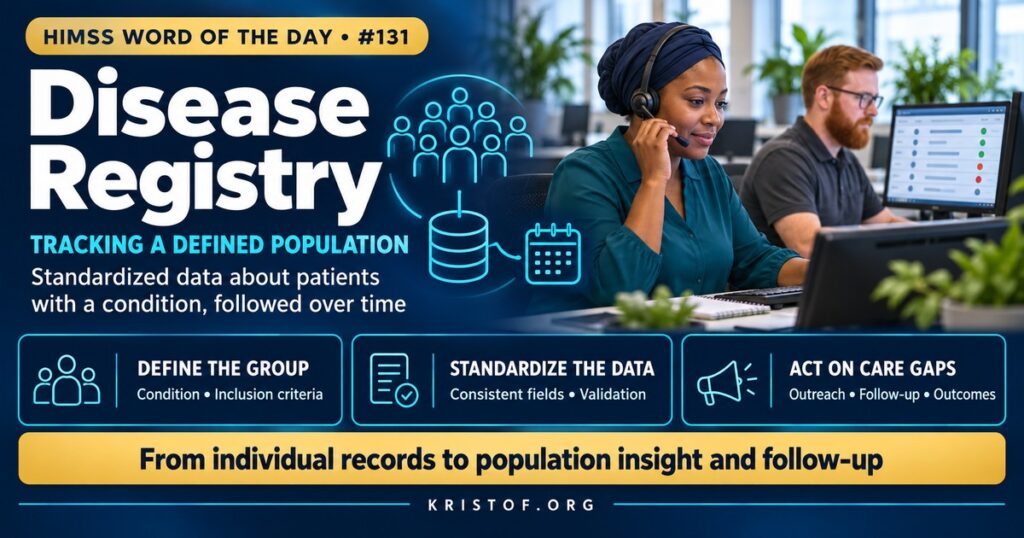
A disease registry is an organized system that collects standardized data about a population of patients with a specific condition, such as diabetes, cancer, or heart failure, to track care, outcomes, and quality over time.
The HIMSS Dictionary describes a disease registry as a large collection of information about chronic health problems affecting patients in a health system. It explains that registries help manage and record data on chronic illnesses, that providers contribute the data, and that providers can use it for benchmarking.
| Registry Type | Purpose | Example |
|---|---|---|
| EHR-Based Registry | Track a practice’s or system’s patients with a condition | A list of patients with diabetes and their recent A1c results |
| Population Health Registry | Identify care gaps and high-risk patients | Patients overdue for screenings or follow-up |
| National Clinical Registry | Benchmark quality and outcomes across organizations | Cardiology or surgical outcomes registries |
| Public Health Registry | Surveillance required or supported by public health agencies | Cancer registries and immunization information systems |
| Research Registry | Study natural history, treatments, and outcomes | A registry for a rare disease |
⚠️ Exam Alert: A registry tracks a defined population with standardized data over time. A data warehouse stores broad organizational data for analysis. An EHR documents individual patient care. A Qualified Clinical Data Registry (QCDR) is a CMS-approved registry that can report quality data for MIPS.
🌐 Why It Matters: Real-World Healthcare IT Context
Registries turn individual records into population views. Instead of seeing one patient at a time, a care team can see all patients with a condition, identify who is overdue for care, and track progress. That capability is central to chronic disease management, value-based payment, and population health.
Inside organizations, EHR-based registries automatically include patients who meet criteria, such as a diagnosis on the problem list or certain lab results, and display key metrics. Care teams use them to plan outreach, schedule visits, and close care gaps.
National clinical registries serve broader purposes. Organizations submit standardized data to registries run by professional societies and others, then receive benchmark reports comparing their outcomes with peers. The American College of Cardiology’s NCDR registries are a well-known example. Some registries are approved by CMS as Qualified Clinical Data Registries for reporting quality measures in the Merit-based Incentive Payment System.
Public health and research rely on registries as well. Cancer registries collect information on cancer cases, and the National Cancer Institute’s SEER Program provides population-based cancer statistics used widely in research and policy. AHRQ has published a user’s guide on designing and using registries to evaluate patient outcomes, reflecting their importance in research.
Data quality is the main challenge. Registries depend on accurate diagnoses, structured data, and consistent definitions. A patient with diabetes who lacks the diagnosis on the problem list may be missed, while outdated diagnoses can add patients who no longer need follow-up. Abstraction for national registries can require trained staff to review charts manually.
Registries can also reveal disparities. When registry data includes demographic and social information, organizations can see whether outcomes such as blood pressure control or cancer screening differ by race, ethnicity, language, or neighborhood, and target improvement work accordingly. That requires consistent, respectful collection of demographic data in the first place.
Interoperability can reduce burden. Standards-based data capture from EHRs, including FHIR-based approaches, aims to populate registries automatically, reducing manual entry and improving timeliness.
Privacy and governance apply as well. Registries that share data outside an organization need agreements defining permitted uses, de-identification where appropriate, and security controls. Public health reporting may be required by law, while participation in research registries often requires consent or ethics review.
Common registry challenges:
- Incomplete or inaccurate problem lists
- Data captured in free text that registries cannot read
- Manual abstraction burden for national registries
- Inconsistent definitions across organizations
- Registries that are built but not used in workflow
- Delays between care and registry updates
What makes registries effective:
- Clear inclusion criteria and data definitions
- Structured documentation in routine workflow
- Regular validation of registry membership
- Integration with outreach and care management tools
- Benchmarking that drives improvement
- Assigned ownership for registry follow-up
🏥 The Nurse’s Perspective: Clinical, Bedside, & Workflow
Nurses are frequent users of registries and contributors to the data that powers them.
At the Bedside
Every structured entry, such as a blood pressure, a foot exam, a depression screening, or a smoking status, can feed a registry. Documenting these items in the designated fields rather than free text ensures that patients receive credit for completed care and are not flagged for unnecessary outreach.
Accurate problem lists matter too. Nurses who notice that a diagnosis is missing or outdated can alert the care team, improving registry accuracy.
During hospital stays, nurses may also document data elements that national registries require, such as time of stroke symptom onset or door-to-needle times. Precise times and structured entries make that information usable later.
In Clinical Workflow
Ambulatory care nurses and care managers often work directly from registries: calling patients with diabetes who are overdue for A1c tests, scheduling heart failure follow-up, or identifying patients who need vaccines. Registries help prioritize limited outreach time.
Nurses involved in quality programs may abstract data for national registries, such as stroke, cardiac, or surgical registries, reviewing charts and entering standardized data elements. Clear documentation by bedside nurses makes abstraction faster and more accurate.
Registry dashboards can also show progress, helping nursing teams see the impact of improvement work.
Registry-driven outreach works best when nurses have protocols that let them act directly, such as ordering overdue screenings under standing orders or scheduling visits, rather than only routing messages to busy providers.
In EHR Implementation (Go-Live Perspective)
During an Epic Go-Live, teams build registries, define inclusion rules, and validate that converted data, such as historical labs and diagnoses, populates them correctly. Patients missing from registries at Go-Live can miss outreach for months.
At-the-elbow support analysts can help nurses find registry reports, outreach work lists, and documentation fields that feed them. Feedback about inaccurate registry membership helps teams refine rules quickly.
🎓 CAHIMS / CPHIMS & HIMSS Perspective
CAHIMS Exam Domain Mapping
Disease registries appear in data, population health, and quality questions:
| CAHIMS Domain | How Disease Registries Appear |
|---|---|
| Healthcare & Technology Environments | Public health reporting; QCDRs; national registries |
| Clinical Informatics | Chronic disease management, care gaps, structured documentation |
| Healthcare Information & Systems Management | Data definitions, data quality, registry integration, interoperability |
| Management & Leadership | Population health strategy, benchmarking, quality improvement |
Key Terms to Know Alongside Disease Registry
- Population Health — managing the health outcomes of a defined group of people
- Care Gap — recommended care that a patient has not received
- Qualified Clinical Data Registry (QCDR) — a CMS-approved registry for MIPS quality reporting
- Data Abstraction — extracting specific data elements from records, often manually
- Benchmarking — comparing performance with peers or standards
- Problem List — the structured list of a patient’s active health conditions
HIMSS Organizational Position
HIMSS supports registries and population health through its data, analytics, and interoperability education, encouraging structured, standards-based data that reduces manual abstraction. Members can find related education and research through the HIMSS Resource Center.
🔗 Explore Further: External References
- AHRQ — Registries https://www.ahrq.gov/topics/registries.html
- National Cancer Institute — Overview of the SEER Program https://seer.cancer.gov/about/overview.html
- American College of Cardiology — NCDR https://cvquality.acc.org/NCDR-Home
- CMS — Quality Payment Program: MIPS Quality https://qpp.cms.gov/reporting-requirements/ways-to-report/traditional-mips/quality
- HL7 International — FHIR https://hl7.org/fhir/
- HIMSS — Nursing Informatics Community https://www.himss.org/networking/communities/nursing-informatics/
Term source: HIMSS Dictionary of Health Information and Technology Terms, Acronyms, and Organizations, 6th Edition (2025). All definitions in this series are paraphrased for editorial purposes. Readers are encouraged to consult the primary source for exact language.
Eric Andrew Kristof, RN, CAHIMS is a Healthcare IT professional and HIMSS Arkansas Chapter member based in Hot Springs Village, AR, with hands-on Epic Go-Live experience and a diverse healthcare and IT background. He writes at kristof.org at the intersection of clinical care and healthcare technology.
Leave a Reply