By Eric Andrew Kristof, RN, CAHIMS | Healthcare IT Professional | HIMSS Arkansas Chapter Member
About This Series: The HIMSS Word of the Day is a running blog series drawing from the HIMSS Dictionary of Health Information and Technology Terms, Acronyms, and Organizations, 6th Edition (2025) — the authoritative reference for healthcare IT professionals and the primary study resource for CAHIMS and CPHIMS certification. Each post paraphrases the term in plain language, grounds it in real-world healthcare IT context, and adds a bedside nursing perspective you won’t find in a textbook.
📖 The Term: mHealth (Mobile Health)
Source: HIMSS Dictionary of Health Information and Technology Terms, Acronyms, and Organizations, 6th Edition (2025)
🔍 Plain-Language Definition
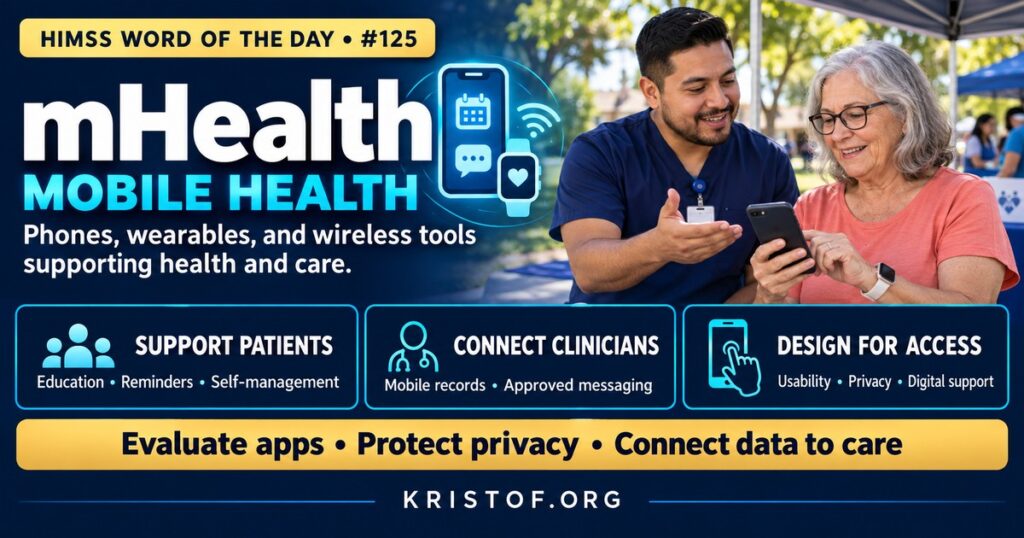
mHealth (mobile health) refers to the use of mobile phones, tablets, wearable devices, and other wireless technologies to support health and healthcare. It includes apps used by patients, tools used by clinicians, and the networks that connect them.
The HIMSS Dictionary describes mHealth as a broad term for applying mobile phones and other wireless technologies to medical care. It lists uses such as patient education, remote monitoring, treatment support, tracking of disease outbreaks, and management of chronic conditions.
| mHealth Category | What It Includes | Example |
|---|---|---|
| Patient Apps | Apps for tracking, education, and self-management | A diabetes app logging glucose readings and meals |
| Wearables and Sensors | Devices that collect physiologic data | A smartwatch detecting irregular heart rhythms |
| Communication | Text messages, secure messaging, and video | Appointment reminders and video visits |
| Clinician Mobile Tools | Mobile EHR access and point-of-care devices | Nurses scanning medications and documenting on handheld devices |
| Public Health Uses | Data collection and outreach in communities | Mobile surveys and outbreak reporting |
⚠️ Exam Alert: mHealth is a subset of digital health focused on mobile and wireless technology. Telehealth is the delivery of care at a distance, which may or may not use mobile devices. Remote patient monitoring collects physiologic data from patients outside the clinic. An app may be a medical device if its intended use is diagnosis or treatment.
🌐 Why It Matters: Real-World Healthcare IT Context
Mobile devices are nearly universal, which makes them a powerful channel for healthcare. Patients use phones to schedule visits, view results, message clinicians, join video visits, and track symptoms. Clinicians use mobile devices to access records, communicate, scan medications, and receive alerts.
Regulation depends on what an app does. The FDA’s guidance on device software functions and mobile medical applications explains that the agency focuses oversight on software functions that meet the definition of a medical device and could pose risk to patients if they do not work as intended, while exercising enforcement discretion for many lower-risk functions. An app that helps patients log their meals is treated differently from one that analyzes data to diagnose a heart rhythm.
Privacy rules depend on who offers the app. When a covered entity or its business associate provides an app, HIPAA applies. Many consumer health apps, however, are not covered by HIPAA, and their data practices are governed by their own privacy policies and by Federal Trade Commission oversight, including the FTC’s Health Breach Notification Rule. Patients may not realize that information they enter into a consumer app lacks HIPAA protections.
Patient access policies have expanded the role of apps. Federal rules require certified EHRs to support standardized APIs that let patients connect apps of their choice to retrieve their health information, making mobile access more common.
Evidence and quality vary widely. Thousands of health apps exist, but many have limited evidence of benefit, and quality, accuracy, and security can be inconsistent. Organizations increasingly evaluate apps before recommending them and integrate approved tools with their EHRs.
Equity also matters. Not all patients have smartphones, reliable data plans, or comfort with technology, and apps designed without accessibility in mind can exclude people with disabilities or limited literacy.
Text messaging programs remain one of the simplest forms of mHealth. Appointment reminders, medication prompts, and follow-up check-ins by text work on basic phones as well as smartphones, which helps reach patients who do not use apps. Organizations must still manage consent, opt-outs, and the limited privacy of standard text messages.
Clinician mobile use brings its own concerns. Personal phones used for work can mix patient information with personal data, so organizations rely on approved apps, mobile device management, and secure messaging platforms rather than ordinary text messages.
Common mHealth challenges:
- Unclear evidence for many consumer apps
- Privacy gaps when apps fall outside HIPAA
- Data from apps and wearables that does not reach the EHR
- Alert and data overload for clinicians
- Digital divides in access and skills
- Security risks on personal and lost devices
What supports safe and effective mHealth:
- Evaluation and curation of recommended apps
- Integration with EHRs through standards such as FHIR
- Clear privacy information for patients
- Mobile device management for clinical devices
- Accessible design and patient support
- Clinical workflows for reviewing patient-generated data
🏥 The Nurse’s Perspective: Clinical, Bedside, & Workflow
Nurses use mobile technology daily and help patients make sense of the mobile tools they use.
At the Bedside
Handheld devices allow nurses to scan medications, document at the point of care, receive alerts, and communicate with the team without returning to a workstation. Keeping devices charged, secured, and cleaned between uses supports both safety and infection prevention.
Patients often ask about apps they have downloaded. Nurses can help them understand what an app does, encourage use of organization-recommended tools, and remind them that information entered into consumer apps may not have the same protections as their medical record.
In Clinical Workflow
Patient-generated data from apps and wearables, such as blood pressure readings, glucose logs, or symptom reports, can support chronic disease management. Nurses reviewing this data need clear protocols for which readings require action and how quickly to respond.
Teaching is a key nursing role. Showing patients how to use the portal app, connect a home device, or join a video visit can determine whether mHealth tools actually help. Teach-back methods confirm understanding.
Secure messaging on approved mobile platforms supports fast communication among nurses, physicians, and other team members. Avoiding standard texting for patient information protects privacy.
Lost or stolen devices should be reported immediately so they can be locked or wiped remotely. Quick reporting limits exposure of patient information.
In EHR Implementation (Go-Live Perspective)
During an Epic Go-Live, mobile clinical applications are configured and deployed alongside workstations. Teams test scanning, documentation, and alerting on handheld devices and ensure that devices are enrolled in mobile device management.
At-the-elbow support analysts often help nurses log in to mobile devices, resolve scanning problems, and navigate mobile documentation. Patient portal app activation may also be promoted at Go-Live, with nurses helping patients sign up.
🎓 CAHIMS / CPHIMS & HIMSS Perspective
CAHIMS Exam Domain Mapping
mHealth appears in technology trend, privacy, and patient engagement questions:
| CAHIMS Domain | How mHealth Appears |
|---|---|
| Healthcare & Technology Environments | Consumer technology trends; FDA oversight; FTC and HIPAA privacy |
| Clinical Informatics | Patient-generated data, patient education, mobile clinical tools |
| Healthcare Information & Systems Management | Mobile device management, APIs, integration, security |
| Management & Leadership | Digital health strategy, app evaluation, equity, patient engagement |
Key Terms to Know Alongside mHealth
- Digital Health — the broad use of digital technologies in health and healthcare
- Patient-Generated Health Data (PGHD) — health data created and recorded by patients
- Software as a Medical Device (SaMD) — software intended for medical purposes without being part of a hardware device
- Mobile Device Management (MDM) — tools for securing and managing mobile devices
- Wearable — a body-worn device that collects health or activity data
- Patient Access API — a standardized interface that lets patients retrieve their data through apps
HIMSS Organizational Position
HIMSS supports mobile and connected health through its education, research, and communities focused on digital health, virtual care, and patient engagement. Members can find related education and research through the HIMSS Resource Center.
🔗 Explore Further: External References
- FDA — Policy for Device Software Functions and Mobile Medical Applications https://www.fda.gov/regulatory-information/search-fda-guidance-documents/policy-device-software-functions-and-mobile-medical-applications
- HHS — Health Information Technology (HIPAA) https://www.hhs.gov/hipaa/for-professionals/special-topics/health-information-technology/index.html
- AMA — Digital Health Implementation Playbook Series https://www.ama-assn.org/practice-management/digital-health/digital-health-implementation-playbook-series
- HL7 — SMART App Launch https://hl7.org/fhir/smart-app-launch/
- NIST — SP 800-46 Rev. 2, Guide to Enterprise Telework, Remote Access, and BYOD Security https://csrc.nist.gov/pubs/sp/800/46/r2/final
- HIMSS — Virtual Care Community https://www.himss.org/networking/communities/virtual-care/
Term source: HIMSS Dictionary of Health Information and Technology Terms, Acronyms, and Organizations, 6th Edition (2025). All definitions in this series are paraphrased for editorial purposes. Readers are encouraged to consult the primary source for exact language.
Eric Andrew Kristof, RN, CAHIMS is a Healthcare IT professional and HIMSS Arkansas Chapter member based in Hot Springs Village, AR, with hands-on Epic Go-Live experience and a diverse healthcare and IT background. He writes at kristof.org at the intersection of clinical care and healthcare technology.
Leave a Reply