By Eric Andrew Kristof, RN, CAHIMS | Healthcare IT Professional | HIMSS Arkansas Chapter Member
About This Series: The HIMSS Word of the Day is a running blog series drawing from the HIMSS Dictionary of Health Information and Technology Terms, Acronyms, and Organizations, 6th Edition (2025) — the authoritative reference for healthcare IT professionals and the primary study resource for CAHIMS and CPHIMS certification. Each post paraphrases the term in plain language, grounds it in real-world healthcare IT context, and adds a bedside nursing perspective you won’t find in a textbook.
📖 The Term: Alternative Payment Models (APMs)
Source: HIMSS Dictionary of Health Information and Technology Terms, Acronyms, and Organizations, 6th Edition (2025)
🔍 Plain-Language Definition
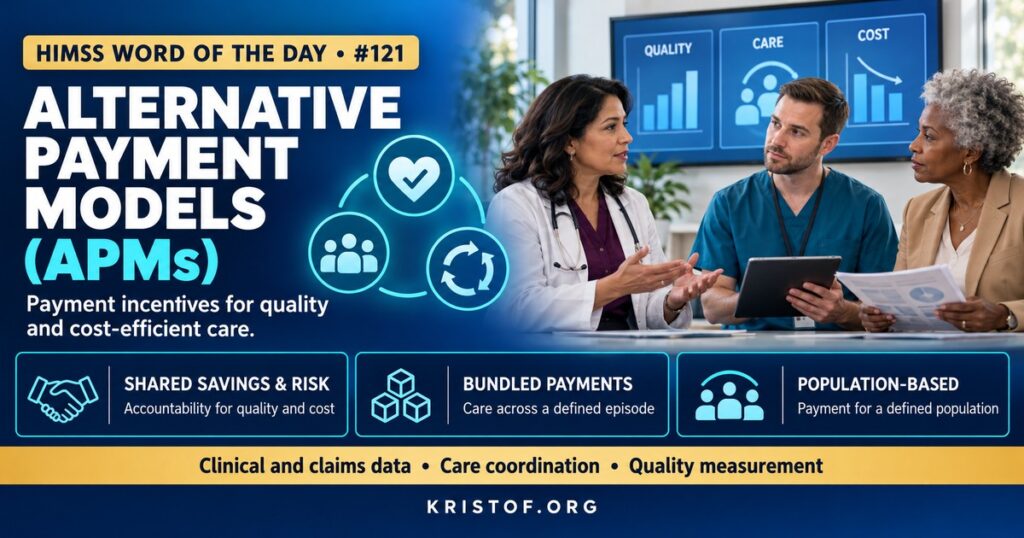
Alternative payment models (APMs) are approaches to paying for healthcare that reward providers for quality and cost efficiency, rather than paying only for the number of services delivered. They range from fee-for-service payments with quality bonuses to arrangements in which providers accept financial responsibility for the total cost of care for a population.
The HIMSS Dictionary describes APMs as models that give providers additional incentive payments for delivering high-quality, cost-efficient care. It notes that MACRA identifies APMs as one route for participating in the Quality Payment Program (QPP), and it lists accountable care organizations, patient-centered medical homes, and bundled payment models as examples.
| APM Type | How It Works | Example |
|---|---|---|
| Shared Savings | Providers share in savings if costs come in below a benchmark while meeting quality goals | An accountable care organization |
| Shared Risk | Providers share savings and may owe money if costs exceed the benchmark | A two-sided risk ACO track |
| Bundled or Episode Payment | A single target price covers care for an episode | Joint replacement from surgery through recovery |
| Medical Home | Payments support enhanced primary care and care management | A primary care practice with care coordinators |
| Population-Based Payment | A fixed amount per person covers a defined set of services | Capitated primary care or total cost of care |
⚠️ Exam Alert: MACRA is the law that created the Quality Payment Program. The QPP has two tracks: MIPS (the Merit-based Incentive Payment System, which adjusts fee-for-service payment) and Advanced APMs (which require financial risk, use of certified EHR technology, and quality measurement). Not every APM qualifies as an Advanced APM.
🌐 Why It Matters: Real-World Healthcare IT Context
For most of its history, American healthcare has been paid mainly through fee-for-service, which rewards volume. APMs aim to change incentives so that keeping people healthy, avoiding complications, and coordinating care are financially rewarded.
Federal policy has driven much of this work. The Affordable Care Act created the CMS Innovation Center to test new payment and delivery models, and MACRA, passed in 2015, established the Quality Payment Program with an Advanced APM track for clinicians who take on meaningful risk. Commercial insurers and state Medicaid programs operate their own APMs as well.
The Health Care Payment Learning & Action Network (HCP-LAN) created a widely used framework for classifying payment. It groups payments into four categories: fee-for-service with no link to quality, fee-for-service linked to quality and value, APMs built on fee-for-service architecture, and population-based payment. The framework helps payers and providers track progress from volume toward value.
APMs depend on data. Organizations need to know which patients are attributed to them, what care those patients receive inside and outside the organization, how they are performing on quality measures, and how costs compare with benchmarks. That requires claims data from payers, clinical data from EHRs, analytics to identify high-risk patients, and tools to manage care across settings.
Results have been mixed. Some models have produced savings and quality improvements, while others have shown modest or no savings. Model design, provider readiness, and the length of participation all appear to matter, and CMS has revised or ended models based on evaluation results.
Equity has become part of APM design. Some models adjust benchmarks or payments to account for social risk, or require participants to collect data on social needs, so that organizations serving disadvantaged communities are not penalized and have resources to address barriers to health. Collecting that information consistently is itself a data challenge.
Health IT is also a formal requirement. Advanced APMs must require use of certified EHR technology, linking payment reform to interoperable systems.
Common APM challenges:
- Delayed or incomplete claims data from payers
- Difficulty attributing patients accurately
- Fragmented data across unaffiliated providers
- Financial risk that smaller practices struggle to absorb
- Many different models with different rules and measures
- Upfront investment in care management staff and analytics
What supports APM success:
- Timely data sharing between payers and providers
- Analytics for risk stratification and performance tracking
- Care management and care coordination programs
- Admission, discharge, and transfer notifications
- Engaged clinicians and clear quality goals
- Strong primary care and community partnerships
🏥 The Nurse’s Perspective: Clinical, Bedside, & Workflow
Nurses are central to the care management and coordination work that makes APMs succeed.
At the Bedside
In APMs, preventing avoidable readmissions, complications, and emergency visits matters financially as well as clinically. Thorough discharge education, medication reconciliation, and follow-up planning by nurses directly influence the outcomes these models reward.
Nurses who understand that their organization participates in an APM can better appreciate why certain documentation, screenings, or follow-up calls are emphasized. Those activities often connect to quality measures tied to payment.
Nurses can also help patients understand why they receive outreach calls or care management offers, which builds trust and improves engagement with programs designed to help them.
In Clinical Workflow
Many APMs fund nurse care managers who follow high-risk patients, coordinate with specialists and community resources, and monitor patients between visits. These nurses use registries, risk scores, and care gap reports to decide who needs outreach.
Notifications when patients are admitted or visit the emergency department allow care managers to intervene quickly. Nurses in bundled payment programs may track patients across the hospital stay, post-acute care, and home recovery to keep the episode on course.
Accurate, structured documentation of diagnoses, screenings, and care plans supports quality reporting and risk adjustment. When information exists only in free text, organizations may miss credit for care delivered.
In EHR Implementation (Go-Live Perspective)
During an Epic Go-Live, organizations in APMs configure registries, care management tools, quality dashboards, and data feeds from payers. Ensuring that attributed patient lists and care gap reports work from the first day helps care managers continue outreach without interruption.
At-the-elbow support analysts can help care management nurses locate outreach work queues, documentation templates, and population health tools. Feedback about missing data or confusing reports helps teams refine these tools quickly.
🎓 CAHIMS / CPHIMS & HIMSS Perspective
CAHIMS Exam Domain Mapping
APMs appear in policy, value-based care, and analytics questions:
| CAHIMS Domain | How APMs Appear |
|---|---|
| Healthcare & Technology Environments | MACRA, the Quality Payment Program, the CMS Innovation Center, payment reform |
| Clinical Informatics | Care management workflows, quality measure documentation, care gaps |
| Healthcare Information & Systems Management | Attribution, claims and clinical data integration, analytics, registries |
| Management & Leadership | Financial risk, strategy, payer contracting, performance improvement |
Key Terms to Know Alongside APMs
- MACRA — the 2015 law that created the Quality Payment Program
- Quality Payment Program (QPP) — the CMS program with MIPS and Advanced APM tracks
- Advanced APM — an APM that requires financial risk, certified EHR technology, and quality measurement
- Accountable Care Organization (ACO) — a group of providers accountable for the quality and cost of care for a population
- Bundled Payment — a single payment or target price for an episode of care
- Attribution — the method of assigning patients to providers for accountability
HIMSS Organizational Position
HIMSS supports value-based care through education on data, analytics, and interoperability, and engages on CMS payment and quality programs through its public policy work. Members can find related education and research through the HIMSS Resource Center.
🔗 Explore Further: External References
- HCP-LAN — APM Framework https://hcp-lan.org/apm-framework/
- CMS — Quality Payment Program https://qpp.cms.gov/
- CMS — About the CMS Innovation Center https://www.cms.gov/priorities/innovation/about
- CMS — Value-Based Programs https://www.cms.gov/medicare/quality/value-based-programs
- ONC — Certified Health IT Product List (CHPL) https://chpl.healthit.gov/
- HIMSS — Public Policy & Advocacy https://www.himss.org/public-policy-advocacy-overview
Term source: HIMSS Dictionary of Health Information and Technology Terms, Acronyms, and Organizations, 6th Edition (2025). All definitions in this series are paraphrased for editorial purposes. Readers are encouraged to consult the primary source for exact language.
Eric Andrew Kristof, RN, CAHIMS is a Healthcare IT professional and HIMSS Arkansas Chapter member based in Hot Springs Village, AR, with hands-on Epic Go-Live experience and a diverse healthcare and IT background. He writes at kristof.org at the intersection of clinical care and healthcare technology.
Leave a Reply