By Eric Andrew Kristof, RN, CAHIMS | Healthcare IT Professional | HIMSS Arkansas Chapter Member
About This Series: The HIMSS Word of the Day is a running blog series drawing from the HIMSS Dictionary of Health Information and Technology Terms, Acronyms, and Organizations, 6th Edition (2025) — the authoritative reference for healthcare IT professionals and the primary study resource for CAHIMS and CPHIMS certification. Each post paraphrases the term in plain language, grounds it in real-world healthcare IT context, and adds a bedside nursing perspective you won’t find in a textbook.
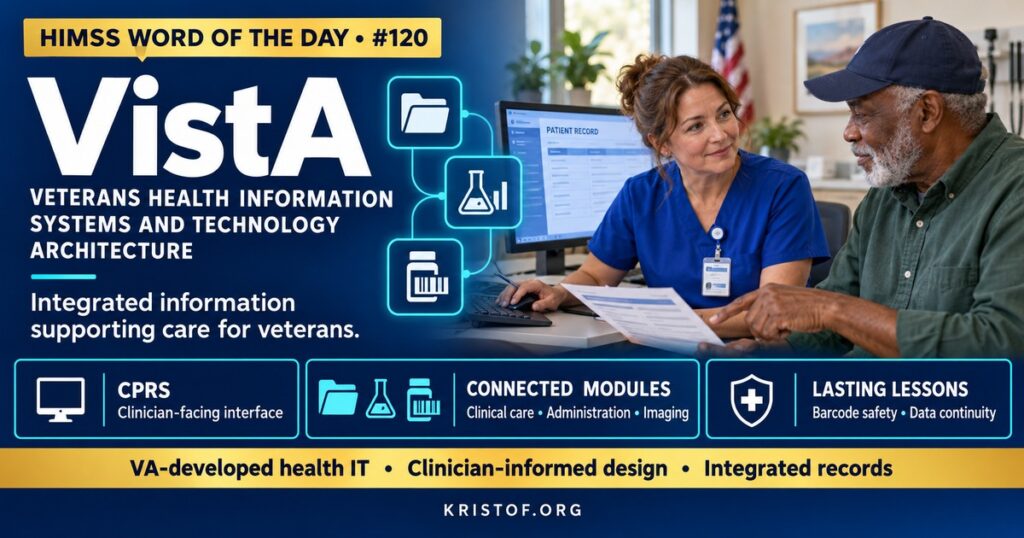
📖 The Term: VistA (Veterans Health Information Systems and Technology Architecture)
Source: HIMSS Dictionary of Health Information and Technology Terms, Acronyms, and Organizations, 6th Edition (2025)
🔍 Plain-Language Definition
VistA (Veterans Health Information Systems and Technology Architecture) is the integrated health information system developed by the U.S. Department of Veterans Affairs (VA) to support clinical care, administration, and operations across Veterans Health Administration (VHA) facilities.
The HIMSS Dictionary describes VistA as a health information technology system that the VHA created and uses in caring for veterans, with the aim of delivering high-quality care that improves veterans’ health and well-being.
VistA is not a single application but a collection of modules that share a common data environment:
| VistA Component | What It Supports | Example |
|---|---|---|
| CPRS (Computerized Patient Record System) | The clinician-facing graphical interface | Viewing notes, entering orders, reviewing results |
| Bar Code Medication Administration (BCMA) | Scanning patients and medications at administration | A nurse scans a wristband and a unit-dose package |
| Clinical Modules | Pharmacy, laboratory, radiology, nursing, and more | A lab result posts to the record and alerts the ordering clinician |
| Administrative Modules | Scheduling, registration, and billing functions | Booking a follow-up visit at a VA clinic |
| VistA Imaging | Integration of images and scanned documents | Viewing a wound photo or scanned consent in the record |
⚠️ Exam Alert: VistA is the VA’s own health information system. CPRS is the clinician interface to VistA. The Federal EHR is the commercial EHR shared by the VA, the Department of Defense, and other federal partners. Do not confuse VistA with Vista, the Microsoft operating system.
🌐 Why It Matters: Real-World Healthcare IT Context
VistA holds an important place in health IT history. The VA developed it internally over decades, working closely with its own clinicians, and deployed it across a national network of hospitals and clinics well before most private health systems had comprehensive electronic records. Clinicians in VA facilities could see a shared record across care settings at a time when paper charts were still common elsewhere.
VistA also helped demonstrate the patient safety value of health IT. The VA was an early adopter of bar code medication administration, which became a model for scanning at the bedside across the industry. The VA’s experience with an enterprise system showed how integrated records, order entry, and decision support could support consistent care across a large organization.
Because VistA was developed with public funds, much of its code has been available to the public through the VA, and other organizations have adapted versions of it. The VA Software Document Library publishes documentation for its applications, which reflects how many modules the system includes.
Age brought challenges. VistA runs on a technology foundation that is decades old, and individual VA facilities customized their instances over time, creating many local variations. Maintaining and modernizing these systems, keeping them interoperable with community partners and the Department of Defense, and recruiting staff with the needed skills became increasingly difficult.
The VA is now transitioning from VistA to the Federal EHR, a commercial system it shares with the Department of Defense and other federal partners. The VA’s EHR Modernization program has rolled out the new system in phases, pausing and adjusting after early deployments raised concerns about usability, training, and patient safety. Those experiences illustrate how complex it is to replace an established system across a large organization.
Data migration is central to that transition. Years of veterans’ records, medication histories, and clinical documentation must remain accessible, and clinicians need confidence that nothing important is lost or misrepresented when a facility moves to the new system.
Common challenges with legacy systems like VistA:
- Aging technology that is costly to maintain
- Local customization that creates inconsistency across sites
- Limited interoperability with external partners
- Shrinking pools of staff familiar with older platforms
- Complex data migration during replacement
- Workflow disruption when clinicians change systems
Lasting contributions of VistA:
- Early enterprise-wide electronic records across a national system
- Bar code medication administration as a safety model
- Clinician involvement in system design
- Shared records across inpatient, outpatient, and long-term care
- Publicly available code and documentation
- Lessons for large-scale EHR replacement
🏥 The Nurse’s Perspective: Clinical, Bedside, & Workflow
Nurses in VA facilities have relied on VistA for medication administration, documentation, and care coordination.
At the Bedside
Bar code medication administration in VistA made scanning the patient and medication a routine nursing step, adding a safety check before each dose. Nurses learned to treat scanning warnings as meaningful alerts that could prevent wrong-patient, wrong-drug, or wrong-dose errors.
Many experienced VA nurses know VistA and CPRS workflows deeply. When a system changes, that expertise matters: nurses who understand how the old system handled tasks can help identify gaps in the new one.
In Clinical Workflow
VistA supported documentation, orders, results review, and communication across inpatient, outpatient, and long-term care settings within the VA. Nurses coordinating care for veterans could see history from other VA facilities, which helped with continuity for patients who traveled or moved.
Transitions between systems introduce risk. When facilities move from VistA to the Federal EHR, nurses may need to verify active medications, allergies, care plans, and pending orders carefully, especially during the cutover period when information may appear in different places.
Veterans receiving care in community settings may bring records from the VA, and nurses outside the VA may encounter VA documentation through health information exchange. Knowing where to look for those records supports safe handoffs.
In EHR Implementation (Go-Live Perspective)
Replacing a long-established system is one of the hardest types of Go-Live. Clinicians must unlearn familiar workflows, and organizations must carefully plan data conversion, dual documentation periods, and downtime procedures. Lessons from the VA’s transition reinforce the value of thorough training, realistic testing, and strong at-the-elbow support.
During an Epic Go-Live or any EHR replacement, at-the-elbow support analysts help nurses find converted data, confirm medication and allergy information, and report issues quickly. Listening to frontline feedback, as the VA did when it adjusted its rollout, can shape safer deployments.
🎓 CAHIMS / CPHIMS & HIMSS Perspective
CAHIMS Exam Domain Mapping
VistA appears in questions about health IT history and federal systems:
| CAHIMS Domain | How VistA Appears |
|---|---|
| Healthcare & Technology Environments | Federal health IT; VA and DoD systems; history of EHR adoption |
| Clinical Informatics | Bar code medication administration; CPRS; clinician involvement in design |
| Healthcare Information & Systems Management | Legacy systems, data migration, interoperability, modernization |
| Management & Leadership | Large-scale system replacement, change management, risk management |
Key Terms to Know Alongside VistA
- CPRS (Computerized Patient Record System) — the clinician-facing interface to VistA
- Bar Code Medication Administration (BCMA) — scanning patients and medications before administration
- Federal EHR — the commercial EHR shared by the VA, the Department of Defense, and other federal partners
- Legacy System — an older system still in use that may be difficult to maintain or replace
- Data Migration — moving data from one system to another during replacement
- Veterans Health Administration (VHA) — the VA component that delivers healthcare to veterans
HIMSS Organizational Position
HIMSS addresses EHR adoption, modernization, and optimization through its education and research, and engages on federal health IT through its public policy work. Members can find related education and research through the HIMSS Resource Center.
🔗 Explore Further: External References
- U.S. Department of Veterans Affairs — VA Software Document Library (VistA) https://www.va.gov/vdl/
- U.S. Department of Veterans Affairs — EHR Modernization https://digital.va.gov/ehr-modernization/
- U.S. Department of Veterans Affairs — VA Health Care https://www.va.gov/health/
- ONC — SAFER Guides https://healthit.gov/clinical-quality-and-safety/safer-guides/
- HIMSS — Public Policy & Advocacy https://www.himss.org/public-policy-advocacy-overview
- HIMSS — Nursing Informatics Community https://www.himss.org/networking/communities/nursing-informatics/
Term source: HIMSS Dictionary of Health Information and Technology Terms, Acronyms, and Organizations, 6th Edition (2025). All definitions in this series are paraphrased for editorial purposes. Readers are encouraged to consult the primary source for exact language.
Eric Andrew Kristof, RN, CAHIMS is a Healthcare IT professional and HIMSS Arkansas Chapter member based in Hot Springs Village, AR, with hands-on Epic Go-Live experience and a diverse healthcare and IT background. He writes at kristof.org at the intersection of clinical care and healthcare technology.
Leave a Reply