By Eric Andrew Kristof, RN, CAHIMS | Healthcare IT Professional | HIMSS Arkansas Chapter Member
About This Series: The HIMSS Word of the Day is a running blog series drawing from the HIMSS Dictionary of Health Information and Technology Terms, Acronyms, and Organizations, 6th Edition (2025) — the authoritative reference for healthcare IT professionals and the primary study resource for CAHIMS and CPHIMS certification. Each post paraphrases the term in plain language, grounds it in real-world healthcare IT context, and adds a bedside nursing perspective you won’t find in a textbook.
📖 The Term: Genomics
Source: HIMSS Dictionary of Health Information and Technology Terms, Acronyms, and Organizations, 6th Edition (2025)
🔍 Plain-Language Definition
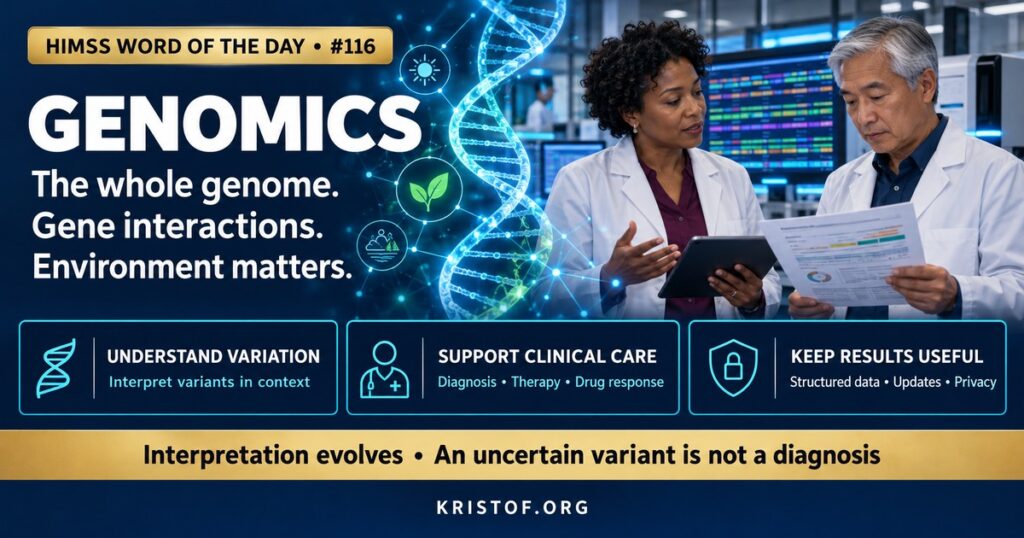
Genomics is the study of an organism’s complete set of DNA, its genome, including how genes work together and how they interact with environmental factors. In healthcare, genomics underpins precision medicine, from diagnosing rare diseases to choosing cancer therapies and medications.
The HIMSS Dictionary defines genomics as studying the full set of a person’s genes, including the ways genes influence one another and respond to environmental factors. It adds that the field also examines complex diseases, which typically stem from many genes acting together with environmental influences rather than from one gene alone, and it refers readers to precision medicine.
| Concept | What It Means | Example |
|---|---|---|
| Genetics | The study of individual genes and inheritance | Testing a single gene associated with a known inherited condition |
| Genomics | The study of all genes and their interactions | Sequencing a whole genome or exome |
| Variant | A difference in DNA sequence compared with a reference | A change in a gene associated with drug metabolism |
| Variant Classification | Interpretation of a variant’s clinical significance | Pathogenic, likely pathogenic, uncertain significance, likely benign, benign |
| Somatic vs Germline | Changes in tumor cells versus inherited changes in all cells | Tumor profiling versus hereditary cancer testing |
⚠️ Exam Alert: Genetics focuses on individual genes; genomics covers the entire genome and gene-environment interactions. Pharmacogenomics applies genomics to drug response. Precision medicine uses genomic and other individual data to tailor care. A variant of uncertain significance is not a diagnosis and may be reclassified as evidence grows.
🌐 Why It Matters: Real-World Healthcare IT Context
Genomics has moved from research into routine care. Since the Human Genome Project produced a reference human genome sequence in the early 2000s, sequencing costs have fallen dramatically, and later work completed previously missing regions of the genome. Today, genomic testing is used to diagnose rare diseases in critically ill infants, guide cancer therapy based on tumor mutations, identify inherited risk for certain cancers and heart conditions, and inform medication choices.
Using genomic data in care is an informatics challenge. Results often arrive as lengthy PDF reports rather than structured data, making it hard for decision support to act on them. A single genome contains millions of variants, and only a small number are clinically relevant. Variant interpretations change as evidence accumulates, so a result classified as uncertain today may be reclassified later, raising questions about who is responsible for updating records and notifying patients.
Raw sequencing data is enormous, so most organizations do not store it in the EHR. Instead, laboratories retain raw data and send interpreted reports, with key findings ideally represented as structured data. When new questions arise later, such as a pharmacogenomic question years after an exome was sequenced, organizations may be able to reanalyze existing data rather than retesting, if processes and agreements allow it.
Public resources support interpretation. NIH’s ClinVar database aggregates information about variants and their clinical significance submitted by laboratories and researchers. HL7 has developed a FHIR Genomics Reporting implementation guide to represent genomic results in structured form so EHRs can store and use them.
Privacy and ethics are central. Genomic information is uniquely identifying, relevant to relatives, and permanent. The Genetic Information Nondiscrimination Act limits use of genetic information in health insurance and employment, but not in all types of insurance, such as life or long-term care. Equity is also a concern, because many genomic data sets have historically underrepresented people of non-European ancestry, which can reduce the accuracy of interpretations for others.
Secondary findings add complexity. Broad sequencing can reveal medically actionable variants unrelated to the original reason for testing, and professional guidelines address which findings laboratories should report. Patients need to understand this possibility during consent.
Common genomics challenges in health IT:
- Results stored as unstructured documents
- Decision support unable to recognize genomic findings
- Reclassification of variants over time
- Limited clinician familiarity with interpretation
- Privacy, consent, and family implications
- Data volume and storage for raw sequencing data
What supports genomic medicine:
- Structured storage of key results using emerging standards
- Pharmacogenomic and risk-based decision support
- Access to genetic counselors and clinical geneticists
- Processes for reclassification and patient recontact
- Clear consent and privacy policies
- Inclusive research and population diversity
🏥 The Nurse’s Perspective: Clinical, Bedside, & Workflow
Nurses play important roles in genomic care, from family history to education and support.
At the Bedside
Family history remains one of the most practical genomic tools. Nurses who collect thorough, structured family history at intake help identify patients who may benefit from genetic evaluation, such as those with multiple relatives affected by early-onset cancer or heart disease.
Patients often have questions about genetic testing: what it can show, what it cannot, and who will see the results. Nurses can provide basic education, address concerns, and connect patients with genetic counselors for detailed discussions and informed consent.
Documentation of genetic counseling referrals and results discussions helps the whole team know what the patient has been told and avoids repeated or conflicting conversations.
Medication reconciliation can include pharmacogenomic results when they exist. Noting a documented gene-drug interaction when a new medication is ordered helps prevent avoidable adverse reactions.
In Clinical Workflow
Oncology, neonatal, cardiology, and pharmacy-related nursing increasingly involve genomic information. A nurse administering a targeted therapy should understand why it was selected; a NICU nurse may support a family through rapid genome sequencing for their infant; a nurse administering medications may see pharmacogenomic alerts.
Emotional support matters. Genomic results can affect not only the patient but also relatives, and can bring anxiety or difficult decisions. Nurses help patients process information and find resources.
In EHR Implementation (Go-Live Perspective)
During an Epic implementation, organizations decide how genomic results are stored, where they display, and how decision support uses them. Legacy genetic reports may need to be migrated and indexed so they can be found.
At-the-elbow support analysts may help clinicians locate genetic test results and family history tools. Feedback about hard-to-find results helps teams improve display and indexing.
🎓 CAHIMS / CPHIMS & HIMSS Perspective
CAHIMS Exam Domain Mapping
Genomics appears in technology trend, data, and privacy questions:
| CAHIMS Domain | How Genomics Appears |
|---|---|
| Healthcare & Technology Environments | Precision medicine; research programs; genetic privacy laws |
| Clinical Informatics | Family history, decision support, patient education, consent |
| Healthcare Information & Systems Management | Structured genomic data, standards, storage, variant databases |
| Management & Leadership | Program strategy, genetic counseling resources, equity, ethics |
Key Terms to Know Alongside Genomics
- Genome — an organism’s complete set of DNA
- Variant — a difference in DNA sequence compared with a reference sequence
- Variant of Uncertain Significance (VUS) — a variant whose clinical impact is not yet known
- Germline Variant — an inherited variant present in all cells
- Somatic Variant — a variant acquired in specific cells, such as tumor cells
- Genetic Counselor — a professional who helps people understand genetic risk and testing
HIMSS Organizational Position
HIMSS addresses genomics as part of precision medicine and data-driven care, emphasizing interoperability, decision support, and privacy needed to bring genomic information into clinical practice. Members can find related education and research through the HIMSS Resource Center.
🔗 Explore Further: External References
- National Human Genome Research Institute https://www.genome.gov/
- NIH — ClinVar https://www.ncbi.nlm.nih.gov/clinvar/
- HL7 — FHIR Genomics Reporting Implementation Guide https://hl7.org/fhir/uv/genomics-reporting/
- FDA — Table of Pharmacogenomic Biomarkers in Drug Labeling https://www.fda.gov/drugs/science-and-research-drugs/table-pharmacogenomic-biomarkers-drug-labeling
- Collins and Varmus (2015), New England Journal of Medicine — A New Initiative on Precision Medicine https://pubmed.ncbi.nlm.nih.gov/25635347/
- CPIC — Clinical Pharmacogenetics Implementation Consortium https://www.clinpgx.org/cpic
Term source: HIMSS Dictionary of Health Information and Technology Terms, Acronyms, and Organizations, 6th Edition (2025). All definitions in this series are paraphrased for editorial purposes. Readers are encouraged to consult the primary source for exact language.
Eric Andrew Kristof, RN, CAHIMS is a Healthcare IT professional and HIMSS Arkansas Chapter member based in Hot Springs Village, AR, with hands-on Epic Go-Live experience and a diverse healthcare and IT background. He writes at kristof.org at the intersection of clinical care and healthcare technology.
Leave a Reply