By Eric Andrew Kristof, RN, CAHIMS | Healthcare IT Professional | HIMSS Arkansas Chapter Member
About This Series: The HIMSS Word of the Day is a running blog series drawing from the HIMSS Dictionary of Health Information and Technology Terms, Acronyms, and Organizations, 6th Edition (2025) — the authoritative reference for healthcare IT professionals and the primary study resource for CAHIMS and CPHIMS certification. Each post paraphrases the term in plain language, grounds it in real-world healthcare IT context, and adds a bedside nursing perspective you won’t find in a textbook.
📖 The Term: Da Vinci Project
Source: HIMSS Dictionary of Health Information and Technology Terms, Acronyms, and Organizations, 6th Edition (2025)
🔍 Plain-Language Definition
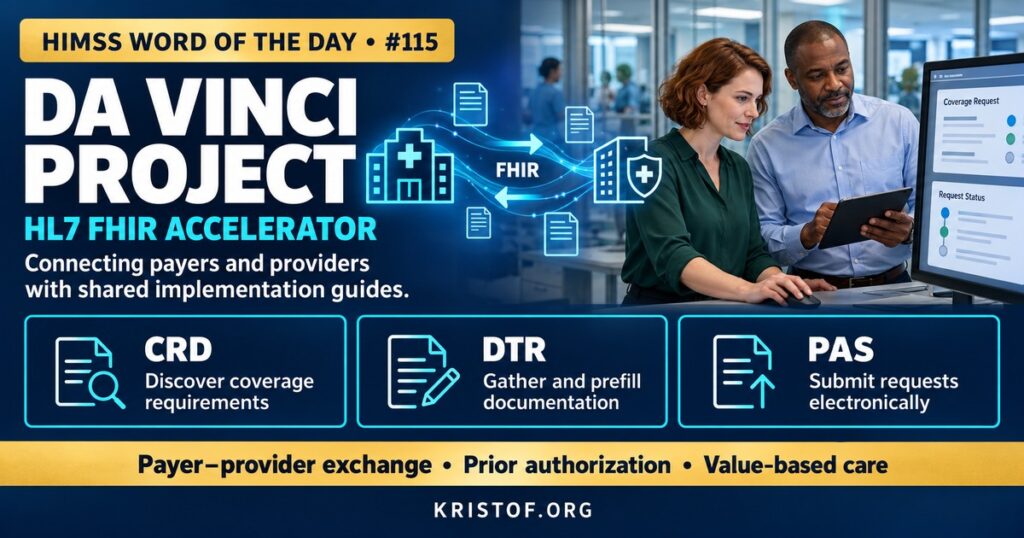
The Da Vinci Project is an HL7 initiative that brings health plans, healthcare providers, and technology vendors together to develop and test FHIR implementation guides for exchanging data needed in value-based care and administrative processes, especially between payers and providers.
The HIMSS Dictionary describes the Da Vinci Project as an initiative working to accelerate adoption of HL7 FHIR as the standard for exchanging and integrating value-based care data across communities, with its first use cases centered on data sharing between health plans and the providers they work with.
Da Vinci is part of HL7’s FHIR Accelerator program, which supports industry collaborations similar in spirit to the earlier Argonaut Project, but focused on specific domains.
| Da Vinci Guide | Purpose | Clinical Workflow Example |
|---|---|---|
| Coverage Requirements Discovery (CRD) | Tells the provider at order time whether prior authorization or documentation is required | A prompt appears when ordering an MRI |
| Documentation Templates and Rules (DTR) | Gathers required documentation, prefilling from the EHR | A questionnaire auto-populates from chart data |
| Prior Authorization Support (PAS) | Submits the prior authorization request electronically | The request goes to the payer without a fax |
| Payer Data Exchange (PDex) | Shares payer-held data with providers and other payers | A clinician sees claims history from the patient’s plan |
| Other Value-Based Care Guides | Support attribution, gaps in care, and notifications | A practice receives a list of attributed patients with open care gaps |
⚠️ Exam Alert: FHIR is the standard. Da Vinci is an HL7 FHIR Accelerator producing implementation guides for payer-provider exchange. The Argonaut Project focused on EHR APIs and core clinical data. Gravity focuses on social determinants of health data, and CARIN on consumer access. Questions may ask which initiative addresses prior authorization; the answer is Da Vinci.
🌐 Why It Matters: Real-World Healthcare IT Context
Administrative processes between payers and providers have long relied on phone calls, fax, and portals. Prior authorization in particular consumes clinician and staff time and can delay care. The information needed, such as diagnoses, prior treatments, and clinical findings, usually already exists in the EHR, but moving it to the payer has been manual.
Da Vinci’s guides aim to change that. CRD can tell the clinician, at the moment of ordering, whether a service needs authorization or documentation. DTR can present the payer’s requirements and prefill answers from the chart. PAS can submit the request electronically and return a decision or status. Together, these guides move prior authorization into the ordering workflow.
Federal policy has created momentum. CMS’s Interoperability and Prior Authorization Final Rule requires many payers to implement FHIR-based APIs, including a prior authorization API, along with APIs for sharing data with providers, patients, and other payers. The rule references HL7 FHIR implementation guides, including Da Vinci guides, as recommended approaches, which encourages consistent implementation across the industry.
Value-based care also depends on payer-provider exchange. Providers need to know which patients are attributed to them, what care gaps exist, and what the payer knows from claims, while payers need clinical data to understand quality and risk. Da Vinci guides support these exchanges using common standards.
CDS Hooks plays a supporting role. Coverage Requirements Discovery uses the CDS Hooks standard to call a payer service at specific points in the ordering workflow, such as when an order is signed, and return information to the clinician inside the EHR. That pattern brings payer knowledge into clinical workflow without requiring clinicians to visit separate portals.
Adoption takes time. Implementing these guides requires work by both EHR vendors and payers, testing between trading partners, and changes to workflows on both sides.
For organizations, participation in Da Vinci testing events and pilots offers a chance to shape guides and prepare early for regulatory deadlines, rather than reacting once requirements take effect.
Benefits of Da Vinci approaches:
- Coverage requirements visible at the time of ordering
- Documentation prefilled from the EHR
- Electronic submission and status of prior authorization requests
- Shared payer data that fills gaps in clinical history
- Consistent standards across many payers
- Reduced phone, fax, and portal work
Challenges to adoption:
- Payers and EHRs implementing guides at different paces
- Variation in payer rules and documentation requirements
- Testing and certification of trading partner connections
- Workflow redesign for ordering clinicians and staff
- Keeping implementation guides current as rules change
- Ensuring privacy and appropriate data sharing
🏥 The Nurse’s Perspective: Clinical, Bedside, & Workflow
Nurses and staff who handle prior authorization stand to gain the most from Da Vinci workflows.
At the Bedside
In ambulatory and specialty settings, nurses frequently gather documentation for prior authorization, call payers, and track approvals. When coverage requirements appear at ordering and documentation is prefilled from the chart, much of that manual work can shrink, and patients may wait less for treatment.
Hospital nurses may see benefits in faster approvals for post-acute services, imaging, or medications at discharge, reducing delays that keep patients waiting for the next level of care.
Patients may also benefit indirectly, through fewer delays in scheduling procedures and fewer calls asking them to wait while authorization is pending.
In Clinical Workflow
Structured documentation becomes more valuable in these workflows. When diagnoses, prior treatments, and assessments are recorded in structured fields, DTR questionnaires can prefill accurately. When key information exists only in free text, someone still has to find it and enter it manually.
Nurses working in utilization management or care management may use payer data shared through these guides, such as claims history and care gaps, to coordinate care and close quality gaps.
In EHR Implementation (Go-Live Perspective)
Da Vinci capabilities are often enabled after an Epic Go-Live, as payers and vendors bring connections online. Teams test which payers support which guides, how prompts appear at ordering, and how questionnaires and statuses display.
At-the-elbow support analysts and super users can help ordering clinicians and staff understand new prompts and where authorization status appears. Clear communication that capabilities vary by payer helps set expectations.
🎓 CAHIMS / CPHIMS & HIMSS Perspective
CAHIMS Exam Domain Mapping
The Da Vinci Project appears in interoperability and policy questions:
| CAHIMS Domain | How the Da Vinci Project Appears |
|---|---|
| Healthcare & Technology Environments | HL7 FHIR Accelerators; CMS interoperability and prior authorization rules |
| Clinical Informatics | Prior authorization in ordering workflow; documentation prefilling |
| Healthcare Information & Systems Management | Implementation guides, FHIR APIs, CDS Hooks, payer connectivity |
| Management & Leadership | Administrative burden reduction, payer relationships, value-based care strategy |
Key Terms to Know Alongside Da Vinci Project
- FHIR Accelerator — an HL7 program supporting industry collaborations that build FHIR implementation guides
- Coverage Requirements Discovery (CRD) — a guide for informing providers about coverage requirements at the time of ordering
- Documentation Templates and Rules (DTR) — a guide for collecting required documentation, often prefilled from the EHR
- Prior Authorization Support (PAS) — a guide for submitting prior authorization requests electronically
- Payer Data Exchange (PDex) — a guide for sharing payer-held data with providers and other payers
- Implementation Guide (IG) — a specification describing how to use a standard for a particular purpose
HIMSS Organizational Position
HIMSS supports standards-based approaches to reducing administrative burden, including electronic prior authorization, and engages on CMS interoperability rules through its public policy work. Members can find related education and research through the HIMSS Resource Center.
🔗 Explore Further: External References
- HL7 International — Da Vinci Project https://www.hl7.org/about/davinci/
- HL7 Confluence — Da Vinci Overview https://confluence.hl7.org/spaces/DVP/overview
- CMS — Interoperability and Prior Authorization Final Rule (CMS-0057-F) https://www.cms.gov/initiatives/burden-reduction/overview/interoperability/policies-regulations/cms-interoperability-prior-authorization-final-rule-cms-0057-f
- HL7 — CDS Hooks https://cds-hooks.hl7.org/
- HL7 International — FHIR https://hl7.org/fhir/
- HL7 — US Core Implementation Guide https://hl7.org/fhir/us/core/
Term source: HIMSS Dictionary of Health Information and Technology Terms, Acronyms, and Organizations, 6th Edition (2025). All definitions in this series are paraphrased for editorial purposes. Readers are encouraged to consult the primary source for exact language.
Eric Andrew Kristof, RN, CAHIMS is a Healthcare IT professional and HIMSS Arkansas Chapter member based in Hot Springs Village, AR, with hands-on Epic Go-Live experience and a diverse healthcare and IT background. He writes at kristof.org at the intersection of clinical care and healthcare technology.
Leave a Reply