By Eric Andrew Kristof, RN, CAHIMS | Healthcare IT Professional | HIMSS Arkansas Chapter Member
About This Series: The HIMSS Word of the Day is a running blog series drawing from the HIMSS Dictionary of Health Information and Technology Terms, Acronyms, and Organizations, 6th Edition (2025) — the authoritative reference for healthcare IT professionals and the primary study resource for CAHIMS and CPHIMS certification. Each post paraphrases the term in plain language, grounds it in real-world healthcare IT context, and adds a bedside nursing perspective you won’t find in a textbook.
📖 The Term: Look-Alike/Sound-Alike (LASA) Drugs
Source: HIMSS Dictionary of Health Information and Technology Terms, Acronyms, and Organizations, 6th Edition (2025)
🔍 Plain-Language Definition
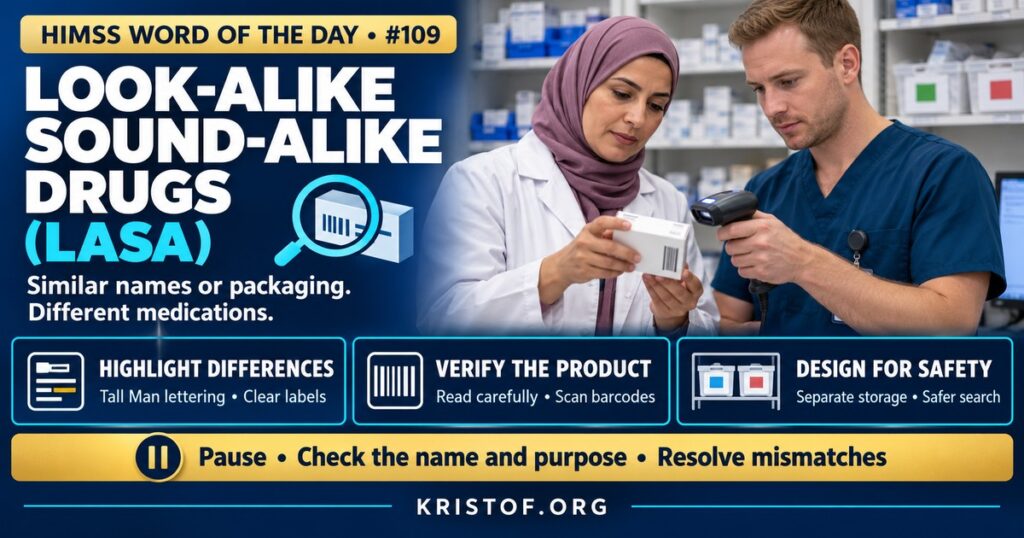
Look-alike/sound-alike (LASA) drugs are medications whose names, abbreviations, packaging, or labels are similar enough to be confused. The confusion can happen when reading an order, hearing a verbal order, searching a drug list, selecting from a dispensing cabinet, or grabbing a vial.
The HIMSS Dictionary explains that care providers compile lists of the confusable medications they keep, dispense, or give, and that these LASA lists help determine which medications warrant extra safeguards to lower error risk and minimize harm.
| Type of Confusion | How It Happens | Example |
|---|---|---|
| Look-Alike Names | Similar spelling when written or displayed | hydrALAZINE and hydrOXYzine |
| Sound-Alike Names | Similar pronunciation in verbal orders or handoffs | Celebrex and Celexa |
| Look-Alike Packaging | Similar vials, colors, or labels | Different concentrations of the same drug in similar vials |
| Search and Selection | Adjacent entries in drug lists or autocomplete | Selecting the wrong item from a CPOE search result |
| Abbreviations | Shortened names that mean different things | Ambiguous abbreviations for drug names |
⚠️ Exam Alert: LASA errors stem from similar names or packaging. Tall Man lettering uses mixed case to highlight differences in similar names. Barcode medication administration is a technology check that can catch a wrong drug at the bedside. High-alert medications are those with heightened risk of harm if used in error, and some LASA pairs are also high-alert drugs.
🌐 Why It Matters: Real-World Healthcare IT Context
LASA errors are a long-standing medication safety problem. Thousands of drug names exist, and new ones are approved every year. Some pairs are similar enough that a rushed glance, an unclear verbal order, or a single wrong click can lead to the wrong drug. When the confused drugs have very different effects, such as an antihypertensive and an antihistamine, or when one is a high-alert medication, the consequences can be serious.
Several organizations address the problem. FDA reviews proposed drug names for confusion risk before approval and has promoted Tall Man lettering through its Name Differentiation Project. The Institute for Safe Medication Practices, now part of ECRI, publishes lists of confused drug names and recommended Tall Man letters. The Joint Commission has long expected organizations to identify and act on look-alike/sound-alike drugs.
Health IT can reduce or increase risk. In CPOE and pharmacy systems, drug search design matters: requiring several characters before showing results, displaying Tall Man letters, including the indication or drug class beside the name, and separating similar items can all reduce selection errors. Poor design, such as long alphabetical lists with tiny text, can make errors more likely. Barcode scanning at dispensing and administration provides a critical backstop by verifying the product itself rather than relying on reading the name.
Decision support can add another layer. Some systems display alerts when a prescriber selects one drug from a known LASA pair, prompting confirmation of the intended medication, or show the indication beside each option so the choice is checked against the reason for the order. These alerts should be targeted carefully to avoid adding to alert fatigue.
Physical design matters too. Storing LASA pairs apart, using shelf labels and alerts in automated dispensing cabinets, and purchasing products with distinct packaging all reduce risk.
Common LASA risk points:
- Verbal and telephone orders without read-back
- Drug search screens that show similar names side by side
- Automated dispensing cabinets with LASA pairs in adjacent pockets
- Similar packaging for different strengths or concentrations
- Handwritten or abbreviated drug names
- Scanning overrides that bypass barcode checks
Safeguards that work:
- An organizational LASA list reviewed regularly
- Tall Man lettering in EHR, pharmacy, and dispensing systems
- Search design that requires more characters and shows indication
- Separate storage and distinct labeling for LASA pairs
- Barcode scanning at dispensing and administration
- Read-back for verbal orders and independent double checks where appropriate
🏥 The Nurse’s Perspective: Clinical, Bedside, & Workflow
Nurses are often the last safeguard against LASA errors before a medication reaches the patient.
At the Bedside
Reading the label carefully, not just recognizing the package, is the first defense. Tall Man letters on labels and the eMAR draw attention to the part of the name that differs. Scanning the medication barcode confirms the product matches the order, and any scanning mismatch is a reason to stop and investigate rather than override.
Knowing why a medication is ordered also helps. If a patient with hypertension is due for a drug that the nurse recognizes as an antihistamine, or the indication on the order does not match the drug, that mismatch should prompt a question to pharmacy or the prescriber.
Patient education is a safeguard too. Patients who know the name, purpose, and appearance of their medications can question a pill that looks different from what they expect, which sometimes catches errors that slipped past every other check.
In Clinical Workflow
Verbal and telephone orders carry particular LASA risk. Reading back the order, spelling the drug name, and stating the indication help confirm that the speaker and listener mean the same drug. Many organizations limit verbal orders to urgent situations for this reason.
Automated dispensing cabinets can present LASA pairs close together. Nurses should report storage configurations that place similar products side by side so pharmacy can separate them.
In EHR Implementation (Go-Live Perspective)
During an Epic Go-Live, medication records and drug search settings are rebuilt. Pharmacy and informatics teams configure Tall Man lettering, search behavior, and display of indications, and test that similar products are clearly differentiated in ordering and on the eMAR.
At-the-elbow support analysts may hear reports of confusing medication names or search results in the new system. Escalating these quickly to pharmacy informatics allows fixes before an error reaches a patient.
🎓 CAHIMS / CPHIMS & HIMSS Perspective
CAHIMS Exam Domain Mapping
LASA drugs appear in medication safety and system design questions:
| CAHIMS Domain | How LASA Drugs Appear |
|---|---|
| Healthcare & Technology Environments | Medication safety organizations; FDA name review; accreditation expectations |
| Clinical Informatics | CPOE search design, eMAR display, verbal orders, barcode checks |
| Healthcare Information & Systems Management | Medication record build, Tall Man lettering, dispensing cabinet configuration |
| Management & Leadership | LASA list maintenance, error reporting, purchasing decisions |
Key Terms to Know Alongside LASA
- Tall Man Lettering — using uppercase letters to emphasize differences between similar drug names
- High-Alert Medication — a drug with heightened risk of significant harm when used in error
- BCMA (Bar Code Medication Administration) — scanning the patient and medication to verify administration
- Read-Back — repeating a verbal order back to the prescriber to confirm accuracy
- Automated Dispensing Cabinet — a computerized storage device that controls access to medications on clinical units
- Medication Error — a preventable event that may cause or lead to inappropriate medication use or harm
HIMSS Organizational Position
HIMSS treats medication safety as a core use case for health IT and nursing informatics, emphasizing well-designed ordering, dispensing, and administration systems. Members can find related education and research through the HIMSS Resource Center.
🔗 Explore Further: External References
- FDA — Name Differentiation Project https://www.fda.gov/drugs/medication-errors-related-cder-regulated-drug-products/fda-name-differentiation-project
- ECRI and ISMP — Guidance, Insights, and Tools https://home.ecri.org/blogs/guidance-insights-tools
- ISMP — High-Alert Medications in Acute Care Settings https://home.ecri.org/blogs/guidance-insights-tools/high-alert-medications-in-acute-care-settings
- FDA — Medication Errors Related to CDER-Regulated Drug Products https://www.fda.gov/drugs/drug-safety-and-availability/medication-errors-related-cder-regulated-drug-products
- AHRQ PSNet — Medication Errors and Adverse Drug Events https://psnet.ahrq.gov/primer/medication-errors-and-adverse-drug-events
- Poon et al. (2010), New England Journal of Medicine — Effect of Bar-Code Technology on the Safety of Medication Administration https://pubmed.ncbi.nlm.nih.gov/20445181/
Term source: HIMSS Dictionary of Health Information and Technology Terms, Acronyms, and Organizations, 6th Edition (2025). All definitions in this series are paraphrased for editorial purposes. Readers are encouraged to consult the primary source for exact language.
Eric Andrew Kristof, RN, CAHIMS is a Healthcare IT professional and HIMSS Arkansas Chapter member based in Hot Springs Village, AR, with hands-on Epic Go-Live experience and a diverse healthcare and IT background. He writes at kristof.org at the intersection of clinical care and healthcare technology.
Leave a Reply