By Eric Andrew Kristof, RN, CAHIMS | Healthcare IT Professional | HIMSS Arkansas Chapter Member
About This Series: The HIMSS Word of The Day is a running blog series drawing from the HIMSS Dictionary of Health Information and Technology Terms, Acronyms, and Organizations, 6th Edition (2025) — the authoritative reference for healthcare IT professionals and the primary study resource for CAHIMS and CPHIMS certification. Each post paraphrases the term in plain language, grounds it in real-world healthcare IT context, and adds a bedside nursing perspective you won’t find in a textbook.
📖 The Term: Bioinformatics
Source: HIMSS Dictionary of Health Information and Technology Terms, Acronyms, and Organizations, 6th Edition (2025)
🔍 Plain-Language Definition
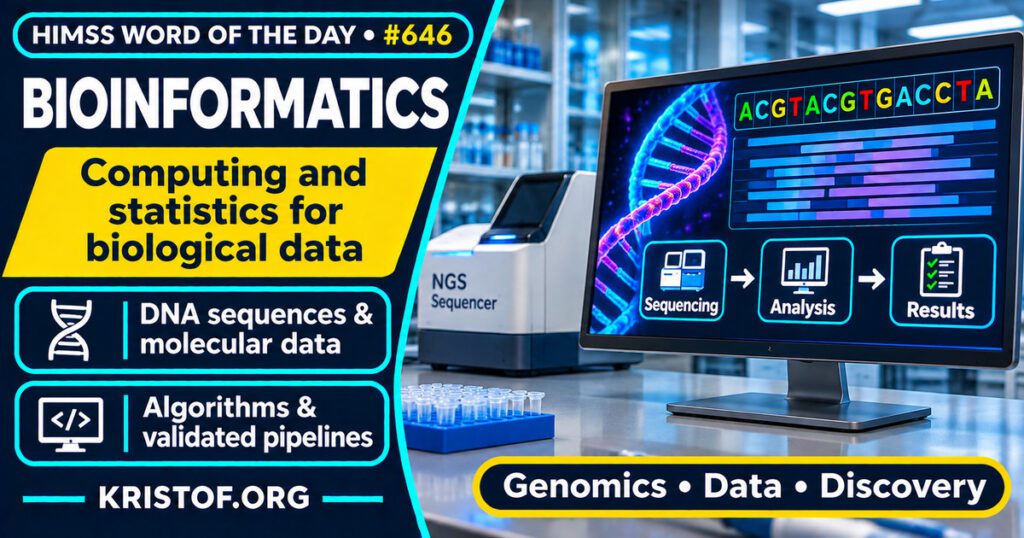
The HIMSS Dictionary describes bioinformatics as the use of computing, statistics, and algorithms to make sense of biological data. That is a short entry, so it helps to see how published sources define the field.
Luscombe and colleagues (2001), in an early article proposing a definition, describe bioinformatics as conceptualizing biology in terms of macromolecules and then applying informatics techniques, drawn from applied mathematics, computer science, and statistics, to organize and understand the information tied to those molecules on a large scale. They say analyses focus mainly on three types of large datasets: macromolecular structures, genome sequences, and the results of functional genomics experiments. That article is more than two decades old, so it shows how the field was framed at the time, not necessarily how every source defines it now.
Gauthier and colleagues (2019) add the history. Their article says the beginnings of bioinformatics go back more than 50 years, with foundations laid in the early 1960s through computational work on protein sequences. They describe a large increase in data from the 1990s through the 2000s as sequencing improved and became cheaper.
| Aspect | What the sources describe |
|---|---|
| Core idea | Computing and statistics applied to large biological datasets |
| Typical data | Macromolecular structures, genome sequences, and functional genomics results (Luscombe and colleagues, 2001) |
| Clinical use | Interpreting sequencing results, as in sequencing pipelines and molecular tumor boards |
| Related areas | Translational bioinformatics and clinical research (biomedical) informatics |
⚠️ Exam Alert: Bioinformatics centers on biological and molecular data. Health informatics centers on health information and care delivery. Genomics is the study of genomes, and bioinformatics supplies many of the tools used to analyze genomic data. Biomedical informatics is a broader term, and sources draw the boundaries between these fields in different places, so expect overlap on an exam.
🌐 Why It Matters: Real-World Healthcare IT Context
Bioinformatics matters in health IT because genomic testing produces data that only software can process, and the software’s accuracy affects patient care.
What studies show. Roy and colleagues (2018), writing for the Association for Molecular Pathology with representation from the College of American Pathologists and the American Medical Informatics Association, published 17 consensus best practice recommendations for validating clinical next-generation sequencing (NGS) bioinformatics pipelines. Their abstract says a lack of published guidance had left laboratories validating pipelines in widely varying ways, and that improperly developed, validated, or monitored pipelines may produce inaccurate results with negative consequences for patient care. These are expert consensus recommendations, not a trial, and they cover validation practice, not outcomes.
Pallocca and colleagues (2024) define clinical bioinformatics as a knowledge framework needed to interpret data of medical interest through computational methods. They note that most definitions of molecular tumor boards call for bioinformaticians, yet the literature had been vague about the digital tools and expertise required. Their article presents a catalog of software families and human skills for the tumor board bioinformatician. It is a descriptive catalog, not evidence that tumor boards with these skills have better results.
Baykal and colleagues (2024) argue that genomic reproducibility, which they define as the ability of bioinformatics tools to maintain consistent results across technical replicates, is essential for medical applications. They say the definition and implementation of reproducibility in genomics remain imprecise, discuss how tools affect it, and recommend best practices. This is an argument and review article, so it offers recommendations rather than a measured rate of problems.
Sirintrapun and colleagues (2016) describe translational bioinformatics as focused on computational techniques in genetics, molecular biology, and systems biology, and clinical research (biomedical) informatics as using informatics to discover and manage new knowledge about health and disease. They detail three hybrid projects, The Cancer Genome Atlas, the cBioPortal for Cancer Genomics, and a Memorial Sloan Kettering clinical variants and results database, all aimed at linking cancer biology to clinical findings.
What I could not find. I did not find a source in this search that measures how many hospitals run their own bioinformatics pipelines, how nurses interact with bioinformatics output, or how EHRs store genomic results. I also did not review newer machine-learning methods in the field, so this post does not assess them. Gauthier and colleagues note that universities are integrating the discipline into curricula, but I did not find workforce numbers.
Common bioinformatics problems:
- Running sequencing pipelines that have not been validated for clinical use
- Results that differ between tools or runs when reproducibility is not checked
- Unclear expectations for the skills and software a clinical bioinformatician needs
- Imprecise terms, such as differing definitions of reproducibility
- Rapid growth in data that outpaces methods and training
- Mixing up research resources with validated clinical tools
What supports good bioinformatics practice:
- Following consensus recommendations when validating clinical pipelines
- Trained, qualified molecular professionals, as the Roy and colleagues recommendations emphasize
- Defined bioinformatics roles on molecular tumor boards
- Checking reproducibility and following published best practices
- Education that builds computing and biology skills together
- Shared cancer genomics resources, such as those described by Sirintrapun and colleagues
🏥 The Nurse’s Perspective: Clinical, Bedside, & Workflow
Nurses seldom work with bioinformatics tools directly, but their output can reach the bedside as interpreted genomic results.
At the Bedside
Where genomic testing is part of care, as in the precision oncology setting Pallocca and colleagues describe, interpreted results may shape treatment discussions that nurses support. Nurses are not described in these sources as validating pipelines. What carries over is the practical habit of asking where a result came from and who reviewed it.
In Clinical Workflow
Nurse informaticists can help clinical teams and technical staff talk about the same results. When a test result looks unexpected or arrives late, questions about the lab, the report, and the reviewing professional matter. The Roy and colleagues recommendations are written for laboratories, so the validation work itself sits with laboratory staff.
In EHR Implementation (Go-Live Perspective)
During an Epic Go-Live, build and testing teams decide how results appear in the chart. A reasonable question for a team is whether genomic results arrive as structured data or as documents. This post did not verify how any particular EHR handles genomic results, and it does not claim that any specific go-live included them.
🎓 CAHIMS / CPHIMS & HIMSS Perspective
CAHIMS Exam Domain Mapping
Bioinformatics connects data, clinical use, and quality:
| CAHIMS Domain | How Bioinformatics Appears |
|---|---|
| Healthcare & Technology Environments | Genomic testing and biological data sources in care |
| Clinical Informatics | Interpreting molecular results, as in tumor boards |
| Healthcare Information & Systems Management | Pipeline validation, data quality, and reproducibility |
| Management & Leadership | Staffing, training, and governance for specialized analytics |
Key Terms to Know Alongside Bioinformatics
- Genomics — the study of genomes and their data
- Biomedical Informatics — a broad field applying informatics to biomedical and health questions
- Health Informatics — the field focused on health information and its use in care
- Next-generation sequencing (NGS) — high-throughput DNA sequencing that produces large datasets
- Bioinformatics pipeline — a chain of software steps that turns raw sequence data into results
- Reproducibility — the ability of tools to give consistent results across technical replicates
HIMSS Organizational Position
HIMSS offers education and research on health information and technology topics through its Resource Center. Members can find related information on the HIMSS Resource Center page.
🧭 More HIMSS Word of The Day Terms
Related terms in the Data and Analytics series:
Browse all Data and Analytics terms or the A–Z glossary.
🔗 Explore Further: External References
- Luscombe et al. (2001), Methods of Information in Medicine — What is bioinformatics? A proposed definition and overview of the field https://pubmed.ncbi.nlm.nih.gov/11552348/
- Gauthier et al. (2019), Briefings in Bioinformatics — A brief history of bioinformatics https://pubmed.ncbi.nlm.nih.gov/30084940/
- Sirintrapun et al. (2016), Clinics in Laboratory Medicine — Translational Bioinformatics and Clinical Research (Biomedical) Informatics https://pubmed.ncbi.nlm.nih.gov/26851671/
- Roy et al. (2018), Journal of Molecular Diagnostics — Standards and Guidelines for Validating Next-Generation Sequencing Bioinformatics Pipelines: A Joint Recommendation of the Association for Molecular Pathology and the College of American Pathologists https://pubmed.ncbi.nlm.nih.gov/29154853/
- Pallocca et al. (2024), Briefings in Bioinformatics — Clinical bioinformatics desiderata for molecular tumor boards https://pubmed.ncbi.nlm.nih.gov/39297878/
- Baykal et al. (2024), Genome Biology — Genomic reproducibility in the bioinformatics era https://pubmed.ncbi.nlm.nih.gov/39123217/
- HIMSS — Resource Center https://www.himss.org/resource-center
Term source: HIMSS Dictionary of Health Information and Technology Terms, Acronyms, and Organizations, 6th Edition (2025). All definitions in this series are paraphrased for editorial purposes. Readers are encouraged to consult the primary source for exact language.
Eric Andrew Kristof, RN, CAHIMS is a Healthcare IT professional and HIMSS Arkansas Chapter member based in Hot Springs Village, AR, with hands-on Epic Go-Live experience and a diverse healthcare and IT background. He writes at kristof.org at the intersection of clinical care and healthcare technology.
Leave a Reply