By Eric Andrew Kristof, RN, CAHIMS | Healthcare IT Professional | HIMSS Arkansas Chapter Member
About This Series: The HIMSS Word of The Day is a running blog series drawing from the HIMSS Dictionary of Health Information and Technology Terms, Acronyms, and Organizations, 6th Edition (2025) — the authoritative reference for healthcare IT professionals and the primary study resource for CAHIMS and CPHIMS certification. Each post paraphrases the term in plain language, grounds it in real-world healthcare IT context, and adds a bedside nursing perspective you won’t find in a textbook.
📖 The Term: JPEG Compression
Source: HIMSS Dictionary of Health Information and Technology Terms, Acronyms, and Organizations, 6th Edition (2025)
🔍 Plain-Language Definition
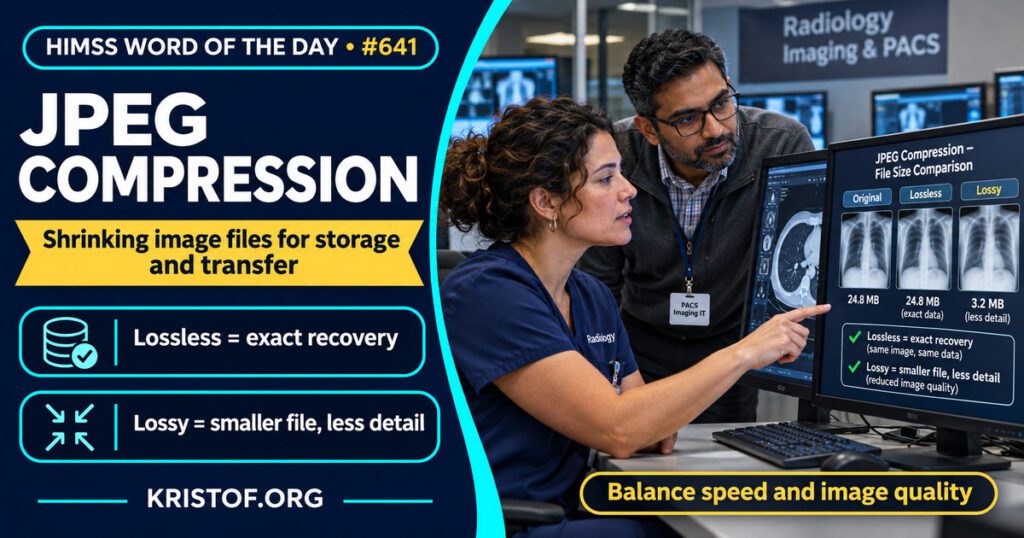
The HIMSS Dictionary describes JPEG compression as a process that reduces the size of a JPEG image file. A related dictionary entry describes JPEG as a common image file format that supports varying levels of compression. In short, the JPEG family of methods makes image files smaller so they are cheaper to store and faster to send.
Compression comes in two broad kinds. Lossless compression shrinks a file in a way that can be reversed exactly. Lossy, also called irreversible, compression shrinks it further by discarding some information that cannot be recovered. Erickson (2002) put the trade-off this way: reversible methods achieved only modest storage savings, while irreversible methods could reach substantially higher ratios.
DICOM, the standard for medical image exchange, includes JPEG in its transfer syntaxes. Part 5 of the DICOM standard says implementations that support any lossless JPEG transfer syntax must support a specific lossless process, and implementations that support 8-bit lossy JPEG must support the Baseline process. The same section says that whether lossy compression is clinically acceptable, and which compression parameters to use, is outside the scope of the standard. Those decisions belong to the organization and its clinicians.
| Feature | Lossless | Lossy (irreversible) |
|---|---|---|
| File size | Modest reduction | Larger reduction |
| Original recoverable | Yes, exactly | No |
| Typical concern | Smaller savings | Loss of detail at high ratios |
| In DICOM | Lossless JPEG transfer syntaxes | Lossy JPEG transfer syntaxes, such as Baseline |
| Who decides acceptability | Not applicable | The organization and clinicians, not the DICOM standard |
The table is a simplified summary of the sources cited below.
⚠️ Exam Alert: JPEG compression is a method, and JPEG is also a file format name. JPEG 2000 is a different, related method, and both are among the compression options used with DICOM images, according to Koff and colleagues (2009). Lossless compression keeps every original value, while lossy compression does not. Do not confuse compression with encryption, which protects confidentiality, or with de-identification, which removes identifiers.
🌐 Why It Matters: Real-World Healthcare IT Context
JPEG compression matters because imaging data grows quickly and has to be stored, archived, and moved between sites. Compression is one lever, and it has a clinical cost if applied carelessly.
What studies show. Erickson (2002), in the Journal of Digital Imaging, reviewed the technology and artifacts of irreversible compression. The paper says irreversible methods can reach much higher ratios than reversible ones without perceptible degradation, and that they were routinely used in teleradiology and often in picture archiving and communication systems. That is a 2002 overview, so it describes the field as it was then.
Koff and colleagues (2009), in the Journal of Digital Imaging, ran a pan-Canadian evaluation of lossy JPEG and JPEG 2000 across seven anatomical areas and five modalities, using diagnostic accuracy and subjective just-noticeable-difference methods. They found no significant difference between the two methods at low compression. At higher levels lossy JPEG did better than JPEG 2000 in some cases, mainly neurological CT, and they said more evaluation was needed for thin-slice CT. They proposed a table of recommended ratios for the Canadian Association of Radiologists standard.
Koff and colleagues (2013), in the same journal, followed up with thin-slice CT, using slices under 3 mm. Twenty-five radiologists each read 70 CT studies at seven levels of compression. There were no overall differences in sensitivity, specificity, accuracy, or confidence. JPEG images were rated as more noticeably different from the original than JPEG 2000 images, 4.16 out of 5 versus 4.53 out of 5, with 4.68 out of 5 for uncompressed images, although that rating was not significantly correlated with accuracy. This is a reader study with a limited set of cases.
Kovacs and colleagues (2015), in the American Journal of Roentgenology, tested JPEG 2000 compression at 80:1 on 194 digital mammography cases read by six mammographers. They found no statistically significant difference in reader performance and concluded that primary interpretation of such images may be viable. The authors state that federal regulations at the time prohibited lossy compression for primary reading and archiving of mammograms, so the current rule should be checked before anyone relies on this study.
Kohzai and colleagues (2026), in Diagnostics, studied irreversible compression of chest radiographs read with AI software, using 335 patients with pulmonary nodules. The software flagged 188 cases (56.1 percent) with no compression, 184 (54.9 percent) at 10:1, and 175 (52.2 percent) at 50:1. The authors report no significant difference at 10:1 but a significant decrease at 50:1. This is one study of one software tool, so it does not show that other tools behave the same way.
What I could not find. I did not review the current Canadian Association of Radiologists standard, so I cannot say which ratios it currently recommends. I did not verify the current rule for mammography compression, and I did not read the DICOM sections on JPEG 2000. I also did not find data on how widely US health systems use lossy compression today.
Common JPEG compression problems:
- Applying one compression ratio to every modality and body region
- Over-compressing until detail needed for diagnosis is lost
- Assuming lossy compression is allowed for every image type
- Confusing JPEG with JPEG 2000, which perform differently in some studies
- Using compressed images with AI software without testing, since detection fell at 50:1 in one study
- Leaving the decision to default settings instead of a clinical policy
What supports sound use of JPEG compression:
- Radiologist input on acceptable ratios for each study type
- Written policies that name the method and ratio for each use
- Testing with both objective accuracy and subjective review, as the Canadian studies did
- Using lossless compression where lossy is not permitted or not trusted
- Retesting when new tools, such as AI software, read the images
- Standards-based exchange through DICOM transfer syntaxes
🏥 The Nurse’s Perspective: Clinical, Bedside, & Workflow
Nurses seldom choose compression settings, but compression affects how quickly and how clearly images appear in the chart.
At the Bedside
A nurse who opens a radiograph or a clinical photograph in the EHR depends on image files that were stored and delivered in some format. Slow loading or an image that looks blurred is the kind of problem that gets reported to the help desk. Which compression, if any, was applied depends on the organization and the system, and no specific product was verified for this post.
In Clinical Workflow
Nurse informaticists often triage image problems: slow loads at a unit workstation, photos that look different from the original, or images that fail to open on a mobile device. They can route those reports to the imaging or infrastructure team along with the exact image and device. The studies above show that acceptable compression depends on the image type, so a blanket answer is rarely right.
In EHR Implementation (Go-Live Perspective)
During an Epic Go-Live, image viewing is one of the first things clinicians test. At-the-elbow analysts hear questions about image speed and quality, and the answer may sit with the imaging or network team. This post does not claim that any specific go-live had an image compression problem. It shows why image performance and quality belong in readiness testing.
🎓 CAHIMS / CPHIMS & HIMSS Perspective
CAHIMS Exam Domain Mapping
JPEG compression connects image standards, storage, and clinical quality:
| CAHIMS Domain | How JPEG Compression Appears |
|---|---|
| Healthcare & Technology Environments | Imaging standards, storage, and network bandwidth |
| Clinical Informatics | Image quality, diagnostic accuracy, and radiologist judgment |
| Healthcare Information & Systems Management | PACS storage planning, transfer syntaxes, and performance testing |
| Management & Leadership | Policy for acceptable compression and review of new use cases |
Key Terms to Know Alongside JPEG Compression
- DICOM — the standard for storing and exchanging medical images
- PACS — the system that stores, retrieves, and displays medical images
- Diagnostic Imaging — imaging used to detect and evaluate disease
- Teleradiology — reading images from a distance
- Lossless compression — compression that can be reversed exactly
- Lossy compression — compression that discards some information
HIMSS Organizational Position
HIMSS offers education and research on health information and technology topics through its Resource Center. Members can find related information on the HIMSS Resource Center page.
🧭 More HIMSS Word of The Day Terms
Related terms in the IT Infrastructure series:
Browse all IT Infrastructure terms or the A–Z glossary.
🔗 Explore Further: External References
- DICOM Standard, Part 5 — Section 8.2: Native or Encapsulated Format Encoding (JPEG Image Compression) https://dicom.nema.org/medical/dicom/current/output/chtml/part05/sect_8.2.html
- Erickson (2002), Journal of Digital Imaging — Irreversible compression of medical images https://pubmed.ncbi.nlm.nih.gov/12134209/
- Koff et al. (2009), Journal of Digital Imaging — Pan-Canadian evaluation of irreversible compression ratios (“lossy” compression) for development of national guidelines https://pubmed.ncbi.nlm.nih.gov/18931879/
- Koff et al. (2013), Journal of Digital Imaging — Evaluation of irreversible compression ratios for medical images thin slice CT and update of Canadian Association of Radiologists (CAR) guidelines https://pubmed.ncbi.nlm.nih.gov/23179406/
- Kovacs et al. (2015), AJR American Journal of Roentgenology — Evaluation of lossy data compression in primary interpretation for full-field digital mammography https://pubmed.ncbi.nlm.nih.gov/25714287/
- Kohzai et al. (2026), Diagnostics — Effect of Irreversible Compression on the Pulmonary Nodule Detection Rate in Chest Radiographs Using AI Software https://pubmed.ncbi.nlm.nih.gov/42279504/
- HIMSS — Resource Center https://www.himss.org/resource-center
Term source: HIMSS Dictionary of Health Information and Technology Terms, Acronyms, and Organizations, 6th Edition (2025). All definitions in this series are paraphrased for editorial purposes. Readers are encouraged to consult the primary source for exact language.
Eric Andrew Kristof, RN, CAHIMS is a Healthcare IT professional and HIMSS Arkansas Chapter member based in Hot Springs Village, AR, with hands-on Epic Go-Live experience and a diverse healthcare and IT background. He writes at kristof.org at the intersection of clinical care and healthcare technology.
Leave a Reply