By Eric Andrew Kristof, RN, CAHIMS | Healthcare IT Professional | HIMSS Arkansas Chapter Member
About This Series: The HIMSS Word of The Day is a running blog series drawing from the HIMSS Dictionary of Health Information and Technology Terms, Acronyms, and Organizations, 6th Edition (2025) — the authoritative reference for healthcare IT professionals and the primary study resource for CAHIMS and CPHIMS certification. Each post paraphrases the term in plain language, grounds it in real-world healthcare IT context, and adds a bedside nursing perspective you won’t find in a textbook.
📖 The Term: Archetype Model
Source: HIMSS Dictionary of Health Information and Technology Terms, Acronyms, and Organizations, 6th Edition (2025)
🔍 Plain-Language Definition
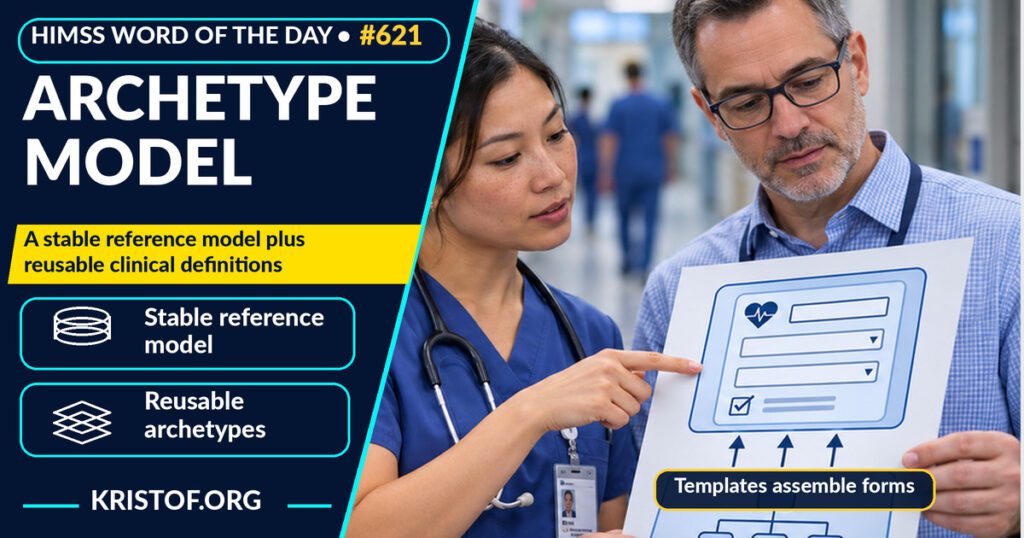
The HIMSS Dictionary describes an archetype model as an information model of metadata. It captures what is distinctive about each kind of clinical entry in an electronic health record by setting values or value constraints on the classes and attributes of an EHR reference model. In plainer terms, the reference model supplies a small, stable set of building blocks, and the archetype model supplies the rules that say what one kind of clinical entry may contain.
The dictionary entry does not name a specification. Two formalisms are the best-known homes for the idea. The openEHR specifications describe archetypes as instances of an archetype model that defines the language archetypes are written in, and a 2015 paper on archetype-based display describes complementing the ISO 13606 archetype model. This post reads the dictionary wording alongside those sources and does not claim that the dictionary refers to either one.
| Item | Detail |
|---|---|
| What it is | A model that defines what an archetype is and how an archetype constrains a reference model |
| Where it sits | The upper level of two-level modelling, above a stable reference model |
| Written in | In openEHR, the Archetype Definition Language (ADL), with other formats such as XML in practical use |
| Related pieces | Archetype, template, archetype repository, and reference model |
| Typical archetype subjects | A blood pressure measurement, an Apgar result, or a laboratory result |
⚠️ Exam Alert: Keep the layers apart. The reference model holds stable structures, an archetype constrains that model for one clinical concept, the archetype model defines what an archetype is, and a template combines archetypes into a form, report, or message. An archetype model is not HL7’s Reference Information Model, and it is not the same thing as a FHIR profile, although profiles also constrain a base model.
🌐 Why It Matters: Real-World Healthcare IT Context
Clinical content changes faster than software. New measures, scales, and care pathways appear constantly, and rebuilding a database each time one arrives is slow and risky. The two-level approach in openEHR’s architecture overview answers that problem by keeping the core model fixed and describing clinical content in separate, reusable definitions.
How the two levels divide the work. According to the openEHR architecture overview, the lower level is a reference model whose concepts, such as Composition, Section, and Observation, do not change. The upper level holds archetypes, which are sets of constraints on the reference model that define which instances count as valid for one subject, such as a blood pressure measurement. Archetypes are kept apart from the data, can be reused and combined, and can be specialized into narrower versions. The Archetype Object Model (AOM) states what an archetype is, and the Archetype Definition Language (ADL) is the normative text format for writing one. Templates assemble archetypes into complete structures such as a discharge summary, and an archetype repository stores the archetypes separately from patient data.
Why the separation exists. openEHR’s Archetype Technology Overview says the business purpose is to add domain meaning to information models without endless growth and maintenance of those models, which would destabilize deployed software and databases. It adds that this lets domain experts model clinical content independently of any particular product. Archetypes carry identifiers that include a custodian namespace, a reference model class, a domain entity name, and a major version number, and the openEHR Foundation acts as the governance body for international archetypes hosted on its Clinical Knowledge Manager. The overview cites ISO 13606-1 as an example of a multi-level modelling approach.
What studies show. Two papers illustrate the idea in practice. Both are small and technical, so they show feasibility more than broad benefit.
- Kopanitsa and colleagues (2015) built an information model for building user interfaces for archetype-based medical data, complementing the ISO 13606 archetype model. The abstract reports a month of testing in a working EHR system with 30 patients and 5 doctors, with average reading time falling from about 310 to 220 seconds for doctors and from about 95 to 39 seconds for patients. This was one system with a very small sample, and the figures come from the abstract, so verify them in the paper.
- Nogueira and colleagues (2015) mapped 68 Functional Status terms from the Nursing Outcome Indicators Catalog of the International Classification for Nursing Practice to an existing openEHR Barthel Index archetype. They found 19 exact matches between a term and an archetype node, 23 archetype nodes that matched one or more terms, no match for 14 terms, and nine nodes with no matching term. The authors conclude that the archetype was sufficient to represent the concept but that differences in data granularity made the mapping complex and potentially hard to implement in real systems.
Common archetype model problems:
- Confusing the archetype model, an archetype, and a template
- Assuming every EHR product uses archetypes, when approaches to modelling clinical content differ
- Treating a mapping between a terminology and an archetype as a one-to-one match
- Letting local variations of an archetype multiply without governance
- Skipping clinician review of archetype content
- Forgetting that archetypes and patient data are stored separately and must be versioned together
What supports good archetype practice:
- A stable reference model with clinical content kept in reusable definitions
- Named custodians and versioned identifiers for each archetype
- Shared repositories of reviewed archetypes
- Templates that assemble archetypes for specific screens, reports, and messages
- Mapping reviews that check granularity as well as presence
🏥 The Nurse’s Perspective: Clinical, Bedside, & Workflow
Nurses meet the archetype idea indirectly, through the assessments and scales that appear as structured forms in a record.
At the Bedside
A scale such as the Barthel Index records functional status through a defined set of items. When those items are modelled once and reused, every screen and report that shows functional status draws on the same definition. The Nogueira mapping study is a useful reminder that nursing terms and record structures do not always line up item for item.
In Clinical Workflow
Nurse informaticists contribute clinical knowledge that archetype work depends on. They review whether a model captures a concept the way practice uses it, check whether scales are complete, and flag items that clinicians would never fill in. The Kopanitsa study suggests that how archetype-based data is presented also matters, because the same data can be shown differently to patients and clinicians.
In EHR Implementation (Go-Live Perspective)
During an Epic Go-Live, analysts at the elbow see how structured flowsheet and assessment content looks on the screen. Archetype-based modelling is one of several approaches to representing that content, and this post does not claim that any specific product or go-live relies on openEHR. The transferable lesson is that content definitions and screen layouts are separate layers, and each needs its own review.
🎓 CAHIMS / CPHIMS & HIMSS Perspective
CAHIMS Exam Domain Mapping
The archetype model supports standards and data modelling knowledge:
| CAHIMS Domain | How Archetype Model Appears |
|---|---|
| Healthcare & Technology Environments | Two-level modelling and EHR information standards |
| Clinical Informatics | Clinical content models, scales, and structured documentation |
| Healthcare Information & Systems Management | Content governance, versioning, and mapping |
| Management & Leadership | Clinician engagement in content review and model governance |
Key Terms to Know Alongside Archetype Model
- Archetype — a set of constraints on a reference model that defines one clinical concept
- Archetype repository — the store where archetypes are kept apart from patient data
- Archetype Definition Language (ADL) — the text format openEHR uses to write archetypes
- openEHR — a foundation that publishes open specifications and clinical models for health records
- ISO 13606 — a health informatics standard for communicating EHR extracts that uses a multi-level modelling approach
- Semantic interoperability — exchange of data with shared, preserved meaning
HIMSS Organizational Position
HIMSS offers education and research on health information and technology topics through its Resource Center. Members can find related information on the HIMSS Resource Center page.
🧭 More HIMSS Word of The Day Terms
Related terms in the Interoperability and Standards series:
- Health Information Exchange (HIE)
- DCM (Detailed Clinical Models)
- Key Management Services
- VMR (Virtual Medical Record)
Browse all Interoperability and Standards terms or the A–Z glossary.
🔗 Explore Further: External References
- openEHR — Archetype Technology Overview https://specifications.openehr.org/releases/AM/latest/Overview.html
- openEHR — Archetypes and Templates (Architecture Overview, release 1.0.1) https://specifications.openehr.org/releases/1.0.1/html/architecture/overview/Output/archetyping.html
- Kopanitsa et al. (2015), Journal of biomedical informatics — Development, implementation and evaluation of an information model for archetype based user responsive medical data visualization https://pubmed.ncbi.nlm.nih.gov/25934466/
- Nogueira et al. (2015), Methods of information in medicine — Mapping a Nursing Terminology Subset to openEHR Archetypes. A Case Study of the International Classification for Nursing Practice https://pubmed.ncbi.nlm.nih.gov/25609209/
- HIMSS — Resource Center https://www.himss.org/resource-center
Term source: HIMSS Dictionary of Health Information and Technology Terms, Acronyms, and Organizations, 6th Edition (2025). All definitions in this series are paraphrased for editorial purposes. Readers are encouraged to consult the primary source for exact language.
Eric Andrew Kristof, RN, CAHIMS is a Healthcare IT professional and HIMSS Arkansas Chapter member based in Hot Springs Village, AR, with hands-on Epic Go-Live experience and a diverse healthcare and IT background. He writes at kristof.org at the intersection of clinical care and healthcare technology.
Leave a Reply