By Eric Andrew Kristof, RN, CAHIMS | Healthcare IT Professional | HIMSS Arkansas Chapter Member
About This Series: The HIMSS Word of the Day is a running blog series drawing from the HIMSS Dictionary of Health Information and Technology Terms, Acronyms, and Organizations, 6th Edition (2025) — the authoritative reference for healthcare IT professionals and the primary study resource for CAHIMS and CPHIMS certification. Each post paraphrases the term in plain language, grounds it in real-world healthcare IT context, and adds a bedside nursing perspective you won’t find in a textbook.
📖 The Term: Ambulatory EHR
Source: HIMSS Dictionary of Health Information and Technology Terms, Acronyms, and Organizations, 6th Edition (2025)
🔍 Plain-Language Definition
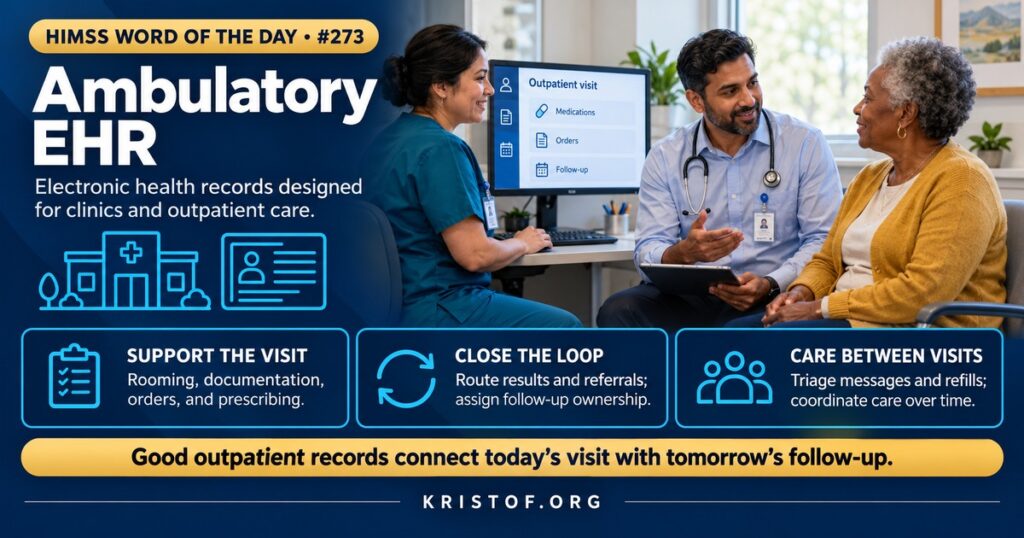
An ambulatory EHR is the electronic health record designed for clinics, physician offices, and other outpatient settings. The HIMSS Dictionary notes that it provides the full range of EHR functions, which can include clinical documentation, order entry, a clinical data repository, and documentation by physicians or nurses. In practice it also covers scheduling, registration, e-prescribing, referrals, results management, patient messaging, and billing connections.
An ambulatory EHR differs from an inpatient system in rhythm and risk. Visits are short and numerous, the patient is present for minutes and the record must carry the story across months or years, care is coordinated through messages and referrals, and many clinicians work in small organizations with limited technical support. Many health systems use one enterprise EHR across both settings; others use separate ambulatory products that interface with the hospital system.
| Ambulatory Function | What It Supports | Example |
|---|---|---|
| Scheduling and check-in | Access and flow | Appointment, insurance verification |
| Visit documentation | Clinical story and billing | Note, problem list, orders |
| Orders and prescribing | Treatment and testing | E-prescribing, lab and imaging orders |
| Results and follow-up | Closing the loop | Abnormal result routing |
| Inbox and messaging | Between-visit care | Patient message, refill request |
| Population health tools | Panel-level care | Gaps in care, registries |
| Patient portal | Access and engagement | Results, scheduling, forms |
⚠️ Exam Alert: An ambulatory EHR serves outpatient care; an inpatient EHR serves hospital stays. An enterprise EHR spans both. Certified EHR technology meets criteria set under the ONC Health IT Certification Program. Interoperability between ambulatory and hospital systems is a recurring exam theme.
🌐 Why It Matters: Real-World Healthcare IT Context
Ambulatory care is where most patients meet the health system, and where chronic disease, prevention, and follow-up are managed. National data show that the EHR is now nearly universal in this setting. The Office of the National Coordinator reports that as of 2024, 91 percent of office-based physicians had adopted a certified EHR, and more than 99 percent of non-federal acute care hospitals had done so, based on federal surveys. Adoption rose steadily after the HITECH Act of 2009 and the start of the certification program in 2010. With adoption nearly complete, the questions have shifted from whether to have an EHR to how well it serves clinicians and patients.
Documentation burden is the central concern. A national longitudinal cohort study in JAMA Internal Medicine followed 18,265 U.S. ambulatory physicians, of whom 1,024 adopted team-based documentation, meaning consistent coauthored notes with another clinical team member. After a 20-week learning period, weekly visits rose 10.8 percent and documentation time fell 16.2 percent. The benefit depended on intensity: physicians for whom more than 40 percent of note text was authored by others reduced documentation time by 53.9 minutes per week, a 21 percent decrease, while low-intensity adopters saw no meaningful change in EHR time but did see more visits. The authors framed this as evidence that documentation support can help, if it is used enough to change the work.
AI scribes are the newest tool. A 2026 multisite study in JAMA followed 8,581 ambulatory clinicians at five U.S. academic institutions, including 1,809 who adopted AI scribes between June 2023 and August 2025. In a difference-in-differences analysis, adoption was associated with 13.4 fewer minutes of EHR time and 16.0 fewer minutes of documentation time, each normalized to eight scheduled patient hours, along with a modest increase in weekly visit volume. The authors described the changes in time as modest. Because adoption was opt-in at most sites, adopters may differ from non-adopters in ways the analysis cannot fully remove.
Efficiency also depends on how the EHR is used day to day. A 2026 study in JAMIA Open analyzed EHR metadata for 218,610 physicians across 413 U.S. organizations. Average same-day chart completion was 72.9 percent and average volume was 10.8 visits per scheduled day. Machine learning models achieved 0.74 accuracy in classifying high chart-completion efficiency, with associations including inbox message turnaround under 1.5 days and after-hours documentation under 25 minutes per scheduled day, and 0.84 accuracy for high visit volume, associated with factors such as EHR time outside scheduled hours under 4.1 minutes per visit. These are associations, not proof of cause, and the thresholds describe patterns in the data and are not targets to adopt without local review. They do suggest that inbox management and after-hours work are practical levers for redesign.
For informatics teams, the ambulatory setting calls for attention to workflow: pre-visit planning, rooming by medical assistants and nurses, templates that fit specialties, order sets that match local practice, results routing that does not overload the inbox, and patient portal messages that are triaged by the right person. Interoperability matters because patients move between clinics and hospitals, so referrals, results, and summaries must travel. Small practices need support for upgrades, security, and downtime, and often rely on vendors and consultants.
Common ambulatory EHR problems:
- Documentation time that extends into evenings and weekends
- Inbox volume with no clear triage model
- Templates built for billing and not for clinical thinking
- Weak links to hospital records and outside results
- Alerts and tasks that add steps without value
- Limited technical support in small practices
What supports effective ambulatory EHR use:
- Team-based workflows, with each role working at the top of its license
- Documentation support such as scribes or AI tools, with evaluation
- Inbox routing and shared coverage models
- Specialty-specific templates and order sets
- Strong interfaces to hospitals, labs, and registries
- Ongoing training and optimization after go-live
🏥 The Nurse’s Perspective: Clinical, Bedside, & Workflow
Ambulatory nurses and medical assistants keep clinic workflow moving, and the EHR shapes their day.
At the Bedside
In the exam room, the nurse rooms the patient, reconciles medications, screens for risks, records vital signs, and sets up the visit. A well-designed ambulatory EHR makes these tasks quick and puts the results where the clinician will see them. Poor design pushes work into the visit or into the evening.
In Clinical Workflow
Ambulatory nurses triage phone calls and portal messages, manage refill requests, follow up on abnormal results, coordinate referrals, and teach patients about self-management. Nurse managers decide how to divide inbox work so that no message waits too long and no one person absorbs all of it. Care managers use registry tools to reach patients overdue for screening or follow-up.
Nurse informaticists optimize clinic workflows, build templates and protocols that allow nurses to work to the top of their license, and measure the effect on time and patient access.
In EHR Implementation (Go-Live Perspective)
An Epic Go-Live in the ambulatory setting involves many small sites with different needs. Schedules are reduced for the first weeks, and at-the-elbow support analysts spend visits alongside clinicians and staff. They see whether rooming steps, referral orders, and inbox routing work in practice, and they capture tips and fixes to share across clinics.
🎓 CAHIMS / CPHIMS & HIMSS Perspective
CAHIMS Exam Domain Mapping
The ambulatory EHR appears in implementation, workflow, and care coordination questions:
| CAHIMS Domain | How the Ambulatory EHR Appears |
|---|---|
| Healthcare & Technology Environments | Care settings, certification, adoption trends |
| Clinical Informatics | Outpatient workflow, documentation, orders, results |
| Healthcare Information & Systems Management | Interfaces, practice management, portals, support models |
| Management & Leadership | Optimization, burden reduction, training, vendor management |
Key Terms to Know Alongside Ambulatory EHR
- Enterprise EHR — single record system spanning inpatient and outpatient care
- Practice Management System — software for scheduling, registration, and billing
- Patient Portal — secure website or app for patient access to records and messaging
- Certified EHR Technology — EHR meeting ONC certification criteria
- Inbox Management — approach to routing and responding to messages and results
- Ambient AI Scribe — tool that drafts clinical notes from visit conversation
HIMSS Organizational Position
HIMSS supports effective use of health information technology across care settings through its research, education, and community work. Members can find related resources through the HIMSS Resource Center.
🔗 Explore Further: External References
- ONC — National Trends in Hospital and Physician Adoption of Electronic Health Records https://healthit.gov/data/quickstats/national-trends-hospital-and-physician-adoption-electronic-health-records/
- Apathy et al. (2024), JAMA Internal Medicine — Physician EHR Time and Visit Volume Following Adoption of Team-Based Documentation Support https://pubmed.ncbi.nlm.nih.gov/39186284/
- Rotenstein et al. (2026), JAMA — Changes in Clinician Time Expenditure and Visit Quantity With Adoption of Artificial Intelligence-Powered Scribes: A Multisite Study https://pubmed.ncbi.nlm.nih.gov/41920565/
- Li et al. (2026), JAMIA Open — Electronic Health Record Use Factors Linked to Efficiency and Productivity: An Explainable Machine Learning Analysis https://pubmed.ncbi.nlm.nih.gov/41767181/
- HealthIT.gov — Health IT Playbook https://playbook.healthit.gov/
Term source: HIMSS Dictionary of Health Information and Technology Terms, Acronyms, and Organizations, 6th Edition (2025). All definitions in this series are paraphrased for editorial purposes. Readers are encouraged to consult the primary source for exact language.
Eric Andrew Kristof, RN, CAHIMS is a Healthcare IT professional and HIMSS Arkansas Chapter member based in Hot Springs Village, AR, with hands-on Epic Go-Live experience and a diverse healthcare and IT background. He writes at kristof.org at the intersection of clinical care and healthcare technology.
Leave a Reply