By Eric Andrew Kristof, RN, CAHIMS | Healthcare IT Professional | HIMSS Arkansas Chapter Member
About This Series: The HIMSS Word of the Day is a running blog series drawing from the HIMSS Dictionary of Health Information and Technology Terms, Acronyms, and Organizations, 6th Edition (2025) — the authoritative reference for healthcare IT professionals and the primary study resource for CAHIMS and CPHIMS certification. Each post paraphrases the term in plain language, grounds it in real-world healthcare IT context, and adds a bedside nursing perspective you won’t find in a textbook.
📖 The Term: Warm Standby
Source: HIMSS Dictionary of Health Information and Technology Terms, Acronyms, and Organizations, 6th Edition (2025)
🔍 Plain-Language Definition
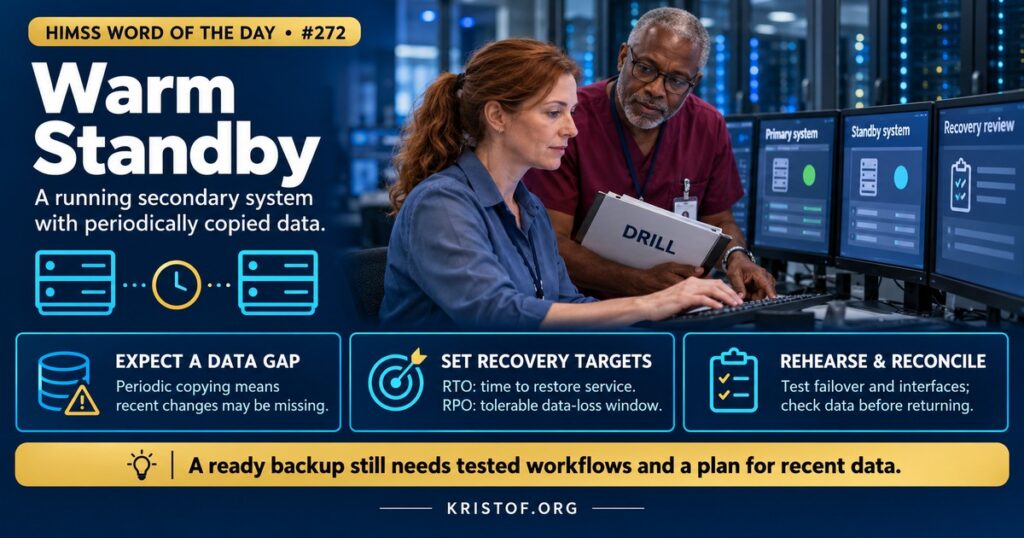
Warm standby is a redundancy method in which a second system, identical to the primary, runs in the background while the primary does the work. Data are copied, or mirrored, to the secondary system at regular intervals. Because the copying is periodic, the two systems may at times hold different data or different versions of data. If the primary fails, the secondary can take over, but it may be missing the most recent changes.
Standby designs sit on a spectrum of readiness and cost. In a cold standby, backup hardware or a site is available but must be configured and loaded before use. In a hot standby, a duplicate system stays closely synchronized and can take over very quickly. Warm standby falls between them. NIST’s contingency planning guide uses a similar spectrum for alternate sites, describing cold sites as facilities with space and infrastructure, warm sites as partially equipped spaces with some or all of the needed hardware, software, telecommunications, and power, and hot sites as fully configured facilities with the necessary equipment and support personnel. It also notes that mirrored sites, which are fully redundant with automated real-time mirroring, are the most expensive and give virtually full availability, while cold sites cost the least but may take substantial time to bring online.
| Standby Type | State of Backup | Recovery Speed | Data Currency |
|---|---|---|---|
| Cold | Available but not running | Slowest | Restore from backups |
| Warm | Running in background, periodically updated | Moderate | May lag the primary |
| Hot | Running and closely synchronized | Fastest | Little or no loss |
⚠️ Exam Alert: Warm standby is a running secondary system with periodically mirrored data, so some recent data may be lost on failover. Recovery time objective (RTO) is how fast service must return; recovery point objective (RPO) is how much data loss is acceptable. A backup copy is not the same as a standby system.
🌐 Why It Matters: Real-World Healthcare IT Context
Health care depends on continuous access to clinical systems. When an EHR, a medication administration system, or a laboratory system goes down, nurses cannot see allergies, medication histories, or orders in the usual way, and patients wait. Organizations therefore design infrastructure with redundancy, and the choice of standby approach reflects a balance of cost, speed, and tolerance for data loss.
Two ideas drive the decision. The first is the recovery time objective: how long the organization can tolerate being without the system. The second is the recovery point objective: how much recent data it can afford to lose. Warm standby usually delivers a shorter recovery time than rebuilding from backups, but because mirroring is periodic, the recovery point is the time of the last copy. If data are mirrored every few minutes, a failover could mean that the last few minutes of documentation, orders, or results are missing or need to be re-entered. For a system that handles medication administration or critical results, even a short gap needs a plan.
Regulation expects planning. The HIPAA Security Rule‘s contingency plan standard, at 45 CFR 164.308(a)(7), requires policies and procedures for responding to an emergency or other occurrence, such as fire, vandalism, system failure, and natural disaster, that damages systems containing electronic protected health information. Its components include a required data backup plan, a required disaster recovery plan, and a required emergency mode operation plan, along with addressable testing and revision procedures and an addressable applications and data criticality analysis. NIST SP 800-34 Rev. 1 guides organizations through contingency planning for information systems, connecting system priority to recovery strategy. Warm standby is one tool in such a plan, appropriate where a system matters but where a short outage is tolerable. The most critical systems may justify hot or mirrored designs, and less critical ones may rely on cold recovery.
Technology alone does not keep care safe. A 2024 article in the Journal of Business Continuity and Emergency Planning describes one health system’s approach to EHR downtime readiness. It notes that integration of the EHR with other platforms since the HITECH Act has increased both the complexity and the consequences of downtime, and that continuity of patient care now depends on an intact EHR. The authors argue that successful planning includes documented downtime processes with annual review and an exercise program that touches all aspects of the process, and describe a system that exercises part of its downtime process quarterly before scheduled EHR upgrades, using the data to target education and fine-tune drills. The paper is a single-system experience, but its message is general: infrastructure redundancy and human readiness have to be practiced together.
Failover is also a change event. Staff need to know when the system is on the secondary, which functions are limited, and when to reconcile any missing data. Interfaces to labs, pharmacy, imaging, and devices must reconnect correctly. After the primary is restored, teams must decide how to move back without losing data created on the secondary. These steps should be written, rehearsed, and led by named roles. Testing a failover during planned maintenance reveals problems that a paper plan hides, such as an interface that does not reconnect or a report that points to the wrong server.
Common warm standby problems:
- Assuming the secondary has all recent data
- Mirroring intervals longer than the clinical tolerance for data loss
- Interfaces or devices that do not reconnect after failover
- Failover plans that have never been tested under load
- No process to reconcile data after returning to the primary
- Staff unaware of how to work during the transition
What supports resilience:
- RTO and RPO set with clinical input for each system
- Mirroring frequency matched to the RPO
- Regular failover tests, including interfaces and devices
- Downtime procedures and printed or read-only views for critical data
- Clear communication and roles during transitions
- Post-event reviews that feed improvements
🏥 The Nurse’s Perspective: Clinical, Bedside, & Workflow
Nurses feel the effects of standby decisions in the minutes after a system failure.
At the Bedside
When the primary system fails and a secondary takes over, nurses may find that recent documentation, orders, or results are not visible. The safe response is to verify the patient’s current situation directly, check the medication administration record against a downtime printout or a read-only view, and document on paper if instructed. After restoration, charting that was done on paper is entered, and recent entries are checked for gaps.
In Clinical Workflow
Nurse managers keep downtime kits stocked and current: forms, printed schedules, and contact numbers. Charge nurses lead reconciliation after an event, making sure medications given during the gap are recorded and that new orders were not missed.
Nurse informaticists help define which data matter most when setting recovery objectives, such as medication administration, allergies, and critical results. They take part in downtime drills and failover tests and update procedures based on what staff report.
In EHR Implementation (Go-Live Perspective)
An Epic Go-Live includes downtime readiness: a tested read-only view, printed reports, and procedures. At-the-elbow support analysts hear exactly where nurses are unsure what to do when screens freeze, and those observations improve training and drills. Teams that rehearse a failover before go-live learn what a short data lag looks like on a real unit.
🎓 CAHIMS / CPHIMS & HIMSS Perspective
CAHIMS Exam Domain Mapping
Warm standby appears in infrastructure, continuity, and risk questions:
| CAHIMS Domain | How Warm Standby Appears |
|---|---|
| Healthcare & Technology Environments | HIPAA contingency planning, risk and resilience |
| Clinical Informatics | Downtime procedures, safe care during system loss |
| Healthcare Information & Systems Management | Redundancy design, mirroring, failover, testing |
| Management & Leadership | Business continuity governance, cost trade-offs, drills |
Key Terms to Know Alongside Warm Standby
- Recovery Time Objective (RTO) — target time to restore a system after disruption
- Recovery Point Objective (RPO) — acceptable amount of data loss measured in time
- Failover — switching operations from a failed system to a backup
- Hot Standby — closely synchronized backup able to take over quickly
- Cold Standby — backup that must be set up before use
- Business Continuity Plan — plan to maintain essential operations during disruption
HIMSS Organizational Position
HIMSS supports resilient, secure health information systems through its Healthcare Cybersecurity Community, research, and education. Members can find related resources through the HIMSS Healthcare Cybersecurity Community page.
🔗 Explore Further: External References
- NIST — SP 800-34 Rev. 1, Contingency Planning Guide for Federal Information Systems https://csrc.nist.gov/pubs/sp/800/34/r1/upd1/final
- eCFR — 45 CFR 164.308, Administrative Safeguards https://www.ecfr.gov/current/title-45/subtitle-A/subchapter-C/part-164/subpart-C/section-164.308
- Bulson (2024), Journal of Business Continuity and Emergency Planning — Electronic Health Record Downtime Responses: One Health System’s Process for Ongoing Readiness https://pubmed.ncbi.nlm.nih.gov/39164867/
- HealthIT.gov — SAFER Guides https://healthit.gov/clinical-quality-and-safety/safer-guides/
- NIST — SP 800-66 Rev. 2, Implementing the HIPAA Security Rule https://csrc.nist.gov/pubs/sp/800/66/r2/final
Term source: HIMSS Dictionary of Health Information and Technology Terms, Acronyms, and Organizations, 6th Edition (2025). All definitions in this series are paraphrased for editorial purposes. Readers are encouraged to consult the primary source for exact language.
Eric Andrew Kristof, RN, CAHIMS is a Healthcare IT professional and HIMSS Arkansas Chapter member based in Hot Springs Village, AR, with hands-on Epic Go-Live experience and a diverse healthcare and IT background. He writes at kristof.org at the intersection of clinical care and healthcare technology.
Leave a Reply