By Eric Andrew Kristof, RN, CAHIMS | Healthcare IT Professional | HIMSS Arkansas Chapter Member
About This Series: The HIMSS Word of the Day is a running blog series drawing from the HIMSS Dictionary of Health Information and Technology Terms, Acronyms, and Organizations, 6th Edition (2025) — the authoritative reference for healthcare IT professionals and the primary study resource for CAHIMS and CPHIMS certification. Each post paraphrases the term in plain language, grounds it in real-world healthcare IT context, and adds a bedside nursing perspective you won’t find in a textbook.
📖 The Term: ABAC (Attribute-Based Access Control)
Source: HIMSS Dictionary of Health Information and Technology Terms, Acronyms, and Organizations, 6th Edition (2025)
🔍 Plain-Language Definition
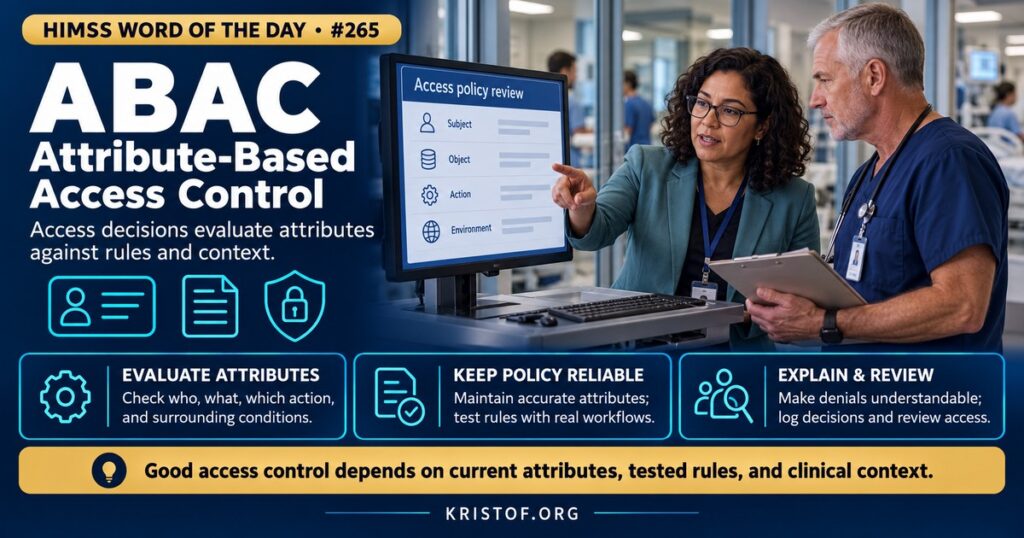
Attribute-based access control (ABAC) is a logical access control model in which a system decides whether to allow a request by checking rules against attributes. The HIMSS Dictionary highlights that those attributes belong to several things at once: the person or system asking (the subject), the thing being accessed (the object), the action requested, and the surrounding conditions. NIST’s guide to ABAC, SP 800-162, describes it as authorization determined by evaluating attributes of the subject, object, requested operations, and sometimes the environment against policy, rules, or relationships that say what is allowed.
Compare this with role-based access control (RBAC), in which users receive permissions through roles such as “staff nurse” or “billing clerk.” Roles are simple and familiar. But a role cannot by itself express “a nurse may open charts of patients on her own unit, during her shift, from a hospital workstation, except for records marked as restricted.”
| Attribute Type | Examples in Health Care |
|---|---|
| Subject | Job role, license, department, shift, training status |
| Object | Patient’s unit, record sensitivity, document type |
| Action | View, edit, print, export, sign |
| Environment | Time of day, device, location, emergency status |
⚠️ Exam Alert: RBAC grants access through roles; ABAC grants access through attributes and rules, which can include roles. Least privilege and minimum necessary are the principles ABAC helps put into practice. A policy engine evaluates each request, and audit logs record the decision.
🌐 Why It Matters: Real-World Healthcare IT Context
The HIPAA Security Rule requires covered entities to implement technical policies and procedures that allow access to electronic protected health information only to persons or software programs that have been granted access rights. It also requires policies for authorizing access under 45 CFR 164.308(a)(4) and mechanisms to record and examine activity under 164.312(b). How a hospital meets these requirements is its choice. Role-based models are the traditional approach and work well for stable job categories. Health care, however, strains them. Staff move between units, cover for colleagues, and hold several functions. Students, travelers, residents, and volunteers need limited access. Some records require tighter handling than others.
One response in RBAC is to create more and more roles, which can lead to “role explosion”: hundreds of narrow roles that are hard to maintain and review. A 2026 study in Digital Health proposed an improved attribute-based role access control model, I_ABRAC, to address role explosion, inefficiency, and compliance problems in hospitals. The model was tested with de-identified operational data from a large tertiary teaching hospital in China, covering 60 access control rules, about 20,000 personnel, and more than 2,000 access points, across 16 test scenarios and 24 configurations. The authors reported a 68 percent reduction in required system roles, from 176 to 56, correct permission assignment across all scenarios, and an 83.3 percent improvement in processing efficiency, with processing time falling from about 55 seconds to about 10 seconds. These results come from one hospital and a research model, but they illustrate how attributes can reduce the sprawl of roles while keeping rules traceable.
ABAC also supports risk-aware access. A 2026 paper on adaptive access governance noted that insider-originated breaches remain the predominant vector of data compromise in health care, and that traditional role-based control offers limited responsiveness to dynamic clinical workflows. It presented a model combining role-based, attribute-based, and risk-based authorization with continuous behavioral anomaly detection, using context such as timing, device provenance, geolocation, and record sensitivity, and reported fewer inappropriate access events in simulated and operational environments, with alignment to GDPR, HIPAA, and ISO/IEC 27001. The abstract does not give effect sizes, so the finding should be read as encouraging and not as proof of a specific reduction.
ABAC has costs. Policies can become complex and hard to test. Attributes must be accurate and current: if a nurse’s department in the directory is wrong, the policy will give the wrong answer. Performance matters because decisions must be made quickly in clinical workflows. Rules can interact in surprising ways, so organizations need governance, a clear policy language, testing with realistic scenarios, and a way to explain a denial to the user. Emergency access must be designed so that care is never blocked by a rule, with strong logging and after-the-fact review.
Many organizations use a hybrid: roles for the broad baseline, plus attribute-based rules for sensitive cases, such as restricted records, research data, or access from outside the hospital. Standards and tools exist for expressing and evaluating such policies, and NIST’s guide describes the architecture and considerations for adoption.
Common ABAC challenges:
- Inaccurate or stale attributes in directories and HR systems
- Policies so complex that no one can predict results
- Slow decisions that interrupt clinical work
- Denials with no explanation, leading staff to seek workarounds
- Weak emergency access design
- Rules that are not reviewed after workflows change
What supports effective ABAC:
- Clean, owned sources for each attribute
- Clear, tested policy language and change control
- Hybrid use with roles where roles are enough
- Explainable denials and a quick request path
- Break-the-glass design with logging and review
- Regular audit of decisions and policy outcomes
🏥 The Nurse’s Perspective: Clinical, Bedside, & Workflow
Nurses experience access control as the moment a chart opens or does not.
At the Bedside
When a nurse covers another unit, floats to a new area, or works from a mobile device, an attribute-based rule might permit or restrict access depending on assignment and context. A clear message that explains the denial and offers a fast path to request access keeps care moving. Nurses protect patients by accessing only records tied to their work, since audit logs record each view.
In Clinical Workflow
Nurse managers keep assignments, schedules, and unit attributes up to date in the systems that feed access decisions. When a float nurse cannot reach a chart, the cause is often an attribute that did not update. Charge nurses know the escalation steps and the emergency access process.
Nurse informaticists help security teams translate clinical workflows into rules that fit real work, such as covering, consulting, rapid response, and transfers. They test scenarios with frontline users and advise on messages shown to the user.
In EHR Implementation (Go-Live Perspective)
An Epic Go-Live sets up security classes and templates for each role, and may add rules based on department, location, or record type. At-the-elbow support analysts hear when a nurse cannot see a patient they are caring for, or can see a patient they should not, and route those reports to security analysts. These early reports shape fixes for both safety and privacy.
🎓 CAHIMS / CPHIMS & HIMSS Perspective
CAHIMS Exam Domain Mapping
ABAC appears in security, privacy, and access management questions:
| CAHIMS Domain | How ABAC Appears |
|---|---|
| Healthcare & Technology Environments | HIPAA access control requirements, minimum necessary |
| Clinical Informatics | Workflow-aware access, emergency access, consent |
| Healthcare Information & Systems Management | Policy engines, directories, attributes, audit logs |
| Management & Leadership | Access governance, policy ownership, compliance review |
Key Terms to Know Alongside ABAC
- RBAC — access based on assigned roles
- Least Privilege — giving only the access needed for a task
- Policy Decision Point — component that evaluates a request against policy
- Attribute — characteristic of a user, resource, action, or environment
- Break-the-Glass — emergency override of normal access limits, with logging
- Audit Log — record of who accessed what and when
HIMSS Organizational Position
HIMSS supports privacy and security in health information through its public policy work, Healthcare Cybersecurity Community, and research. Members can find related resources through the HIMSS Healthcare Cybersecurity Community page.
🔗 Explore Further: External References
- NIST — SP 800-162, Guide to Attribute Based Access Control (ABAC) Definition and Considerations https://csrc.nist.gov/pubs/sp/800/162/upd2/final
- Wang et al. (2026), Digital Health — Enhancing Healthcare Service Efficiency and Compliance: A Dynamic Permission Access Control Method for Hospital Environments Based on I_ABRAC Model https://pubmed.ncbi.nlm.nih.gov/42436891/
- Capparelli et al. (2026), Studies in Health Technology and Informatics — Adaptive Access Governance in Healthcare https://pubmed.ncbi.nlm.nih.gov/42175252/
- NIST — Role-Based Access Control Project https://csrc.nist.gov/projects/role-based-access-control
- eCFR — 45 CFR 164.312, Technical Safeguards https://www.ecfr.gov/current/title-45/subtitle-A/subchapter-C/part-164/subpart-C/section-164.312
Term source: HIMSS Dictionary of Health Information and Technology Terms, Acronyms, and Organizations, 6th Edition (2025). All definitions in this series are paraphrased for editorial purposes. Readers are encouraged to consult the primary source for exact language.
Eric Andrew Kristof, RN, CAHIMS is a Healthcare IT professional and HIMSS Arkansas Chapter member based in Hot Springs Village, AR, with hands-on Epic Go-Live experience and a diverse healthcare and IT background. He writes at kristof.org at the intersection of clinical care and healthcare technology.
Leave a Reply