By Eric Andrew Kristof, RN, CAHIMS | Healthcare IT Professional | HIMSS Arkansas Chapter Member
About This Series: The HIMSS Word of the Day is a running blog series drawing from the HIMSS Dictionary of Health Information and Technology Terms, Acronyms, and Organizations, 6th Edition (2025) — the authoritative reference for healthcare IT professionals and the primary study resource for CAHIMS and CPHIMS certification. Each post paraphrases the term in plain language, grounds it in real-world healthcare IT context, and adds a bedside nursing perspective you won’t find in a textbook.
📖 The Term: APT (Advanced Persistent Threat)
Source: HIMSS Dictionary of Health Information and Technology Terms, Acronyms, and Organizations, 6th Edition (2025)
🔍 Plain-Language Definition
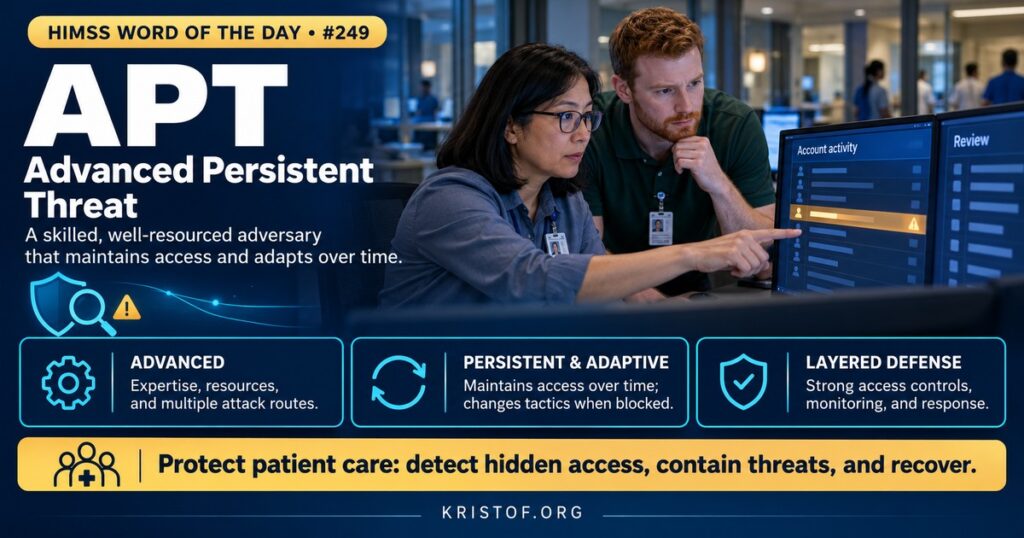
An advanced persistent threat (APT) is an adversary with a high level of expertise and substantial resources, able to pursue goals through several attack routes at once, such as cyber, physical, and deception. The HIMSS Dictionary, drawing on the NIST glossary, says that APT objectives usually involve establishing and extending a presence in an organization’s technology infrastructure to steal information continually, to undermine or impede key parts of a mission, program, or organization, or to be ready to do so later. Three traits define it: the adversary pursues its objectives repeatedly over a long time, adapts to defenders’ efforts to resist, and is determined to keep the level of access needed to reach its goals.
The word persistent separates APTs from smash-and-grab attacks. A commodity attack may try thousands of targets and move on quickly. An APT may focus on a single organization or sector, take months to prepare, and avoid detection by blending in with normal activity.
| APT Trait | What It Means | Why It Matters in Health Care |
|---|---|---|
| Advanced | Skilled, well-funded, multiple methods | Can defeat basic defenses and use stolen credentials |
| Persistent | Stays inside for long periods | Long exposure of records, research, and systems |
| Threat | Has intent and capability | Goals may include data theft, disruption, or positioning |
| Adaptive | Changes tactics when blocked | Static defenses lose value over time |
| Multiple vectors | Cyber, physical, and social engineering | Staff and facilities are part of the attack surface |
⚠️ Exam Alert: An APT is defined by the adversary’s sophistication and persistence, not by a single malware type. Ransomware is a payload that may be delivered by criminal groups or APTs. Dwell time is how long an intruder remains undetected. Lateral movement is the intruder’s movement from one system to others inside the network.
🌐 Why It Matters: Real-World Healthcare IT Context
Health care holds many things an adversary may want. Patient records contain identity and clinical data that are valuable for fraud and intelligence. Research organizations and drug and device makers hold intellectual property. Hospitals run critical services that, if disrupted, affect communities. Connected medical devices and aging systems add weak points. The HHS 405(d) Program, a partnership between the Health Sector Coordinating Council and the federal government, exists to align industry security approaches against the most relevant threats to the health sector, and publishes the Health Industry Cybersecurity Practices guidance for that purpose.
APT campaigns follow a recognizable path, described in knowledge bases such as MITRE ATT&CK, a globally accessible catalog of adversary tactics and techniques based on real-world observations. The sequence usually starts with reconnaissance and initial access, often a phishing email, a stolen password, or a vulnerable internet-facing system. The intruder then establishes persistence, so that access survives a reboot or password change, escalates privileges, moves laterally to find valuable systems, collects data, and exfiltrates it, sometimes in small, slow transfers to avoid alarms. Throughout, the adversary tries to evade defenders by using legitimate tools and accounts. Defenders can disrupt the chain at each step.
The regulatory environment is moving toward stronger baseline defenses. In January 2025, HHS published a notice of proposed rulemaking to revise the HIPAA Security Rule, citing changes in how care is delivered, significant increases in breaches and cyberattacks, deficiencies observed in OCR investigations, and other cybersecurity guidance. The proposal is not final law as of this writing and could change, but the direction shows that regulators view stronger technical controls as necessary. NIST’s Cybersecurity Framework provides a common vocabulary, organizing outcomes into functions that include identify, protect, detect, respond, and recover, with govern added in version 2.0, and it applies directly to the APT problem.
Because APTs adapt, no single product stops them. Defense is layered. Strong authentication, especially multifactor authentication on remote access and privileged accounts, limits the value of stolen passwords. Network segmentation keeps an intruder from reaching everything once inside. Logging and monitoring, supported by endpoint detection and response tools, create the chance to notice odd behavior, such as a user account accessing systems it never touched before. Patch management closes known holes. Least privilege reduces what a compromised account can do. Threat hunting, in which analysts search for signs of intrusion without waiting for an alert, shortens dwell time. Incident response plans and practice exercises prepare the organization to contain and eradicate an intruder without making matters worse, and tested backups protect recovery.
People remain part of the defense. Phishing and social engineering are common first steps, and clinicians are busy, trusting people who receive many emails. Training that is short, specific, and non-punitive, plus an easy way to report suspicious messages, turns every employee into a sensor. Physical security matters too, since an APT may try to enter through a visitor badge, an unattended workstation, or an unsecured network port.
Common APT-related weaknesses:
- Single-factor remote access and shared administrative accounts
- Flat networks where one compromised system reaches everything
- Incomplete logging, so intrusions go unseen for months
- Unpatched internet-facing systems and legacy devices
- Staff unsure how to report suspicious messages
- Vendor and third-party connections with broad access
What supports resilience against APTs:
- Multifactor authentication and least-privilege access
- Network segmentation, including for medical devices
- Central logging, endpoint detection, and active threat hunting
- Tested incident response and recovery plans
- Vendor risk management and monitored third-party access
- Short, regular security awareness training with easy reporting
🏥 The Nurse’s Perspective: Clinical, Bedside, & Workflow
Nurses are rarely the target of an APT by name, but their accounts and workstations can be the way in.
At the Bedside
Clinicians receive emails, texts, and calls that look routine. A message that asks for a password, a link that opens an odd login page, or an unfamiliar person asking for access to a workstation deserves a pause. Reporting the event right away, even if the nurse already clicked, gives security staff a chance to contain a problem early. Using only one’s own login, and logging out when leaving a workstation, keeps stolen or shared credentials from becoming a path for an intruder.
In Clinical Workflow
Nurse managers can reinforce security habits in huddles, ask for training that fits clinical schedules, and make sure staff know how to reach security during nights and weekends. Units that depend on connected devices, such as infusion pumps or monitors, work with biomedical engineering and IT to ensure those devices are inventoried and segmented.
Nurse informaticists help security teams understand clinical workflows, so that controls such as multifactor authentication are designed to work at a busy bedside. They also take part in downtime planning and drills, since an intrusion that disrupts systems must not stop safe care.
In EHR Implementation (Go-Live Perspective)
An Epic Go-Live creates many new accounts, interfaces, and vendor connections in a short period, all of which must be controlled. Security teams confirm that access is based on role, that remote support is monitored, and that default credentials are removed. At-the-elbow support analysts reinforce good habits, such as never sharing logins, and pass along reports of suspicious messages that staff receive in the busy first weeks.
🎓 CAHIMS / CPHIMS & HIMSS Perspective
CAHIMS Exam Domain Mapping
APTs appear in security, risk, and incident management questions:
| CAHIMS Domain | How APTs Appear |
|---|---|
| Healthcare & Technology Environments | Cyber threats, regulations, sector guidance |
| Clinical Informatics | Clinical workflow impact of security controls, downtime planning |
| Healthcare Information & Systems Management | Layered defenses, monitoring, segmentation, incident response |
| Management & Leadership | Risk management, governance, security investment, vendor oversight |
Key Terms to Know Alongside APT
- Dwell Time — the period an intruder remains in a network before detection
- Lateral Movement — movement of an attacker from one system to others in a network
- Threat Hunting — proactive search for hidden intruders in a network
- MITRE ATT&CK — public knowledge base of adversary tactics and techniques
- Endpoint Detection and Response (EDR) — tools that monitor and respond to threats on devices
- Network Segmentation — dividing a network into zones to limit an intruder’s reach
HIMSS Organizational Position
HIMSS supports healthcare cybersecurity through its Healthcare Cybersecurity Community, research, and education. Members can find related resources through the HIMSS Healthcare Cybersecurity Community pages.
🔗 Explore Further: External References
- NIST — Computer Security Resource Center Glossary: Advanced Persistent Threat https://csrc.nist.gov/glossary/term/advanced_persistent_threat
- MITRE — ATT&CK Knowledge Base https://attack.mitre.org/
- HHS 405(d) Program — Health Industry Cybersecurity Practices https://405d.hhs.gov/
- Federal Register — HIPAA Security Rule To Strengthen the Cybersecurity of Electronic Protected Health Information (Proposed Rule) https://www.federalregister.gov/documents/2025/01/06/2024-30983/hipaa-security-rule-to-strengthen-the-cybersecurity-of-electronic-protected-health-information
- NIST — Cybersecurity Framework https://www.nist.gov/cyberframework
- HIMSS — Healthcare Cybersecurity Community https://www.himss.org/networking/communities/healthcare-cybersecurity/
Term source: HIMSS Dictionary of Health Information and Technology Terms, Acronyms, and Organizations, 6th Edition (2025). All definitions in this series are paraphrased for editorial purposes. Readers are encouraged to consult the primary source for exact language.
Eric Andrew Kristof, RN, CAHIMS is a Healthcare IT professional and HIMSS Arkansas Chapter member based in Hot Springs Village, AR, with hands-on Epic Go-Live experience and a diverse healthcare and IT background. He writes at kristof.org at the intersection of clinical care and healthcare technology.
Leave a Reply