By Eric Andrew Kristof, RN, CAHIMS | Healthcare IT Professional | HIMSS Arkansas Chapter Member
About This Series: The HIMSS Word of the Day is a running blog series drawing from the HIMSS Dictionary of Health Information and Technology Terms, Acronyms, and Organizations, 6th Edition (2025) — the authoritative reference for healthcare IT professionals and the primary study resource for CAHIMS and CPHIMS certification. Each post paraphrases the term in plain language, grounds it in real-world healthcare IT context, and adds a bedside nursing perspective you won’t find in a textbook.
📖 The Term: SQL (Structured Query Language)
Source: HIMSS Dictionary of Health Information and Technology Terms, Acronyms, and Organizations, 6th Edition (2025)
🔍 Plain-Language Definition
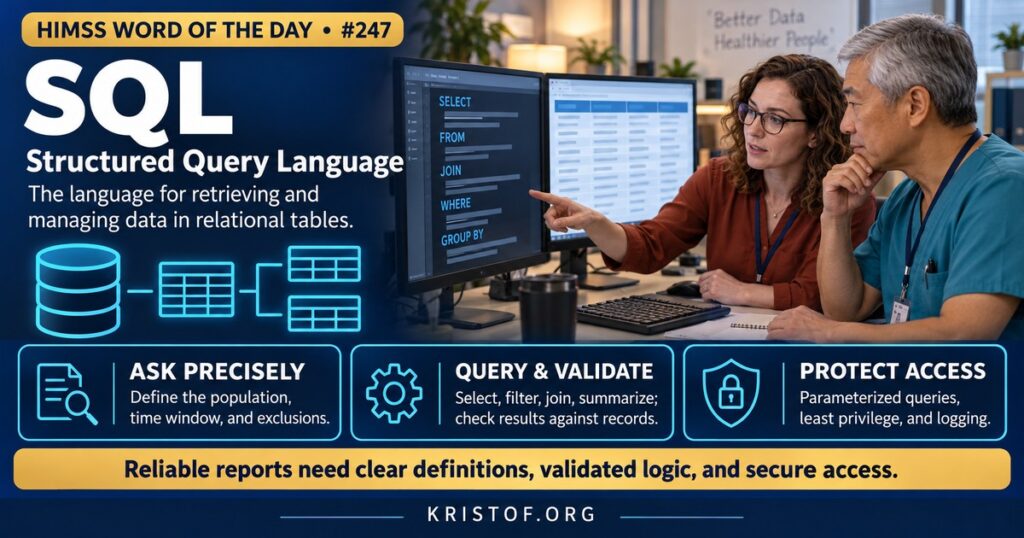
SQL, the Structured Query Language, is the standard computer language for managing and manipulating data in relational databases. The HIMSS Dictionary notes that it can retrieve, add, change, and alter stored data, and that the current standard is a voluntary one that vendors follow, overseen by ANSI. A relational database stores data in tables of rows and columns, and SQL describes what data to retrieve or change without spelling out how the database should find it.
Most reports, dashboards, and data extracts in health care are built on SQL somewhere in the chain. An EHR vendor may keep a reporting database that analysts query directly, and research networks use shared data models so the same query can run at many sites.
| SQL Statement | What It Does | Clinical Example |
|---|---|---|
| SELECT | Retrieves rows and columns | List patients discharged last month |
| WHERE | Filters rows | Only patients on a given unit |
| JOIN | Combines tables | Link encounters with medication orders |
| GROUP BY | Summarizes | Count falls by unit |
| INSERT / UPDATE / DELETE | Adds, changes, or removes data | Maintenance tasks, usually restricted |
| CREATE / ALTER | Defines database structure | Building a reporting table |
⚠️ Exam Alert: SQL works on relational databases with tables, whereas NoSQL systems use other structures. A query that reads data is lower risk than one that changes it. SQL injection is an attack that inserts malicious SQL through an input field and is prevented mainly by parameterized queries and least privilege.
🌐 Why It Matters: Real-World Healthcare IT Context
Clinical questions often come down to data questions: How many patients had a fall this quarter? Which units have the longest medication administration delays? Which patients meet criteria for a registry? Answering them means selecting, filtering, and joining data from many tables. Analysts who know SQL can answer quickly, and informaticists who understand it can specify requests precisely and review results critically.
Accuracy depends on understanding the data, not only the syntax. A query for “patients with diabetes” must decide whether to use a problem list, diagnosis codes on claims, laboratory values, medications, or some combination. Date logic, duplicate records, and null values change counts. Two correct queries can return different numbers because they ask slightly different questions. Good practice is to write the definition in plain language first, test the query on a small sample against the chart, and document it so others can reuse it.
Research networks add standardization. The OHDSI community promotes a common data model so that analysis code written once can run against many institutions’ converted data, which makes SQL skills portable across sites that share the model.
Artificial intelligence now offers to write SQL from plain-language questions. Two 2026 studies show promise and caution. In a University of California, San Francisco proof of concept, clinicians posed 30 questions about hepatocellular carcinoma to a privacy-compliant chatbot that translated them into SQL, ran the queries, and returned code and results. Outputs were compared with SQL written by a data scientist. Prompt interpretation accuracy was 73.3 percent, and SQL accuracy and output accuracy each ranged from 53 to 63 percent. Frequent errors involved group comparisons, ambiguous variables, and exploratory questions. A separate system for querying the MIMIC-IV critical care database in natural language was tested on 100 answerable questions from a benchmark, and two language models reached 94 percent and 93 percent accuracy. On 100 unanswerable questions, where the right response is to decline, the smaller model abstained correctly 69 percent of the time. Most failures stemmed from complex temporal reasoning or ambiguous phrasing. These results differ because the databases, questions, and scoring differ, and they show that text-to-SQL can help people without coding skills but that a wrong answer can look just as confident as a right one. Showing the generated query and having a knowledgeable person review it are essential.
Security is the other half. SQL injection happens when an application builds a query by pasting in user input, allowing an attacker to alter the query and read or change data. The OWASP prevention guidance lists parameterized queries (prepared statements) as the primary defense, supported by stored procedures, allow-list input validation, and least privilege so that an application account can do only what it must. Health care databases hold sensitive data, so applications that connect to them, from patient portals to vendor tools, deserve review for these protections. Direct database access for analysts should be limited, logged, and read-only where possible, and queries that touch protected health information should follow minimum necessary and approval rules.
Common SQL problems in health care:
- Queries that answer a slightly different question than intended
- Duplicate patients or encounters inflating counts
- Unreviewed AI-generated queries treated as correct
- Applications that build queries from raw user input
- Broad write access to production databases
- Query code not documented, so results cannot be reproduced
What supports reliable SQL use:
- Written metric definitions before coding
- Peer review and validation against sample charts
- Read-only access for analysts, with logging
- Parameterized queries and least privilege in applications
- Review of any AI-generated SQL by a skilled person
- Version-controlled, documented query libraries
🏥 The Nurse’s Perspective: Clinical, Bedside, & Workflow
Nurses depend on SQL-driven reports even if they never write a query, and nurse informaticists often specify or review them.
At the Bedside
When a unit dashboard shows pressure injury rates or medication delays, SQL produced those numbers. If a count looks wrong, such as a patient missing from a list, the nurse who raises it with a clear example, including the patient, time, and unit, gives analysts the clue needed to find a logic or data problem.
Nurses also contribute to correct data entry. Fields documented in the wrong place may not be captured by a report.
In Clinical Workflow
Nurse managers ask for reports on staffing, falls, restraint use, and quality measures. Clear requests include the definition, the time window, the units, and what to exclude. Nurse informaticists translate those needs into specifications for analysts and validate the results against the chart.
Nurse researchers and quality leaders who learn basic SQL can explore data directly in approved environments, but they should follow governance rules on access, privacy, and review.
In EHR Implementation (Go-Live Perspective)
An Epic Go-Live is followed by many requests for reports that the new system must support. Analysts check that nursing documentation fields feed the reporting database correctly and that key metrics, such as sepsis screening completion, can be queried. At-the-elbow support analysts hear where nurses documented in a place that does not populate a report and pass on the finding so build or training can be corrected.
🎓 CAHIMS / CPHIMS & HIMSS Perspective
CAHIMS Exam Domain Mapping
SQL appears in data management, analytics, and security questions:
| CAHIMS Domain | How SQL Appears |
|---|---|
| Healthcare & Technology Environments | Databases, data models, standards organizations |
| Clinical Informatics | Metric definitions, report validation, data quality |
| Healthcare Information & Systems Management | Relational databases, queries, access control, SQL injection |
| Management & Leadership | Data governance, analytics teams, report request processes |
Key Terms to Know Alongside SQL
- Relational Database — database that stores data in related tables
- Query — request for data from a database
- SQL Injection — attack that inserts malicious SQL through an input
- Parameterized Query — query that treats input as data, not code
- Data Warehouse — repository integrating data for reporting and analysis
- Common Data Model — standard structure that lets analyses run across organizations
HIMSS Organizational Position
HIMSS supports data literacy and analytics in health care through its education, research, and community work. Members can find related resources through the HIMSS Resource Center.
🔗 Explore Further: External References
- OWASP — SQL Injection Prevention Cheat Sheet https://cheatsheetseries.owasp.org/cheatsheets/SQL_Injection_Prevention_Cheat_Sheet.html
- OHDSI — Data Standardization https://www.ohdsi.org/data-standardization/
- Far et al. (2026), JAMIA Open — Large Language Model Chatbot-Based Text-to-SQL Application for Database Analyses in Liver Diseases and Hepatology Research https://pubmed.ncbi.nlm.nih.gov/42327622/
- Al Attrach et al. (2026), PLOS Digital Health — M3: Conversational LLMs Simplify Secure Clinical Data Access, Understanding, and Analysis https://pubmed.ncbi.nlm.nih.gov/42752561/
- Giancotti et al. (2026), JAMIA Open — DataAtlas: Automatic Generation of Data Dictionaries Using Large Language Models https://pubmed.ncbi.nlm.nih.gov/42369827/
Term source: HIMSS Dictionary of Health Information and Technology Terms, Acronyms, and Organizations, 6th Edition (2025). All definitions in this series are paraphrased for editorial purposes. Readers are encouraged to consult the primary source for exact language.
Eric Andrew Kristof, RN, CAHIMS is a Healthcare IT professional and HIMSS Arkansas Chapter member based in Hot Springs Village, AR, with hands-on Epic Go-Live experience and a diverse healthcare and IT background. He writes at kristof.org at the intersection of clinical care and healthcare technology.
Leave a Reply