By Eric Andrew Kristof, RN, CAHIMS | Healthcare IT Professional | HIMSS Arkansas Chapter Member
About This Series: The HIMSS Word of the Day is a running blog series drawing from the HIMSS Dictionary of Health Information and Technology Terms, Acronyms, and Organizations, 6th Edition (2025) — the authoritative reference for healthcare IT professionals and the primary study resource for CAHIMS and CPHIMS certification. Each post paraphrases the term in plain language, grounds it in real-world healthcare IT context, and adds a bedside nursing perspective you won’t find in a textbook.
📖 The Term: MedDRA (Medical Dictionary for Regulatory Activities)
Source: HIMSS Dictionary of Health Information and Technology Terms, Acronyms, and Organizations, 6th Edition (2025)
🔍 Plain-Language Definition
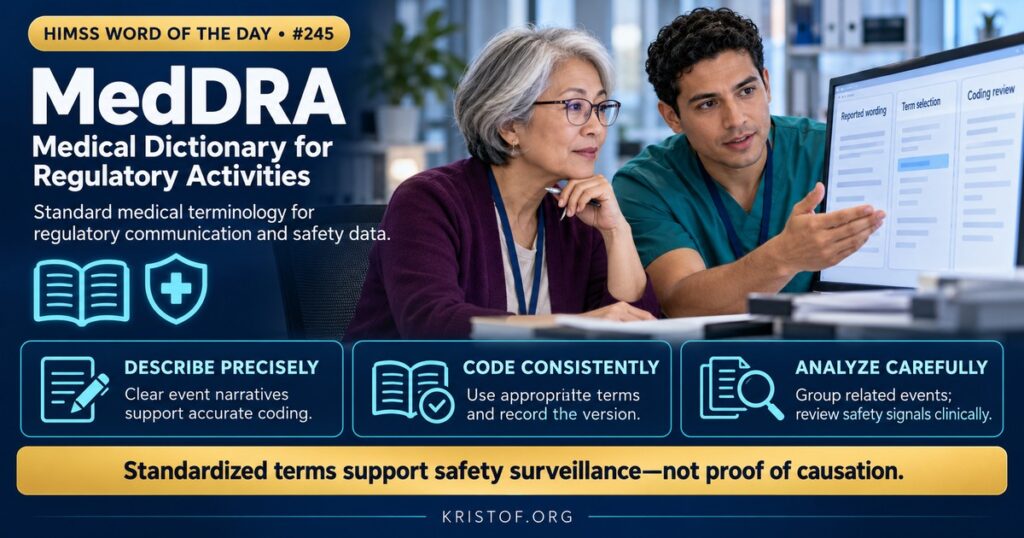
MedDRA, the Medical Dictionary for Regulatory Activities, is a standardized medical terminology used by regulatory authorities and drug manufacturers. The HIMSS Dictionary describes it as developed under the International Conference on Harmonisation and as an international terminology for regulatory communication that supports product registration, record keeping, and safety surveillance through each regulatory phase. The aim is to align requirements and paperwork across the major regulatory regions.
MedDRA is organized as a hierarchy so the same event can be analyzed at different levels of detail. The most specific level holds the terms people actually write, and the highest level groups them by body system. This structure lets safety teams search for a narrow event, such as a specific rash, or a broad group, such as all skin disorders.
| MedDRA Level | Role | Example Use |
|---|---|---|
| System Organ Class (SOC) | Broadest grouping by body system or topic | Summary tables by organ system |
| High Level Group Term (HLGT) | Groups related high level terms | Broad category review |
| High Level Term (HLT) | Groups related preferred terms | Cluster review |
| Preferred Term (PT) | Distinct medical concept for an event | Standard unit for counting events |
| Lowest Level Term (LLT) | Closest to reported wording, including synonyms | Coding the exact words used in a report |
⚠️ Exam Alert: MedDRA is for regulatory and safety data, such as adverse events, while ICD-10 is for diagnosis classification and SNOMED CT is a clinical terminology for the record. The Preferred Term is the usual unit for counting adverse events. MedDRA is used in FDA’s adverse event reporting system.
🌐 Why It Matters: Real-World Healthcare IT Context
Drug and device safety depends on pooling reports from many sources: clinicians, patients, manufacturers, clinical trials, and registries. If every reporter used different words, nobody could count or compare events. MedDRA provides the common vocabulary so that “heart attack,” “myocardial infarction,” and similar phrasing map to the same concept.
The FDA states that its Adverse Event Reporting System, known as FAERS, is built to follow the international safety reporting guidance of the ICH E2B standard and that adverse events and medication errors are coded using MedDRA terms. Reports reach FAERS from health professionals, consumers, and manufacturers, including through the MedWatch program. Researchers then analyze FAERS data in published pharmacovigilance studies, often reporting results by MedDRA system organ class and preferred term. Many of the recent drug-safety papers in the literature follow this pattern, which makes understanding the terminology valuable for anyone reading them.
A registry study shows the method in practice. In Japan, a nationwide registry across 14 outpatient clinics analyzed 179 clinically definitive cases of persistent symptoms after COVID-19 vaccination out of 279 enrollees. All adverse events were coded with the Japanese version of MedDRA using preferred terms and system organ classes, and severity followed the NCI Common Terminology Criteria for Adverse Events. The cohort experienced 493 adverse events, a median of two per patient. Three system organ classes, general disorders at 29.2 percent, nervous system disorders at 22.3 percent, and musculoskeletal disorders at 10.1 percent, accounted for 61.7 percent of events. Fatigue, brain fog, dizziness, and extremity pain were most common. The authors used the coding to describe patterns and subgroups and called for better surveillance. As a single registry with its own enrollment limits, the study shows how coding enables structured description of symptoms, not the cause of any event.
Coding choices matter. Which term a coder selects can change whether a signal appears. If a single clinical concept is split among several preferred terms, each count may look small, while grouping them can reveal a larger pattern. Coders therefore follow conventions and use groupings, such as standardized queries, to capture related terms. Different versions of MedDRA are released periodically, so analyses need to state the version used.
For health systems, MedDRA appears at the edges of care: clinical trials run at the institution, adverse event reporting to manufacturers or FDA, pharmacy and medication safety programs, and research data warehouses. Hospital EHRs usually record problems and reactions in other vocabularies, so reporting often requires mapping from clinical terms to MedDRA. Good mappings and clear narrative text in the adverse event description reduce coder guesswork.
Common MedDRA problems:
- Reports with vague descriptions that coders must interpret
- Different versions of the dictionary used across studies
- Mapping gaps between EHR vocabularies and MedDRA
- Events split across terms, hiding signals
- Counting reports as if they proved cause
- Over-reliance on automated coding without review
What supports good MedDRA use:
- Clear, specific event descriptions at the point of report
- Trained coders and documented coding conventions
- Version control and stated MedDRA release in every analysis
- Mapping tables maintained between local and regulatory terminologies
- Use of grouping queries to catch related terms
- Clinical review of signals before conclusions
🏥 The Nurse’s Perspective: Clinical, Bedside, & Workflow
Nurses often see the first sign of an adverse event, and the quality of their description shapes the data that follows.
At the Bedside
A nurse who notices a new rash, a drop in blood pressure after a first dose, or unexplained confusion can document what was seen, when it started, what the patient was taking, and what was done. Precise wording, such as the appearance of a rash and its location, helps a later coder choose the right term. Vague wording like “reaction” leaves room for guessing.
Reporting through the organization’s medication safety process and, when appropriate, to FDA’s MedWatch program supports surveillance beyond one hospital.
In Clinical Workflow
Research nurses and study coordinators record adverse events for clinical trials, assess severity, and send data to sponsors who code them in MedDRA. Pharmacy and medication safety nurses review events for patterns. Nurse leaders support reporting culture by making the process simple and nonpunitive.
Nurse informaticists help design adverse event forms with discrete fields and searchable terms, and they work with pharmacy and quality teams on mappings from local reaction lists to regulatory vocabularies.
In EHR Implementation (Go-Live Perspective)
An Epic Go-Live that includes allergy and reaction documentation raises questions about how reactions are recorded and reported. Analysts test whether reaction terms are specific and whether safety reports can pull needed details. At-the-elbow support analysts hear when nurses cannot find the right reaction term and relay those gaps so that lists and build can be improved.
🎓 CAHIMS / CPHIMS & HIMSS Perspective
CAHIMS Exam Domain Mapping
MedDRA appears in terminology, regulatory, and safety questions:
| CAHIMS Domain | How MedDRA Appears |
|---|---|
| Healthcare & Technology Environments | Regulatory standards, ICH, international harmonization |
| Clinical Informatics | Adverse event documentation, medication safety, research data |
| Healthcare Information & Systems Management | Terminology mapping, versioning, reporting interfaces |
| Management & Leadership | Pharmacovigilance programs, research governance, compliance |
Key Terms to Know Alongside MedDRA
- Preferred Term (PT) — standard MedDRA term for a distinct medical concept
- System Organ Class (SOC) — highest level grouping in MedDRA
- FAERS — FDA database of adverse event and medication error reports
- Pharmacovigilance — monitoring the safety of medicines after approval
- ICH E2B — international standard for transmitting individual case safety reports
- Adverse Event — any unfavorable occurrence linked in time to a medical product
HIMSS Organizational Position
HIMSS supports standards-based data exchange and patient safety through its research, education, and community work. Members can find related resources through the HIMSS Resource Center.
🔗 Explore Further: External References
- MedDRA — Medical Dictionary for Regulatory Activities https://www.meddra.org/
- ICH — MedDRA https://www.ich.org/page/meddra
- FDA — FDA Adverse Event Reporting System (FAERS) https://www.fda.gov/drugs/surveillance/fda-adverse-event-reporting-system-faers
- FDA — MedWatch: The FDA Safety Information and Adverse Event Reporting Program https://www.fda.gov/safety/medwatch-fda-safety-information-and-adverse-event-reporting-program
- Fujisawa et al. (2026), Scientific Reports — Characterizing Persistent Post-COVID-19 Vaccination Symptoms Using MedDRA System Organ Class and Preferred Term Classifications https://pubmed.ncbi.nlm.nih.gov/41832317/
Term source: HIMSS Dictionary of Health Information and Technology Terms, Acronyms, and Organizations, 6th Edition (2025). All definitions in this series are paraphrased for editorial purposes. Readers are encouraged to consult the primary source for exact language.
Eric Andrew Kristof, RN, CAHIMS is a Healthcare IT professional and HIMSS Arkansas Chapter member based in Hot Springs Village, AR, with hands-on Epic Go-Live experience and a diverse healthcare and IT background. He writes at kristof.org at the intersection of clinical care and healthcare technology.
Leave a Reply