By Eric Andrew Kristof, RN, CAHIMS | Healthcare IT Professional | HIMSS Arkansas Chapter Member
About This Series: The HIMSS Word of the Day is a running blog series drawing from the HIMSS Dictionary of Health Information and Technology Terms, Acronyms, and Organizations, 6th Edition (2025) — the authoritative reference for healthcare IT professionals and the primary study resource for CAHIMS and CPHIMS certification. Each post paraphrases the term in plain language, grounds it in real-world healthcare IT context, and adds a bedside nursing perspective you won’t find in a textbook.
📖 The Term: Scrum
Source: HIMSS Dictionary of Health Information and Technology Terms, Acronyms, and Organizations, 6th Edition (2025)
🔍 Plain-Language Definition
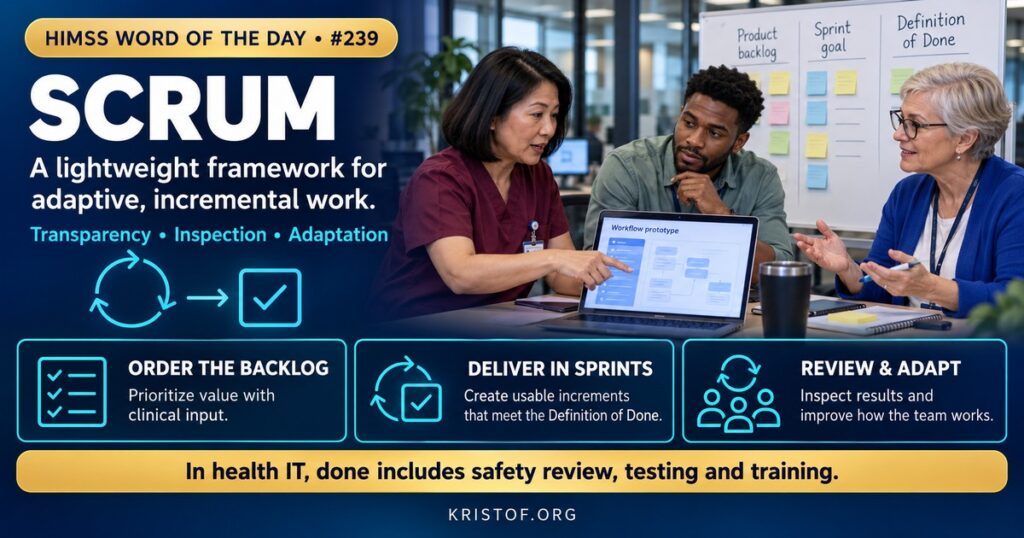
Scrum is an iterative and incremental framework for managing projects, used mainly in agile software development. The HIMSS Dictionary highlights its emphasis on working software, the ability to adapt as needs change, and strong communication and collaboration. The official Scrum Guide describes Scrum as a lightweight framework that helps people, teams, and organizations generate value through adaptive solutions for complex problems.
Scrum rests on three pillars: transparency, inspection, and adaptation. Work is done in sprints, which are fixed-length events of one month or less. A Scrum team has three accountabilities: a Product Owner, who orders the work in the product backlog; a Scrum Master, who helps the team follow the framework and remove obstacles; and Developers, who build a usable increment each sprint.
| Scrum Element | Purpose |
|---|---|
| Product Backlog | Ordered list of what the product needs |
| Sprint Backlog | Work selected for the current sprint, with a plan |
| Increment | Usable result that meets the definition of done |
| Sprint Planning | Event to choose and plan the sprint’s work |
| Daily Scrum | Short event to inspect progress and adjust the plan |
| Sprint Review | Event to inspect the increment with stakeholders |
| Sprint Retrospective | Event to improve how the team works |
⚠️ Exam Alert: Scrum is a framework, while agile is a set of values and principles. Scrum has three roles, five events (including the sprint itself), and three artifacts. A waterfall approach completes each phase before the next begins, whereas Scrum delivers small increments repeatedly. Kanban limits work in progress without fixed sprints.
🌐 Why It Matters: Real-World Healthcare IT Context
Health IT work often begins with requirements that change once users see something real. A nurse reviewing a draft flowsheet may notice a missing field, an awkward order of questions, or a screen that does not fit the patient’s pace of care. A long, fixed plan can lock in those problems until late testing. Scrum’s cycle of build, review, and adjust brings feedback earlier and more often, at the price of requiring users to participate regularly.
Published projects show how this works in health care. A perioperative EHR optimization effort at a US academic center used an agile workflow process with the Scrum framework. An interdisciplinary team of clinicians, informatics specialists, and analysts spent six weeks assessing users and optimizing scheduling, day-of-surgery, and post-operative workflows, with elbow-to-elbow retraining alongside content development. The approach averaged one week from build to implementation of a change. In all, 242 perioperative enhancements were completed, touching documentation, billing, reporting, registration, device integration, scheduling, and central supply. First-case on-time starts improved from under 70 percent to over 85 percent and total delay was halved, and the gains were sustained for more than a year. The authors also reported that only 5 percent of users agreed to a proficiency statement before optimization, which illustrates how much the work addressed usability as well as speed.
Another approach, Translating Research into Agile Development, or TRIAD, combined close collaboration among researchers, end users, and developers and used agile Scrum sprint cycles to build tools for behavioral health clinicians embedded in primary care. The team ran six two-week sprints across three domains: assessment and documentation, information retrieval, and monitoring and tracking. The result was eight new EHR features. An experience report from a Brazilian health technology group described the Scrum team, artifacts such as the product backlog, sprints, and burn-down, and ceremonies, and concluded that Scrum helped integrate roles and knowledge across a multidisciplinary team. These are reports from specific projects and not controlled comparisons, but they show the pattern: short cycles, visible work, and regular user feedback.
Scrum also has risks in clinical settings. Safety-critical changes, regulatory requirements, and enterprise EHR release cycles do not always fit a two-week sprint. A vendor’s EHR may allow rapid changes to forms and order sets but require longer testing for interfaces and device integrations. Teams have to define what done means, including clinical safety review, testing, and training, and not only technical completion. Without that, sprint velocity can encourage shipping changes faster than clinicians can absorb.
The Product Owner role is where clinical voice matters most. A product owner decides what comes first in the backlog, so that role needs authority, clinical knowledge, and time. When the product owner is a distant manager who never uses the system, priorities drift away from frontline needs. Many health systems pair a clinical product owner, often a nurse or physician informaticist, with technical leads.
Common Scrum problems in health IT:
- Clinicians not available for sprint reviews, so feedback arrives late
- Backlogs that are long wish lists without clear ordering
- No clinical safety review in the definition of done
- Sprints used to rush changes that need longer testing
- A Scrum Master who acts as a task manager and not as a coach
- Retrospectives that produce no follow-through
What supports effective Scrum:
- A clinically knowledgeable product owner with decision authority
- Regular sprint reviews with real end users
- A definition of done that includes testing, safety, and training
- Backlog refinement that responds to frontline feedback
- Transparent boards and metrics shared with stakeholders
- Retrospectives with actions that are tracked
🏥 The Nurse’s Perspective: Clinical, Bedside, & Workflow
Nurses are often the end users whose feedback decides whether a sprint’s work is useful.
At the Bedside
A nurse who joins a sprint review sees a working piece of the system and can say right away whether it fits the patient care pace. Concrete comments carry weight: which field is missing, which click adds time, which alert interrupts at the wrong moment. Since the next sprint can address the comment, bedside nurses see their feedback produce changes in days or weeks, not years.
Frontline staff also need clear communication about what changed and when, because frequent small releases can confuse users who do not hear about them.
In Clinical Workflow
Nurse leaders and super users often help set the order of the backlog by describing which problems cost the most time or pose the greatest safety risk. They help write user stories in plain language, such as what a charge nurse needs to see at shift change, and they test increments before release.
Nurse informaticists commonly serve as product owners or key advisors. They balance requests, translate between clinical and technical language, and make sure each increment has been checked against policy and safety requirements.
In EHR Implementation (Go-Live Perspective)
After an Epic Go-Live, optimization teams collect pain points from at-the-elbow support logs, help desk tickets, and unit rounding. A sprint-based approach can turn that stream into a backlog of fixes for documentation, order sets, and reports, with a short cycle to build and release them. Early wins in the first weeks after go-live build trust and keep staff engaged while the learning curve flattens.
🎓 CAHIMS / CPHIMS & HIMSS Perspective
CAHIMS Exam Domain Mapping
Scrum appears in project management and system development questions:
| CAHIMS Domain | How Scrum Appears |
|---|---|
| Healthcare & Technology Environments | Software development approaches, agile versus waterfall |
| Clinical Informatics | User feedback, workflow optimization, clinical product ownership |
| Healthcare Information & Systems Management | System development life cycle, release management, testing |
| Management & Leadership | Project methods, team roles, stakeholder engagement, continuous improvement |
Key Terms to Know Alongside Scrum
- Agile — set of values and principles for iterative, collaborative development
- Sprint — fixed-length period in which a usable increment is created
- Product Backlog — ordered list of everything the product might need
- User Story — short description of a need from the user’s perspective
- Definition of Done — shared standard for when work is complete
- Kanban — flow-based method that limits work in progress
HIMSS Organizational Position
HIMSS supports project and change management skills through its education, professional development, and community work. Members can find related resources through the HIMSS Resource Center.
🔗 Explore Further: External References
- Schwaber and Sutherland — The Scrum Guide (2020) https://scrumguides.org/scrum-guide.html
- Agile Manifesto — Manifesto for Agile Software Development https://agilemanifesto.org/
- Franceschi et al. (2020), Annals of Surgery — A Novel Interdisciplinary Iterative Approach for Optimizing the Electronic Health Record to Improve Perioperative Efficiency https://pubmed.ncbi.nlm.nih.gov/32932324/
- Clark et al. (2019), Methods of Information in Medicine — Translating Research into Agile Development (TRIAD): Development of Electronic Health Record Tools for Primary Care Settings https://pubmed.ncbi.nlm.nih.gov/31277082/
- Torrente et al. (2021), Studies in Health Technology and Informatics — Scrum Framework and Health Solutions: Management and Results https://pubmed.ncbi.nlm.nih.gov/34920528/
Term source: HIMSS Dictionary of Health Information and Technology Terms, Acronyms, and Organizations, 6th Edition (2025). All definitions in this series are paraphrased for editorial purposes. Readers are encouraged to consult the primary source for exact language.
Eric Andrew Kristof, RN, CAHIMS is a Healthcare IT professional and HIMSS Arkansas Chapter member based in Hot Springs Village, AR, with hands-on Epic Go-Live experience and a diverse healthcare and IT background. He writes at kristof.org at the intersection of clinical care and healthcare technology.
Leave a Reply