By Eric Andrew Kristof, RN, CAHIMS | Healthcare IT Professional | HIMSS Arkansas Chapter Member
About This Series: The HIMSS Word of the Day is a running blog series drawing from the HIMSS Dictionary of Health Information and Technology Terms, Acronyms, and Organizations, 6th Edition (2025) — the authoritative reference for healthcare IT professionals and the primary study resource for CAHIMS and CPHIMS certification. Each post paraphrases the term in plain language, grounds it in real-world healthcare IT context, and adds a bedside nursing perspective you won’t find in a textbook.
📖 The Term: Evidence-Based Medicine (Evidence-Based Practice)
Source: HIMSS Dictionary of Health Information and Technology Terms, Acronyms, and Organizations, 6th Edition (2025)
🔍 Plain-Language Definition
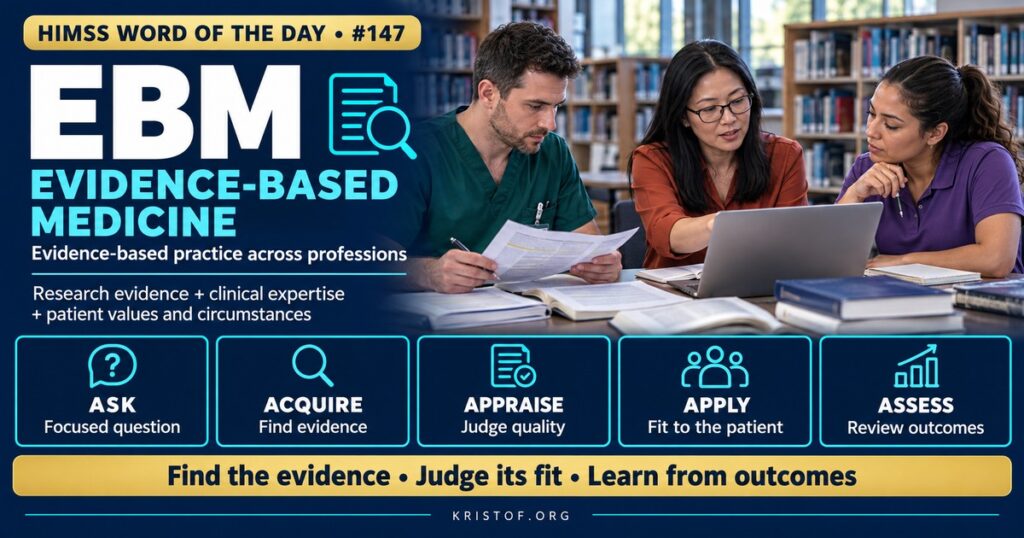
Evidence-based medicine (EBM) is an approach to clinical decision-making that integrates the best available research evidence with clinical expertise and the values, preferences, and circumstances of the individual patient. The broader term evidence-based practice (EBP) applies the same approach across nursing and other health professions.
The HIMSS Dictionary offers two related descriptions. It describes EBM as the careful, explicit, and thoughtful use of current best evidence in decisions about an individual’s care, blending what clinicians have learned through experience and what patients value with the strongest available research. It also outlines four steps: turning a patient’s problem into a focused clinical question, searching the literature for relevant articles, critically appraising the evidence for validity and usefulness, and putting useful findings into practice.
| EBM Step | What Happens | Example |
|---|---|---|
| Ask | Form a focused, answerable question, often using PICO | In older inpatients, does hourly rounding reduce falls compared with usual care? |
| Acquire | Search for the best available evidence | Searching PubMed, CINAHL, or Cochrane reviews |
| Appraise | Evaluate validity, results, and applicability | Assessing study design, bias, and relevance |
| Apply | Integrate evidence with expertise and patient values | Adapting a fall prevention program to a unit |
| Assess | Evaluate outcomes after implementation | Tracking fall rates after the change |
⚠️ Exam Alert: Evidence-based practice integrates research evidence, clinical expertise, and patient preferences. Research generates new knowledge; EBP applies existing evidence; quality improvement improves local processes using data. PICO stands for Population, Intervention, Comparison, Outcome. Systematic reviews and meta-analyses are typically near the top of evidence hierarchies.
🌐 Why It Matters: Real-World Healthcare IT Context
The modern EBM movement gained prominence in the 1990s. A widely cited 1996 BMJ editorial by David Sackett and colleagues described EBM as integrating individual clinical expertise with the best available external evidence, and emphasized that it is not “cookbook” medicine. That balance remains central: evidence informs decisions, but it does not override judgment or patient preferences.
Evidence varies in strength. Hierarchies typically place systematic reviews and well-designed randomized trials above observational studies, case reports, and expert opinion, although the best design depends on the question. Frameworks such as GRADE assess certainty of evidence by considering risk of bias, consistency, directness, precision, and other factors.
Evidence must be found and appraised efficiently. Clinicians rarely have time to search primary literature during care, so they rely on synthesized sources: systematic reviews from organizations like Cochrane, clinical practice guidelines, evidence summaries, and point-of-care references. Libraries and librarians help organizations access and evaluate these resources.
Health IT can bring evidence to the point of care. Infobuttons link patient-specific context in the EHR to relevant reference information. Order sets and decision support embed guideline recommendations into workflow. Analytics help organizations measure whether evidence-based practices are being followed and whether outcomes improve.
EHR data also generates evidence. Real-world data from EHRs, registries, and claims supports observational research, quality improvement, and learning health systems, where data from care is continuously analyzed to improve practice. That depends on high-quality, structured documentation.
Implementation is often the hardest part. Research suggests that adopting new evidence into routine practice can take many years. Implementation science studies strategies to speed adoption, such as audit and feedback, clinical champions, and workflow redesign.
De-implementation matters too. Evidence sometimes shows that a common practice offers little benefit or causes harm, and removing such low-value practices can be as important as adopting new ones. Campaigns that encourage clinicians and patients to question unnecessary tests and treatments reflect this side of evidence-based care.
Nursing has a strong EBP tradition. Nursing organizations promote EBP models, and recognition programs such as Magnet emphasize evidence-based practice and nursing research. Organizations such as JBI produce evidence syntheses and implementation resources used widely in nursing.
Common barriers to evidence-based practice:
- Limited time to search and appraise evidence
- Lack of access to databases or librarian support
- Organizational cultures that favor tradition
- Evidence that does not fit local populations or resources
- Decision support that is outdated or poorly designed
- Insufficient data to measure outcomes after changes
What supports evidence-based practice:
- Access to synthesized evidence at the point of care
- EBP mentors, councils, and education
- Leadership support and protected time for projects
- Integration of evidence into order sets and care plans
- Data and analytics to evaluate outcomes
- Respect for patient preferences in shared decisions
🏥 The Nurse’s Perspective: Clinical, Bedside, & Workflow
Evidence-based practice is a core competency in nursing, from bedside decisions to unit-level changes.
At the Bedside
Many daily nursing practices, such as pressure injury prevention, central line care, pain assessment, and patient positioning, are grounded in evidence. Understanding the reasons behind practices helps nurses apply them consistently and recognize when a patient’s situation calls for a different approach.
Patient preferences matter. A recommendation that fits the evidence may not fit a patient’s goals or circumstances, and nurses often help bring those preferences into care decisions.
In Clinical Workflow
Frontline nurses frequently identify practice questions, such as whether a routine task is still necessary or whether a new approach could reduce harm. EBP councils and mentors help turn these questions into PICO format, search the literature, and evaluate evidence.
Nursing practice changes based on evidence often require updates to policies, documentation, and EHR tools. Informatics teams help build flowsheets and reminders that support the new practice and collect data to measure outcomes.
Reference tools within the EHR, such as links to procedures or drug information, help nurses access evidence quickly during care.
Nurses pursuing graduate education or certifications learn appraisal skills that strengthen their ability to lead EBP projects and evaluate new technologies.
Sharing results of EBP projects, through unit meetings, posters, or publications, spreads successful practices to other units and organizations.
In EHR Implementation (Go-Live Perspective)
During an Epic Go-Live, organizations review clinical content, such as care plans, protocols, and order sets, against current evidence. This is an opportunity to retire outdated practices embedded in legacy systems.
At-the-elbow support analysts can help nurses locate evidence-based references, care plans, and protocol tools in the new system. Feedback about practices that seem outdated can be routed to practice councils for review.
🎓 CAHIMS / CPHIMS & HIMSS Perspective
CAHIMS Exam Domain Mapping
Evidence-based medicine appears in clinical informatics and decision support questions:
| CAHIMS Domain | How Evidence-Based Medicine Appears |
|---|---|
| Healthcare & Technology Environments | Evidence sources; guideline developers; learning health systems |
| Clinical Informatics | Point-of-care evidence, decision support, nursing EBP, patient preferences |
| Healthcare Information & Systems Management | Infobuttons, content integration, data for outcomes measurement |
| Management & Leadership | EBP culture, councils, implementation strategies, Magnet |
Key Terms to Know Alongside Evidence-Based Medicine
- PICO — a format for clinical questions: Population, Intervention, Comparison, Outcome
- Systematic Review — a structured synthesis of studies on a specific question
- Critical Appraisal — evaluating research for validity, results, and relevance
- Clinical Practice Guideline — systematically developed recommendations for care
- Infobutton — a context-aware link from the EHR to relevant reference information
- Learning Health System — a system that continuously generates and applies evidence from care
HIMSS Organizational Position
HIMSS supports evidence-based care through clinical informatics education, decision support resources, and advocacy for data infrastructure that enables learning health systems. Members can find related education and research through the HIMSS Resource Center.
🔗 Explore Further: External References
- Sackett et al. (1996), BMJ — Evidence Based Medicine: What It Is and What It Isn’t https://pubmed.ncbi.nlm.nih.gov/8555924/
- Cochrane Library — About Cochrane Reviews https://www.cochranelibrary.com/about/about-cochrane-reviews
- GRADE Working Group https://www.gradeworkinggroup.org/
- JBI https://jbi.global/
- U.S. Preventive Services Task Force https://www.uspreventiveservicestaskforce.org/uspstf/
- HIMSS — Nursing Informatics Community https://www.himss.org/networking/communities/nursing-informatics/
Term source: HIMSS Dictionary of Health Information and Technology Terms, Acronyms, and Organizations, 6th Edition (2025). All definitions in this series are paraphrased for editorial purposes. Readers are encouraged to consult the primary source for exact language.
Eric Andrew Kristof, RN, CAHIMS is a Healthcare IT professional and HIMSS Arkansas Chapter member based in Hot Springs Village, AR, with hands-on Epic Go-Live experience and a diverse healthcare and IT background. He writes at kristof.org at the intersection of clinical care and healthcare technology.
Leave a Reply