By Eric Andrew Kristof, RN, CAHIMS | Healthcare IT Professional | HIMSS Arkansas Chapter Member
About This Series: The HIMSS Word of the Day is a running blog series drawing from the HIMSS Dictionary of Health Information and Technology Terms, Acronyms, and Organizations, 6th Edition (2025) — the authoritative reference for healthcare IT professionals and the primary study resource for CAHIMS and CPHIMS certification. Each post paraphrases the term in plain language, grounds it in real-world healthcare IT context, and adds a bedside nursing perspective you won’t find in a textbook.
📖 The Term: Average Length of Stay (ALOS)
Source: HIMSS Dictionary of Health Information and Technology Terms, Acronyms, and Organizations, 6th Edition (2025)
🔍 Plain-Language Definition
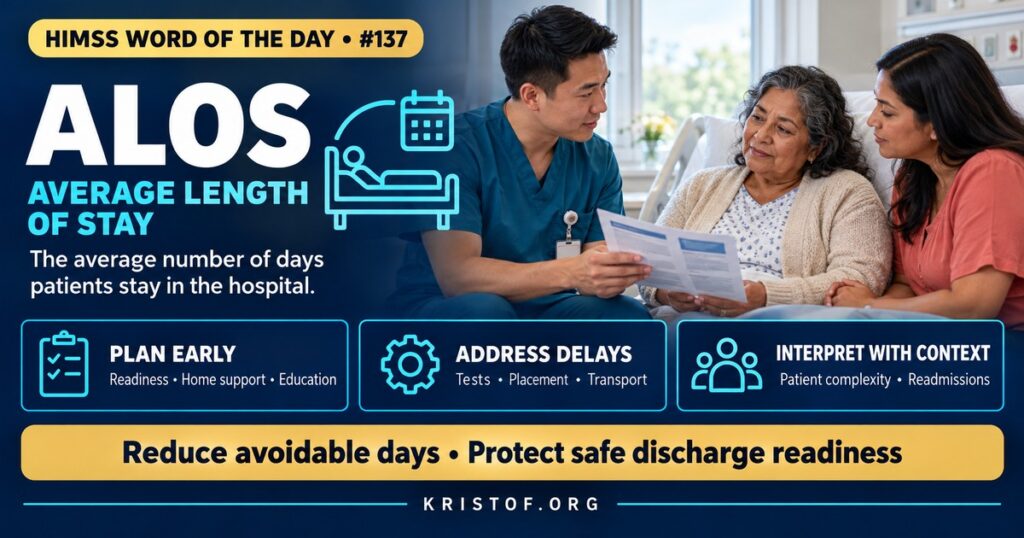
Average length of stay (ALOS) is the average number of days that inpatients remain in a hospital during a defined period. It is one of the most commonly used measures of hospital efficiency, resource use, and capacity.
The HIMSS Dictionary describes ALOS as the average number of days patients spend in the hospital. It explains that ALOS is usually calculated by dividing all inpatient days during a year by the number of admissions or discharges, and that same-day cases, such as day surgeries, are left out.
| ALOS Concept | What It Means | Example |
|---|---|---|
| Inpatient Days | Total days patients stayed during the period | 12,000 patient days in a year |
| Discharges | Number of patients discharged in the period | 3,000 discharges |
| ALOS | Inpatient days divided by discharges | 12,000 ÷ 3,000 = 4.0 days |
| Expected LOS | Predicted stay based on diagnosis and patient factors | A risk-adjusted benchmark for similar patients |
| LOS Index (O/E) | Observed ALOS divided by expected ALOS | An index above 1.0 means longer stays than expected |
| GMLOS | Geometric mean length of stay for a DRG | A CMS benchmark less affected by outlier stays |
⚠️ Exam Alert: ALOS is a utilization and efficiency measure, not a direct measure of quality. Expected or risk-adjusted LOS accounts for patient complexity. The geometric mean reduces the effect of very long outlier stays. Observation stays and same-day cases are typically excluded from inpatient ALOS.
🌐 Why It Matters: Real-World Healthcare IT Context
Length of stay connects clinical care with hospital finances and capacity. Under Medicare’s inpatient prospective payment system, hospitals are generally paid a fixed amount per stay based on the Medicare Severity Diagnosis-Related Group (MS-DRG). When a patient stays longer than necessary, costs rise while payment often does not, so hospitals monitor length of stay closely.
Capacity matters as much as cost. Every avoidable day occupies a bed that another patient may need, contributing to emergency department boarding, delayed transfers, and canceled procedures. Reducing unnecessary days improves access for the whole community.
Raw ALOS can mislead. A hospital that treats sicker patients or performs complex surgeries will naturally have longer stays. Comparing observed length of stay with expected length of stay, adjusted for diagnosis, severity, age, and other factors, gives a fairer picture. CMS publishes a geometric mean length of stay for each MS-DRG, which hospitals often use as a benchmark.
ALOS is not a quality measure on its own. Shorter stays are good only when patients are ready to leave safely. Pushing discharges too early can increase readmissions and complications. Organizations typically review length of stay alongside readmission rates, mortality, patient experience, and discharge disposition.
Many avoidable days come from nonclinical delays. Patients may wait for test results, consults, skilled nursing facility placement, insurance authorization, transportation, or home equipment. Data that identifies the reason for each delay helps organizations target fixes, such as weekend services, earlier discharge planning, or partnerships with post-acute providers.
Health IT supports length of stay management. EHRs can display expected discharge dates, discharge readiness checklists, barriers to discharge, and real-time capacity dashboards. Predictive models may estimate which patients are at risk for extended stays, allowing earlier case management involvement. Agencies such as AHRQ, through its Healthcare Cost and Utilization Project, provide national data that organizations and researchers use to compare utilization patterns.
Discharge timing within the day also affects flow. Even when length of stay is appropriate, discharges that cluster in the late afternoon leave morning admissions waiting in the emergency department or recovery areas. Many hospitals track the share of discharges completed before a target time and work on earlier physician rounding, prescription readiness, and transportation to free beds sooner.
Data definitions matter. Whether a stay counts from the admission order, the arrival time, or midnight census, and how transfers and observation time are handled, all affect results. Consistent definitions are essential for trustworthy trending and benchmarking.
Common length of stay drivers:
- Delayed tests, results, or consults
- Late discharge planning
- Waiting for post-acute placement or authorization
- Weekend and holiday service gaps
- Complications such as infections or falls
- Social barriers such as housing or caregiver availability
What helps manage length of stay safely:
- Expected discharge dates set early and updated daily
- Multidisciplinary rounds focused on barriers
- Real-time tracking of avoidable days and their causes
- Early case management and social work involvement
- Prevention of hospital-acquired complications
- Monitoring readmissions alongside length of stay
🏥 The Nurse’s Perspective: Clinical, Bedside, & Workflow
Nurses influence length of stay through safe, timely care and early preparation for discharge.
At the Bedside
Preventing complications is one of the most effective ways to avoid extra days. Fall prevention, pressure injury prevention, early mobility, infection prevention, and careful medication management all reduce events that prolong stays.
Discharge preparation starts at admission. Nurses who assess home support, functional status, and learning needs early help identify barriers before the day of discharge, when there is little time to solve them.
In Clinical Workflow
Multidisciplinary rounds bring nurses, physicians, case managers, therapists, and pharmacists together to review each patient’s plan and expected discharge date. Nurses contribute up-to-date information on patient condition, readiness, and family concerns.
Documenting barriers to discharge in structured fields, such as awaiting placement or pending test, gives leaders data to address systemic delays. When barriers live only in conversation, they are difficult to measure or fix.
Patient education throughout the stay, not just at discharge, improves readiness and reduces last-minute delays. Teach-back for medications and warning signs supports both safe discharge and fewer readmissions.
Nurse leaders often review length of stay data by unit, comparing observed and expected values and investigating outliers to find opportunities.
Throughput also depends on timely bed status updates. Marking rooms ready and patients departed promptly in the EHR helps bed management and environmental services keep beds moving.
In EHR Implementation (Go-Live Perspective)
During an Epic Go-Live, organizations configure expected discharge dates, discharge milestones, capacity management boards, and reporting. Converted patients may need expected discharge information reentered so dashboards are accurate from the start.
At-the-elbow support analysts help nurses and case managers find discharge planning tools and capacity views. Early feedback on confusing milestones or missing data helps teams improve tools that directly affect patient flow.
🎓 CAHIMS / CPHIMS & HIMSS Perspective
CAHIMS Exam Domain Mapping
ALOS appears in analytics, operations, and payment questions:
| CAHIMS Domain | How ALOS Appears |
|---|---|
| Healthcare & Technology Environments | DRG-based payment; national utilization data; hospital benchmarks |
| Clinical Informatics | Discharge planning tools, documentation of barriers, multidisciplinary rounds |
| Healthcare Information & Systems Management | Data definitions, dashboards, predictive models, risk adjustment |
| Management & Leadership | Capacity management, cost control, performance improvement |
Key Terms to Know Alongside ALOS
- MS-DRG — the Medicare Severity Diagnosis-Related Group used to classify and pay inpatient stays
- Geometric Mean Length of Stay (GMLOS) — a benchmark less influenced by outliers
- Observed-to-Expected (O/E) Ratio — a comparison of actual and risk-adjusted predicted results
- Avoidable Day — a hospital day that is not medically necessary
- Case Mix Index (CMI) — the average relative weight of a hospital’s DRGs, reflecting patient complexity
- Capacity Management — coordinating beds, staff, and flow to meet demand
HIMSS Organizational Position
HIMSS supports analytics and data-driven operations through its education, research, and resources on using data to improve care, efficiency, and patient flow. Members can find related education and research through the HIMSS Resource Center.
🔗 Explore Further: External References
- CMS — Acute Inpatient Prospective Payment System https://www.cms.gov/medicare/payment/prospective-payment-systems/acute-inpatient-pps
- AHRQ — Healthcare Cost and Utilization Project (HCUP) https://hcup-us.ahrq.gov/
- Institute for Healthcare Improvement https://www.ihi.org/
- CMS — Value-Based Programs https://www.cms.gov/medicare/quality/value-based-programs
- ONC — SAFER Guides https://healthit.gov/clinical-quality-and-safety/safer-guides/
- HIMSS — Nursing Informatics Community https://www.himss.org/networking/communities/nursing-informatics/
Term source: HIMSS Dictionary of Health Information and Technology Terms, Acronyms, and Organizations, 6th Edition (2025). All definitions in this series are paraphrased for editorial purposes. Readers are encouraged to consult the primary source for exact language.
Eric Andrew Kristof, RN, CAHIMS is a Healthcare IT professional and HIMSS Arkansas Chapter member based in Hot Springs Village, AR, with hands-on Epic Go-Live experience and a diverse healthcare and IT background. He writes at kristof.org at the intersection of clinical care and healthcare technology.
Leave a Reply