By Eric Andrew Kristof, RN, CAHIMS | Healthcare IT Professional | HIMSS Arkansas Chapter Member
About This Series: The HIMSS Word of the Day is a running blog series drawing from the HIMSS Dictionary of Health Information and Technology Terms, Acronyms, and Organizations, 6th Edition (2025) — the authoritative reference for healthcare IT professionals and the primary study resource for CAHIMS and CPHIMS certification. Each post paraphrases the term in plain language, grounds it in real-world healthcare IT context, and adds a bedside nursing perspective you won’t find in a textbook.
📖 The Term: HEDIS (Healthcare Effectiveness Data and Information Set)
Source: HIMSS Dictionary of Health Information and Technology Terms, Acronyms, and Organizations, 6th Edition (2025)
🔍 Plain-Language Definition
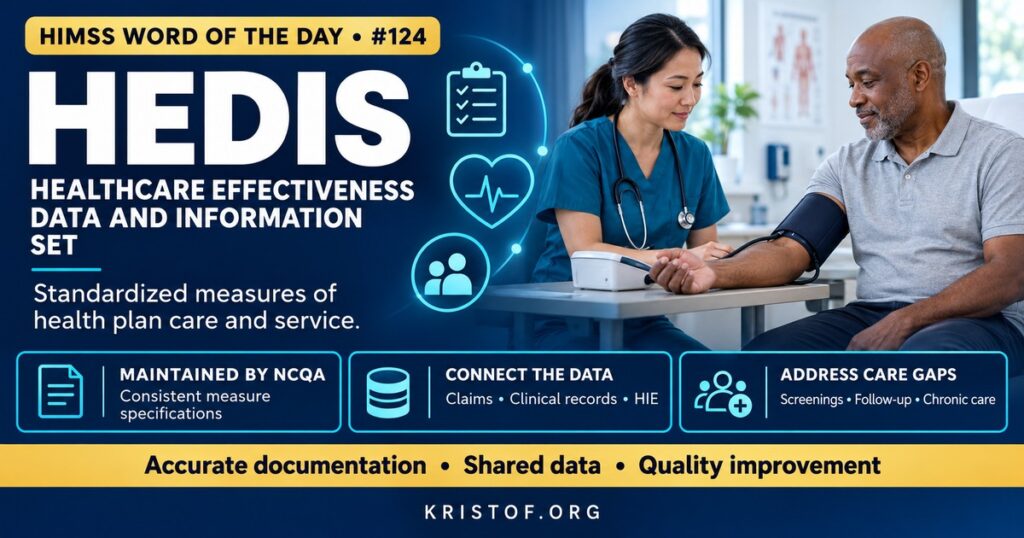
HEDIS (Healthcare Effectiveness Data and Information Set) is a standardized set of performance measures maintained by the National Committee for Quality Assurance (NCQA) to evaluate the quality of care and service that health plans provide to their members.
The HIMSS Dictionary describes HEDIS as a measurement tool that the large majority of U.S. health plans use to assess key aspects of care and service. It notes that medical practices have also been able to use HEDIS since 2008, that its precise specifications allow fair comparisons across plans, and that NCQA updates the measure set every year through its Committee on Performance Measurement.
NCQA describes HEDIS as including more than 90 measures across six domains. Examples of what HEDIS measures include:
| Measure Area | What It Looks At | Example |
|---|---|---|
| Prevention and Screening | Whether members receive recommended screenings | Breast, cervical, and colorectal cancer screening |
| Chronic Condition Management | Control and monitoring of chronic diseases | Blood pressure control; diabetes care |
| Behavioral Health | Follow-up and treatment for mental health and substance use | Follow-up after hospitalization for mental illness |
| Medication Management | Appropriate and safe medication use | Medication adherence or avoiding potentially harmful drugs in older adults |
| Access and Utilization | Use of services and access to care | Well-child visits and preventive visits |
⚠️ Exam Alert: HEDIS measures health plan performance and is maintained by NCQA. eCQMs are electronic clinical quality measures used largely in CMS provider and hospital programs. CAHPS surveys measure patient experience. Star Ratings for Medicare plans draw on several data sources, including some HEDIS measures.
🌐 Why It Matters: Real-World Healthcare IT Context
HEDIS shapes how health plans are judged and paid. Results are used in NCQA health plan accreditation and ratings, in Medicare Advantage Star Ratings, in state Medicaid managed care oversight, and in employer purchasing decisions. Because results influence bonuses, contracts, and reputation, plans invest heavily in improving them.
Plans calculate HEDIS results from several data sources. Administrative data, mainly claims, is the foundation. For some measures, plans review medical records to find care that claims did not capture, such as a blood pressure reading or a screening performed years earlier. Plans also use supplemental data from providers, registries, and health information exchanges.
That reliance on clinical data connects HEDIS directly to provider documentation. If a patient’s colonoscopy was completed elsewhere and never recorded in a structured way, the plan may show a care gap even though the patient is up to date. Structured documentation, data feeds, and health information exchange reduce unnecessary chart chasing and give a more accurate picture.
Measurement is going digital. NCQA has been moving HEDIS toward digital measures that can be calculated from standardized electronic data, including Electronic Clinical Data Systems (ECDS) reporting that uses EHR, registry, and HIE data. This shift aligns with broader digital quality measurement efforts that rely on FHIR and reduce manual abstraction.
Accuracy and fairness matter. HEDIS results are audited through NCQA’s compliance audit process, and specifications are revised as evidence and guidelines change. NCQA also has added ways to stratify results by race and ethnicity for some measures, helping identify disparities.
Exclusions matter as much as numerators. Many measures exclude patients for documented reasons, such as a history of total colectomy for colorectal cancer screening or hospice enrollment for several measures. When those exclusions are not recorded in a way the plan can see, patients are counted as gaps, scores fall, and outreach is wasted on people who do not need the service.
Providers feel the effects through care gap reports. Plans share lists of members who are missing screenings or other recommended care, and practices in value-based contracts are often rewarded for closing those gaps.
Timing adds complexity. HEDIS measures use defined measurement years and look-back periods, so a screening completed a few days too early or late may not count, and organizations plan outreach throughout the year rather than rushing at the end.
Common HEDIS data challenges:
- Care documented only in free text or scanned documents
- Screenings performed outside the network and never recorded
- Delayed or incomplete claims data
- Mismatched patient identity between plans and providers
- Manual medical record review that is costly and slow
- Care gap lists that do not match what practices see in their EHR
What improves HEDIS performance and accuracy:
- Structured documentation of screenings, results, and exclusions
- Supplemental data feeds from EHRs to health plans
- Health information exchange participation
- Point-of-care care gap alerts and outreach lists
- Standing orders for routine screenings where appropriate
- Collaboration between plans and practices on data quality
🏥 The Nurse’s Perspective: Clinical, Bedside, & Workflow
Nurses play a direct role in the care that HEDIS measures, from screenings to follow-up after hospitalization.
At the Bedside
Many HEDIS measures reflect basic nursing work: obtaining accurate blood pressure readings, completing screenings, administering immunizations, and educating patients about preventive care. Accurate technique and documentation affect both patient care and measured quality.
Medication reconciliation and follow-up planning at discharge support measures related to transitions, such as follow-up after hospitalization for mental illness or medication management after discharge.
In Clinical Workflow
In ambulatory settings, nurses frequently review care gap alerts during visit preparation, identifying overdue screenings or tests and placing orders under standing protocols when appropriate. Pre-visit planning that catches gaps before the patient arrives helps close them during the visit.
Documenting outside results in structured fields, such as the date and result of a colonoscopy performed elsewhere, ensures that patients are not counted as noncompliant and do not receive unnecessary outreach.
Care management and quality nurses often coordinate outreach to members with open gaps, work with plan representatives on data discrepancies, and help practices understand which documentation counts for each measure.
Patients sometimes receive calls from both their plan and their practice about the same gap. Nurses who coordinate with plan care managers can reduce duplicate outreach and confusion.
In EHR Implementation (Go-Live Perspective)
During an Epic Go-Live, quality teams validate that health maintenance topics, care gap alerts, and quality reports reflect current measure specifications. Historical screening data may need to be converted carefully so patients do not suddenly appear overdue.
At-the-elbow support analysts can show nurses where to record outside results and how to address health maintenance alerts. Feedback about inaccurate alerts helps teams correct logic quickly and maintain clinician trust.
🎓 CAHIMS / CPHIMS & HIMSS Perspective
CAHIMS Exam Domain Mapping
HEDIS appears in quality measurement and value-based care questions:
| CAHIMS Domain | How HEDIS Appears |
|---|---|
| Healthcare & Technology Environments | NCQA; health plan accreditation; Medicare Star Ratings; quality programs |
| Clinical Informatics | Care gap alerts, health maintenance, structured documentation |
| Healthcare Information & Systems Management | Claims and clinical data integration, supplemental data, digital measures |
| Management & Leadership | Value-based contracts, quality improvement strategy, payer collaboration |
Key Terms to Know Alongside HEDIS
- NCQA — the National Committee for Quality Assurance, which maintains HEDIS and accredits health plans
- Care Gap — recommended care that a patient has not received
- Supplemental Data — clinical data used alongside claims to calculate measures
- ECDS — Electronic Clinical Data Systems reporting, which uses electronic clinical data for HEDIS
- Star Ratings — the CMS rating system for Medicare Advantage and Part D plans
- eCQM — electronic clinical quality measures used in CMS provider and hospital programs
HIMSS Organizational Position
HIMSS supports quality measurement that relies on interoperable, standardized data, reducing manual abstraction and improving accuracy through its education and policy work. Members can find related education and research through the HIMSS Resource Center.
🔗 Explore Further: External References
- NCQA — HEDIS https://www.ncqa.org/hedis/
- NCQA — HEDIS Measures and Technical Resources https://www.ncqa.org/hedis/measures/
- NCQA — Health Plan Report Cards https://www.ncqa.org/report-cards/health-plans/
- CMS — Part C and D Performance Data (Star Ratings) https://www.cms.gov/medicare/health-drug-plans/part-c-d-performance-data
- eCQI Resource Center — Digital Quality Measures https://ecqi.healthit.gov/dqm
- HIMSS — Public Policy & Advocacy https://www.himss.org/public-policy-advocacy-overview
Term source: HIMSS Dictionary of Health Information and Technology Terms, Acronyms, and Organizations, 6th Edition (2025). All definitions in this series are paraphrased for editorial purposes. Readers are encouraged to consult the primary source for exact language.
Eric Andrew Kristof, RN, CAHIMS is a Healthcare IT professional and HIMSS Arkansas Chapter member based in Hot Springs Village, AR, with hands-on Epic Go-Live experience and a diverse healthcare and IT background. He writes at kristof.org at the intersection of clinical care and healthcare technology.
Leave a Reply