By Eric Andrew Kristof, RN, CAHIMS | Healthcare IT Professional | HIMSS Arkansas Chapter Member
About This Series: The HIMSS Word of the Day is a running blog series drawing from the HIMSS Dictionary of Health Information and Technology Terms, Acronyms, and Organizations, 6th Edition (2025) — the authoritative reference for healthcare IT professionals and the primary study resource for CAHIMS and CPHIMS certification. Each post paraphrases the term in plain language, grounds it in real-world healthcare IT context, and adds a bedside nursing perspective you won’t find in a textbook.
📖 The Term: Utilization Management (UM)
Source: HIMSS Dictionary of Health Information and Technology Terms, Acronyms, and Organizations, 6th Edition (2025)
🔍 Plain-Language Definition
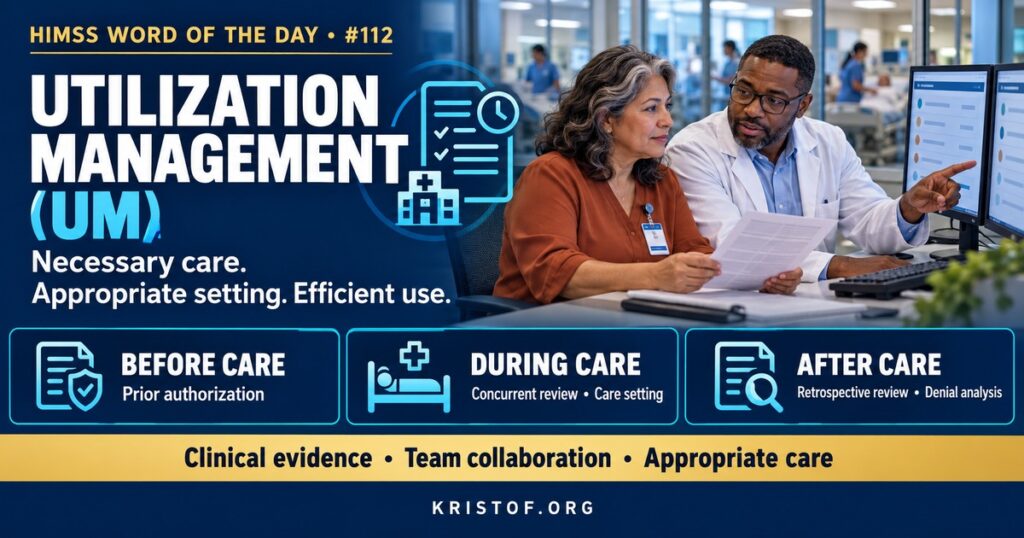
Utilization management (UM) is the process of evaluating whether healthcare services are medically necessary, delivered in the appropriate setting, and used efficiently. Both payers and providers perform UM, often using standardized clinical criteria.
The HIMSS Dictionary defines UM as assessing whether healthcare services, procedures, and facilities are needed, appropriate, and used efficiently.
| Type of Review | When It Happens | Example |
|---|---|---|
| Prospective (Prior Authorization) | Before a service is delivered | Approval required before an MRI or elective surgery |
| Concurrent Review | During an episode of care | Daily review of an inpatient stay against criteria |
| Retrospective Review | After care is delivered | Review of a claim and records after discharge |
| Status Determination | At or near admission | Deciding between inpatient and observation status |
| Discharge Planning Review | Throughout the stay | Assessing readiness and the appropriate next level of care |
⚠️ Exam Alert: Utilization management evaluates necessity and appropriateness. Utilization review is a closely related term, often used for the hospital’s own review process required by Medicare. Case management coordinates care and transitions for individual patients and often includes UM duties. Prior authorization is one form of UM. Medical necessity criteria are commonly applied from standardized commercial or payer criteria sets.
🌐 Why It Matters: Real-World Healthcare IT Context
UM aims to promote appropriate care and control costs, but it also creates significant administrative burden and can delay care. Clinicians and hospitals spend substantial time obtaining prior authorizations, responding to payer reviews, and appealing denials.
Hospitals have their own requirements. Medicare’s Conditions of Participation require hospitals to have a utilization review plan that reviews services for medical necessity, including admissions and extended stays, and hospitals use UM committees and staff to meet that requirement. Medicare’s Two-Midnight rule shapes inpatient versus outpatient status decisions, which affect both payment and patient costs.
Federal policy is pushing UM toward electronic processes. CMS’s Interoperability and Prior Authorization Final Rule (CMS-0057-F) requires impacted payers, such as Medicare Advantage organizations, Medicaid and CHIP programs, and qualified health plans on federal exchanges, to implement FHIR-based APIs supporting prior authorization and to meet decision timeframes, generally 72 hours for expedited requests and 7 calendar days for standard requests, with requirements phasing in from 2026. HL7’s Da Vinci Project has developed implementation guides that support these workflows, such as determining whether authorization is required, gathering documentation, and submitting requests electronically.
Avoidable days are another UM focus. When a patient no longer needs hospital-level care but remains hospitalized while waiting for a skilled nursing bed, a test, or a consult, the extra days add cost and risk without benefit. UM and case management teams track these delays, identify their causes, and work with departments and community partners to reduce them. Data from the EHR, such as orders, results timing, and discharge milestones, makes those patterns visible.
Health IT supports UM in many ways: payer portals and APIs, criteria tools integrated with the EHR, work queues for review staff, documentation templates, and analytics on denials and length of stay. When these tools pull clinical data directly from the EHR, reviewers spend less time copying information and more time evaluating it.
Denial management closes the loop. Analyzing why claims are denied, whether for missing authorization, insufficient documentation, or status disputes, helps organizations fix upstream processes rather than fighting the same denials repeatedly.
Observation status deserves its own mention. Whether a patient is admitted as an inpatient or kept in observation affects payment, patient cost sharing, and eligibility for some post-acute benefits, so UM teams review status decisions carefully and help ensure patients receive required notices.
Common UM challenges:
- Manual prior authorization through phone, fax, and portals
- Clinical documentation that does not clearly support medical necessity
- Delays in care while waiting for approval
- Denials and appeals that consume staff time
- Inconsistent criteria across payers
- Status decisions that confuse patients and affect their costs
What improves UM:
- Electronic prior authorization integrated with ordering workflows
- Clear documentation of clinical rationale in provider notes
- Concurrent review processes that start early in the stay
- Analytics on denials, delays, and avoidable days
- Collaboration between UM, case management, and clinical teams
- Patient communication about status and coverage decisions
🏥 The Nurse’s Perspective: Clinical, Bedside, & Workflow
Utilization management is one of the most common nonbedside roles for registered nurses, and bedside documentation feeds UM decisions every day.
At the Bedside
Nursing assessments often provide the clinical evidence that supports continued hospitalization: oxygen requirements, IV medication needs, vital sign instability, mobility limitations, or safety concerns. When those findings are documented clearly and on time, UM reviewers can show why the patient needs the current level of care.
Nurses also hear patients’ questions about status and coverage. A patient who learns they are in observation rather than inpatient status may worry about costs. Nurses can connect patients with case management or UM staff who can explain what the status means.
Clear physician documentation of the reasons for admission and continued stay is often the deciding factor in payer reviews. UM nurses frequently help providers understand what payers need to see, without changing the clinical facts.
In Clinical Workflow
UM nurses review records against criteria, communicate with payers, coordinate with physicians when documentation needs clarification, and work with case managers on discharge planning. Their clinical judgment helps translate complex patient situations into the information payers require.
Prior authorization in ambulatory settings often falls to nurses and medical assistants. Electronic prior authorization tools that show requirements at the time of ordering, and that pull needed documentation automatically, can save significant time.
In EHR Implementation (Go-Live Perspective)
During an Epic Go-Live, UM and case management workflows, including review work queues, criteria integration, payer communication, and discharge planning tools, are configured and tested. Early monitoring of denials, avoidable days, and status changes helps catch workflow gaps.
At-the-elbow support analysts may help UM nurses find clinical information quickly in the new system and route problems with payer interfaces or criteria tools to the right teams.
🎓 CAHIMS / CPHIMS & HIMSS Perspective
CAHIMS Exam Domain Mapping
UM appears in payment, policy, and workflow questions:
| CAHIMS Domain | How UM Appears |
|---|---|
| Healthcare & Technology Environments | Payer rules, CMS Conditions of Participation, prior authorization regulations |
| Clinical Informatics | Documentation of medical necessity; status decisions; case management |
| Healthcare Information & Systems Management | Electronic prior authorization, FHIR APIs, criteria tools, work queues |
| Management & Leadership | Denial management, length of stay, staffing for UM, payer relations |
Key Terms to Know Alongside Utilization Management
- Prior Authorization — payer approval required before a service is delivered
- Concurrent Review — evaluation of ongoing care while it is being delivered
- Medical Necessity — services that are reasonable and necessary for diagnosis or treatment
- Observation Status — outpatient status used to evaluate whether inpatient admission is needed
- Case Management — coordination of care, resources, and transitions for individual patients
- Denial — a payer’s refusal to pay for a service, which may be appealed
HIMSS Organizational Position
HIMSS supports reducing administrative burden through standards-based automation of processes such as prior authorization and engages on related federal rules through its public policy work. Members can find related education and research through the HIMSS Resource Center.
🔗 Explore Further: External References
- eCFR — 42 CFR 482.30, Condition of Participation: Utilization Review https://www.ecfr.gov/current/title-42/chapter-IV/subchapter-G/part-482/subpart-C/section-482.30
- CMS — Interoperability and Prior Authorization Final Rule (CMS-0057-F) https://www.cms.gov/initiatives/burden-reduction/overview/interoperability/policies-regulations/cms-interoperability-prior-authorization-final-rule-cms-0057-f
- HL7 International — Da Vinci Project https://www.hl7.org/about/davinci/
- CMS — Interoperability (Burden Reduction) https://www.cms.gov/initiatives/burden-reduction/overview/interoperability
- CMS — Acute Inpatient PPS https://www.cms.gov/medicare/payment/prospective-payment-systems/acute-inpatient-pps
- HIMSS — Public Policy and Advocacy https://www.himss.org/public-policy-advocacy-overview
Term source: HIMSS Dictionary of Health Information and Technology Terms, Acronyms, and Organizations, 6th Edition (2025). All definitions in this series are paraphrased for editorial purposes. Readers are encouraged to consult the primary source for exact language.
Eric Andrew Kristof, RN, CAHIMS is a Healthcare IT professional and HIMSS Arkansas Chapter member based in Hot Springs Village, AR, with hands-on Epic Go-Live experience and a diverse healthcare and IT background. He writes at kristof.org at the intersection of clinical care and healthcare technology.
Leave a Reply