By Eric Andrew Kristof, RN, CAHIMS | Healthcare IT Professional | HIMSS Arkansas Chapter Member
About This Series: The HIMSS Word of the Day is a running blog series drawing from the HIMSS Dictionary of Health Information and Technology Terms, Acronyms, and Organizations, 6th Edition (2025) — the authoritative reference for healthcare IT professionals and the primary study resource for CAHIMS and CPHIMS certification. Each post paraphrases the term in plain language, grounds it in real-world healthcare IT context, and adds a bedside nursing perspective you won’t find in a textbook.
📖 The Term: Foundation Model AI
Source: HIMSS Dictionary of Health Information and Technology Terms, Acronyms, and Organizations, 6th Edition (2025)
🔍 Plain-Language Definition
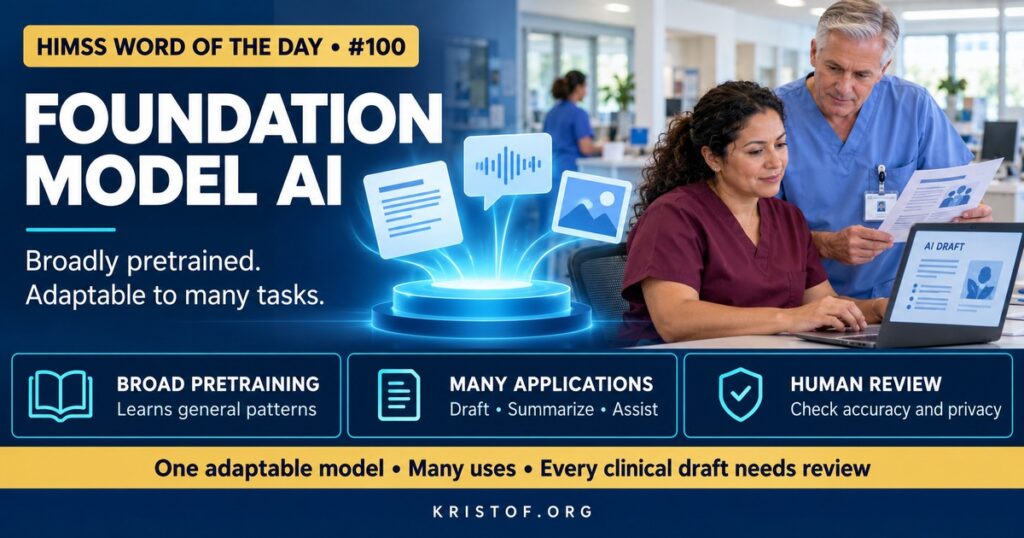
A foundation model is a large artificial intelligence model trained on very broad data so that it can be adapted to many different tasks, rather than being built for just one. Large language models behind chat assistants and documentation tools are the best-known examples, but foundation models also exist for images, audio, molecules, and combinations of data types.
The HIMSS Dictionary describes a foundation model as a deep learning algorithm pretrained on extremely large data sets gathered from the public internet. It contrasts these models with narrow AI systems trained for a single task, noting that foundation models learn from many kinds of data and can carry what they learn on one task over to another. According to the Dictionary, such a model needs only one round of training before being adapted for different kinds of work; it can cost millions of dollars to build because of its enormous number of learned values and training data; and once built, it can be modified repeatedly to automate many separate tasks. (Technically, those learned values are usually called parameters rather than hyperparameters.)
The term was popularized by a 2021 report from Stanford’s Center for Research on Foundation Models.
| Concept | What It Means | Healthcare Example |
|---|---|---|
| Pretraining | Learning general patterns from massive, broad data | Learning language from large text collections |
| Fine-Tuning | Additional training for a specific task or domain | Adapting a model to clinical note summarization |
| Prompting | Giving instructions or examples at the time of use | Asking a model to draft a patient education handout |
| Retrieval Augmentation | Supplying trusted documents for the model to draw on | Answering policy questions from the organization’s own policy library |
| Multimodal Models | Models that handle text, images, and other data together | Describing findings on an image alongside a clinical question |
⚠️ Exam Alert: Narrow AI is built for one task. A foundation model is general-purpose and adaptable. Large language models are foundation models trained mainly on text. Generative AI refers to models that create new content, such as text or images. Fine-tuning adapts a pretrained model; prompting guides it without retraining.
🌐 Why It Matters: Real-World Healthcare IT Context
Foundation models changed how quickly AI can be applied. Instead of collecting labeled data and training a new model for each problem, organizations can adapt one capable model to many tasks. In healthcare, that has accelerated tools for ambient documentation, chart summarization, patient message drafting, coding support, prior authorization letters, and literature search.
A 2023 perspective in Nature by Michael Moor and colleagues described the idea of generalist medical AI: foundation models that could interpret many kinds of medical data and perform a wide range of tasks with little task-specific training. The authors also emphasized challenges in validation, verification, and privacy.
The risks are significant. Foundation models can produce fluent, confident text that is wrong, a problem known as hallucination. They may reflect biases in their training data, give inconsistent answers to the same question, or expose sensitive information if prompts include protected health information and the tool lacks appropriate safeguards. Because they are general-purpose, they can be used in ways their developers never tested.
Governance frameworks are responding. NIST published a Generative AI Profile as a companion to its AI Risk Management Framework, describing risks such as confabulation, data privacy, and information integrity. ONC’s HTI-1 rule introduced transparency requirements for predictive decision support interventions in certified health IT. Many health systems have formed AI governance committees to review tools before use.
Common risks with foundation models in healthcare:
- Hallucinated facts, citations, or clinical details
- Bias inherited from training data
- Protected health information entered into tools without safeguards
- Overreliance on drafts that are not carefully reviewed
- Unclear intended use and accountability
- Performance changes when vendors update models
Practices for responsible use:
- Clear policies on approved tools and permitted data
- Business associate agreements and security reviews for vendors
- Human review of all clinical content before it is used or signed
- Evaluation on local data and use cases before deployment
- Monitoring of errors, user feedback, and model updates
- Transparency with clinicians and patients about where AI is used
🏥 The Nurse’s Perspective: Clinical, Bedside, & Workflow
Foundation models are already entering nursing workflows, often through documentation and communication tools.
At the Bedside
Ambient documentation tools may listen to a nursing assessment or patient conversation, with appropriate consent, and draft documentation. AI tools may summarize a long hospitalization into a handoff or draft a patient education handout at a specific reading level. These capabilities can save time, but every draft must be checked against what actually happened before it becomes part of the record.
Patients may also use general AI chat tools to ask health questions and bring the answers to their nurses. Nurses can help patients interpret that information, correct errors, and understand when an answer does not apply to them.
In Clinical Workflow
Patient message management is a common early use. AI may draft replies to portal messages for nurses and providers to edit. Reviewing drafts carefully for accuracy, tone, and completeness, and never sending a reply that does not fit the patient, keeps communication safe.
Privacy rules still apply. Entering patient information into public, consumer AI tools that the organization has not approved can be an impermissible disclosure. Approved tools are typically integrated into the EHR or provided under contract with appropriate protections.
In EHR Implementation (Go-Live Perspective)
Generative AI features are often introduced after an Epic Go-Live, in phases, with pilot groups and clear labeling of AI-generated content. Teams decide which roles can use which features, how outputs are reviewed, and how errors are reported.
At-the-elbow support analysts and super users help clinicians understand where AI drafts appear and how to edit or reject them. Reinforcing that the clinician remains responsible for what they sign is one of the most important messages during rollout.
🎓 CAHIMS / CPHIMS & HIMSS Perspective
CAHIMS Exam Domain Mapping
Foundation models appear in AI, governance, and policy questions:
| CAHIMS Domain | How Foundation Models Appear |
|---|---|
| Healthcare & Technology Environments | Generative AI trends; federal AI guidance; transparency requirements |
| Clinical Informatics | Ambient documentation, summarization, message drafting, clinician review |
| Healthcare Information & Systems Management | Fine-tuning, retrieval augmentation, integration, security, model updates |
| Management & Leadership | AI governance, vendor contracts, privacy, accountability, workforce training |
Key Terms to Know Alongside Foundation Model AI
- Large Language Model (LLM) — a foundation model trained mainly on text that can understand and generate language
- Generative AI — AI that produces new content such as text, images, or audio
- Fine-Tuning — additional training that adapts a pretrained model to a specific task or domain
- Hallucination — model output that is fluent but false or unsupported
- Retrieval-Augmented Generation (RAG) — supplying trusted documents to a model so its answers draw on them
- Narrow AI — AI designed to perform a single, specific task
HIMSS Organizational Position
HIMSS addresses generative AI and foundation models through its AI-focused education, research, and policy engagement, emphasizing responsible adoption, governance, and workforce readiness. Members can find related education and research through the HIMSS Resource Center.
🔗 Explore Further: External References
- Stanford CRFM — On the Opportunities and Risks of Foundation Models https://crfm.stanford.edu/report.html
- Moor et al. (2023), Nature — Foundation Models for Generalist Medical Artificial Intelligence https://pubmed.ncbi.nlm.nih.gov/37045921/
- NIST — AI Risk Management Framework: Generative Artificial Intelligence Profile https://www.nist.gov/publications/artificial-intelligence-risk-management-framework-generative-artificial-intelligence
- NIST — AI Risk Management Framework https://www.nist.gov/itl/ai-risk-management-framework
- ONC — HTI-1 Final Rule https://healthit.gov/regulations/hti-rules/hti-1-final-rule/
- FDA — Artificial Intelligence-Enabled Medical Devices https://www.fda.gov/medical-devices/digital-health-center-excellence/artificial-intelligence-enabled-medical-devices
Term source: HIMSS Dictionary of Health Information and Technology Terms, Acronyms, and Organizations, 6th Edition (2025). All definitions in this series are paraphrased for editorial purposes. Readers are encouraged to consult the primary source for exact language.
Eric Andrew Kristof, RN, CAHIMS is a Healthcare IT professional and HIMSS Arkansas Chapter member based in Hot Springs Village, AR, with hands-on Epic Go-Live experience and a diverse healthcare and IT background. He writes at kristof.org at the intersection of clinical care and healthcare technology.
Leave a Reply