By Eric Andrew Kristof, RN, CAHIMS | Healthcare IT Professional | HIMSS Arkansas Chapter Member
About This Series: The HIMSS Word of the Day is a running blog series drawing from the HIMSS Dictionary of Health Information and Technology Terms, Acronyms, and Organizations, 6th Edition (2025) — the authoritative reference for healthcare IT professionals and the primary study resource for CAHIMS and CPHIMS certification. Each post paraphrases the term in plain language, grounds it in real-world healthcare IT context, and adds a bedside nursing perspective you won’t find in a textbook.
📖 The Term: OAuth (Open Authorization)
Source: HIMSS Dictionary of Health Information and Technology Terms, Acronyms, and Organizations, 6th Edition (2025)
🔍 Plain-Language Definition
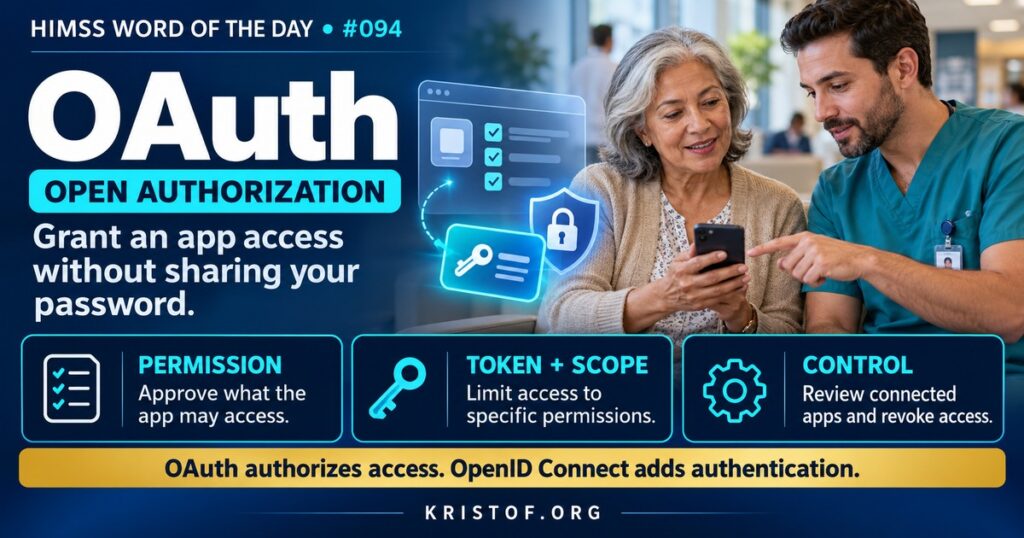
OAuth is an open standard that allows one application to access a user’s information on another service with the user’s permission, without the user handing over their password. Instead, the service issues the application an access token with limited rights and a limited lifetime.
The HIMSS Dictionary describes OAuth as an open internet standard that uses tokens for authentication and authorization, letting third-party services use an end user’s account information without exposing the user’s password.
A helpful analogy is a hotel key card. The front desk confirms who the guest is, then issues a card that opens only certain doors for a certain time. The card is not the guest’s identity; it is a limited permission that can be canceled.
| OAuth Role | What It Is | Healthcare Example |
|---|---|---|
| Resource Owner | The person who owns the data or grants permission | A patient, or a clinician launching an app |
| Client | The application requesting access | A health app on the patient’s phone |
| Authorization Server | The service that authenticates the user and issues tokens | The health system’s EHR login and consent screen |
| Resource Server | The service holding the data | The EHR’s FHIR API |
| Access Token | A credential granting limited access | A token allowing the app to read medications and lab results |
| Scope | The specific permissions requested | Read-only access to certain data types |
⚠️ Exam Alert: Despite the Dictionary’s wording, OAuth 2.0 is primarily an authorization framework: it decides what an app may access. OpenID Connect, built on OAuth 2.0, adds authentication, confirming who the user is. SMART on FHIR uses OAuth 2.0 and OpenID Connect to authorize and launch health apps. An access token is not a password and can be limited and revoked.
🌐 Why It Matters: Real-World Healthcare IT Context
APIs have opened health data to apps used by patients, clinicians, and researchers. Without a safe way to grant access, users would have to share passwords with every app, giving those apps unlimited access and making accounts far easier to compromise. OAuth solves that problem by separating sign-in from data access.
The current version, OAuth 2.0, is defined by the Internet Engineering Task Force in RFC 6749, with many related specifications for token formats, security practices, and specific flows. Healthcare relies on it heavily. The SMART App Launch framework, which certified EHRs must support for their standardized patient and population APIs, uses OAuth 2.0 to let patients authorize apps and to let clinician-facing apps launch inside the EHR in the context of the current patient.
In practice, a patient selects their health system in an app, signs in on the health system’s own login page, reviews a consent screen listing what the app is requesting, and approves. The EHR then gives the app a token for exactly those permissions. The patient can later revoke access.
Bulk data access uses a related approach for systems rather than people. When a payer or analytics platform needs data on a population of patients, FHIR Bulk Data relies on backend services authorization, in which the client application proves its identity with cryptographic credentials and receives a token scoped to the data it is allowed to export. The principle is the same: limited, auditable access without sharing passwords.
OAuth also brings responsibilities. Organizations must protect their authorization servers, monitor which apps are connected, and educate patients that once data reaches a third-party app, that app’s privacy practices apply. App developers must protect tokens, request only the scopes they need, and follow current security guidance.
Common OAuth-related concerns:
- Apps requesting broader scopes than they need
- Long-lived tokens that are not revoked when no longer used
- Patients approving access without understanding what data is shared
- Weak protection of tokens stored on devices
- Phishing pages that imitate login screens
- Limited visibility into which apps hold active tokens
Practices that strengthen OAuth use:
- Least-privilege scopes and short-lived access tokens
- Clear, plain-language consent screens
- Patient tools for viewing and revoking app access
- Monitoring of app activity and unusual data pulls
- App review processes for clinician-facing integrations
- Following current security guidance for OAuth implementations
🏥 The Nurse’s Perspective: Clinical, Bedside, & Workflow
Nurses encounter OAuth indirectly when patients connect apps and when clinical apps launch inside the EHR.
At the Bedside
Patients may ask how a health app on their phone got their records, or whether connecting an app is safe. Nurses can explain that patients sign in through the health system, choose what to share, and can revoke access later, and that information shared with an app may be governed by the app’s own privacy policy rather than HIPAA. Detailed questions can be directed to the organization’s portal or privacy support.
Patients sometimes bring information from those apps to appointments. Nurses verify it like any outside information, especially medication lists and allergies.
In Clinical Workflow
Clinician-facing apps launched from the EHR, such as risk calculators, specialty dashboards, or decision support tools, often use SMART on FHIR and OAuth behind the scenes. The app opens already knowing the patient and the user, without a separate login, because the EHR has authorized it for that session.
When such an app fails to open or shows an authorization error, the cause is usually configuration or token issues, not a user mistake, and the issue should be routed to the integration or application team.
In EHR Implementation (Go-Live Perspective)
During an Epic Go-Live, connected apps may need to be re-registered and re-authorized with the new system. Patient-facing apps often require patients to reconnect, and clinician-facing apps need updated configuration for each user role.
At-the-elbow support analysts can help clinicians recognize authorization errors and capture the details integration teams need. Patient-facing staff benefit from simple scripts explaining that patients may need to reconnect their apps after the transition.
🎓 CAHIMS / CPHIMS & HIMSS Perspective
CAHIMS Exam Domain Mapping
OAuth appears in interoperability and security questions:
| CAHIMS Domain | How OAuth Appears |
|---|---|
| Healthcare & Technology Environments | Federal API requirements; patient access to data through apps |
| Clinical Informatics | Apps launched in clinical workflow; patient education about app access |
| Healthcare Information & Systems Management | Access tokens, scopes, SMART on FHIR, OpenID Connect, authorization servers |
| Management & Leadership | App governance, privacy communication, third-party risk |
Key Terms to Know Alongside OAuth
- Access Token — a credential that grants an application limited access to protected resources
- Scope — a defined permission specifying what data or actions an application may access
- Authorization Server — the service that authenticates users and issues tokens
- OpenID Connect — an identity layer built on OAuth 2.0 that provides authentication
- SMART App Launch — the HL7 framework for authorizing and launching apps that use FHIR data
- Refresh Token — a credential used to obtain new access tokens without the user signing in again
HIMSS Organizational Position
HIMSS supports secure, standards-based access to health data through APIs and engages on related interoperability and privacy policy through its public policy work. Members can find related education and research through the HIMSS Resource Center.
🔗 Explore Further: External References
- IETF — RFC 6749, The OAuth 2.0 Authorization Framework https://datatracker.ietf.org/doc/html/rfc6749
- OAuth.net — OAuth 2.0 https://oauth.net/2/
- HL7 — SMART App Launch https://hl7.org/fhir/smart-app-launch/
- OpenID Foundation — How OpenID Connect Works https://openid.net/developers/how-connect-works/
- Mandel et al. (2016), JAMIA — SMART on FHIR: A Standards-Based, Interoperable Apps Platform https://pubmed.ncbi.nlm.nih.gov/26911829/
- ONC — API Resource Guide https://healthit.gov/resources/api-resource-guide/
Term source: HIMSS Dictionary of Health Information and Technology Terms, Acronyms, and Organizations, 6th Edition (2025). All definitions in this series are paraphrased for editorial purposes. Readers are encouraged to consult the primary source for exact language.
Eric Andrew Kristof, RN, CAHIMS is a Healthcare IT professional and HIMSS Arkansas Chapter member based in Hot Springs Village, AR, with hands-on Epic Go-Live experience and a diverse healthcare and IT background. He writes at kristof.org at the intersection of clinical care and healthcare technology.
Leave a Reply