By Eric Andrew Kristof, RN, CAHIMS | Healthcare IT Professional | HIMSS Arkansas Chapter Member
About This Series: The HIMSS Word of The Day is a running blog series drawing from the HIMSS Dictionary of Health Information and Technology Terms, Acronyms, and Organizations, 6th Edition (2025) — the authoritative reference for healthcare IT professionals and the primary study resource for CAHIMS and CPHIMS certification. Each post paraphrases the term in plain language, grounds it in real-world healthcare IT context, and adds a bedside nursing perspective you won’t find in a textbook.
📖 The Term: APG (Ambulatory Patient Group)
Source: HIMSS Dictionary of Health Information and Technology Terms, Acronyms, and Organizations, 6th Edition (2025)
🔍 Plain-Language Definition
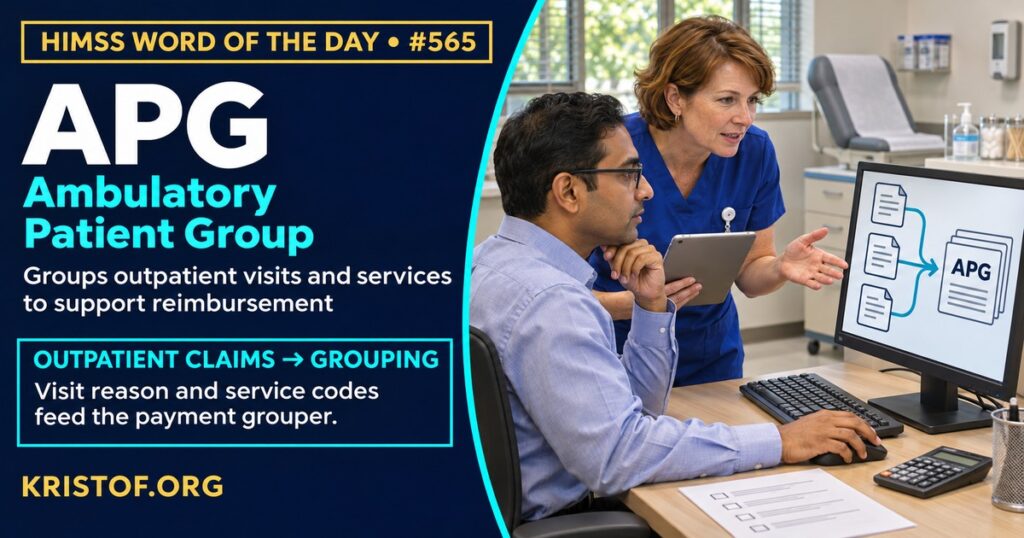
The HIMSS Dictionary describes an Ambulatory Patient Group (APG) as a reimbursement method that 3M Health Information Systems developed for the federal agency then called the Health Care Financing Administration. The entry compares APGs with DRGs: APGs are to outpatient procedures and visits what DRGs are to inpatient days. An APG provides a fixed payment to an institution, builds in why the patient came and information about the patient when it groups a visit, and is meant to discourage unbundling of ancillary services. The entry points readers to ACG and ADG for related classification systems.
In practical terms, an APG system takes the codes on an outpatient claim, assigns the visit and its services to groups, and pays according to those groups. The sources reviewed below describe APGs both as a patient classification system and as the basis for a payment system.
| Related term | How it relates to APG |
|---|---|
| DRG (Diagnosis Related Group) | The inpatient counterpart that groups stays for payment |
| APC (Ambulatory Payment Classification) | The classification used in Medicare’s hospital outpatient payment system |
| Case mix | The mix of patient types a provider treats, which grouping systems adjust for |
| Unbundling | Billing separately for services that belong together |
| Grouper | Software logic that assigns a claim to a payment group |
The table is a teaching sketch and not an official taxonomy.
⚠️ Exam Alert: An APG is not an APC. Medicare’s outpatient prospective payment system uses Ambulatory Payment Classifications, while APGs came out of a separate design that some other payers and state programs have used. An APG is also not a code set, since it groups services that are already identified by codes such as CPT and HCPCS, and it is not a DRG, which applies to inpatient stays.
🌐 Why It Matters: Real-World Healthcare IT Context
Peer-reviewed research on APGs is modest in volume and mostly about payment policy. The PubMed searches run for this post found a design review, a state implementation article, and a few evaluations from other countries, so the sources below also include New York State documents, which are primary sources on one long-running use. Each article was checked against its published abstract, and the study type is noted.
The design and the APC contrast. Goldfield and colleagues, in the Journal of Ambulatory Care Management (2008), review APG Version 3.0. The abstract describes APGs as a patient classification system designed as the basis for an outpatient prospective payment system, and says six major non-Medicare payers implemented an APG-based system between 1995 and 2000. They argue that the APC-based Medicare system is not really a prospective payment system and has become a variant of fee-for-service, which the article presents as a reason some payers renewed interest in APGs. That is the authors’ assessment in a review article, not an independent evaluation.
A state rate-setting use. Atkinson and Murray, in the same journal (2008), describe how the Maryland Health Services Cost Review Commission planned to regulate hospital ambulatory surgery revenue using APGs beginning in the state’s fiscal year 2008. The stated aims were to create better incentives to control utilization and to compare case-mix-adjusted charges per ambulatory surgery case across hospitals. This article describes a planned implementation and does not report results.
An APG plus capitation reform. Zhang and colleagues, in Risk Management and Healthcare Policy (2023), studied an outpatient payment reform in Jinhua, China, that combined APGs with capitation. They used a controlled interrupted time series with 19 intervention hospitals and 39 control hospitals. Outpatient visits in municipal hospitals fell by about 1,418 per month compared with controls, while visits in county hospitals rose by about 1,058 per month. Drug and consumable spending dropped in both hospital types. The setting is a different health system, so the findings may not transfer to the United States.
Using the groups for claims review. Shin and colleagues, in the Journal of Biomedical Informatics (2021), developed a scoring model that uses patient classification systems, including APGs, to help select institutions for review of possible abusive billing. The abstract describes the method, and it is a data science study built on claims, not a payment policy evaluation.
A long-running U.S. use. The New York State Department of Health’s Medicaid rates page says state statute authorized it to implement APGs as a new outpatient payment system for Article 28 facilities, and the page lists hospital outpatient departments, other than emergency services, as paid with APGs for dates of service on and after December 1, 2008. A 2013 audit from the New York State Comptroller examined whether the Medicaid claims processing and payment system overpaid APG claims. These are government documents, so they describe the program, and the audit’s purpose shows why claim edits matter in a grouper-based system.
Common APG problems:
- Mixing up APGs and APCs, which have different designs and payers
- Treating the group as a code set, when grouping depends on codes already on the claim
- Weak claim edits, which the state audit above examined for APG claims
- Incomplete or inaccurate coding of the visit reason and procedures, which would change grouping
- Assuming a study from one country or payer applies to every setting
- Reading APG “fixed payment” language as the same as capitation
What supports APG-based payment:
- Grouping that uses the reason for the visit and the services provided, as the Dictionary describes
- Case-mix adjustment that allows comparison across hospitals, as the Maryland article describes
- A visit-level payment unit that is intended to discourage unbundling
- Claims data detailed enough for the grouper to work with
- State documentation and training materials, such as New York’s program pages
🏥 The Nurse’s Perspective: Clinical, Bedside, & Workflow
For nurses, APGs matter indirectly through documentation, charge capture, and clinic workflow.
At the Bedside
In outpatient clinics, infusion centers, and ambulatory surgery units, nurses document the reason for the visit, procedures, and the services delivered. When a payer uses APG grouping, the codes on the claim drive the group, so the clinical record needs to support them. Nurses do not assign payment groups, and coding staff typically assign the codes, but accurate notes feed that work.
In Clinical Workflow
Revenue cycle teams use grouper software and claim edits, and clinical staff may be asked to clarify documentation when services appear to be missing or duplicated. A nurse informaticist can help by mapping which nursing-documented services become billable items and by checking that order and charge workflows reflect how the clinic actually provides care. Questions about which payers use APGs belong to billing and compliance staff.
In EHR Implementation (Go-Live Perspective)
During an Epic Go-Live, analysts at the elbow see how one missing field can hold up a claim. For outpatient payment systems, useful test cases include visits with several procedures on the same day, services performed by different staff, and cancelled or modified orders, because grouping depends on how those appear in the charge data. The Comptroller audit’s focus on claim processing is a reminder that edits and duplicates need testing on the payer side as well.
🎓 CAHIMS / CPHIMS & HIMSS Perspective
CAHIMS Exam Domain Mapping
APGs connect classification systems, payment policy, and revenue cycle data:
| CAHIMS Domain | How APG Appears |
|---|---|
| Healthcare & Technology Environments | Payment systems and the role of classification in reimbursement |
| Clinical Informatics | Classification of visits, case mix, and how documentation supports coding |
| Healthcare Information & Systems Management | Grouper software, claim edits, and charge data quality |
| Management & Leadership | Payer contracts, rate setting, and financial impact analysis |
Key Terms to Know Alongside APG
- APC (Ambulatory Payment Class) — Medicare outpatient payment group
- DRG (Diagnosis Related Group) — inpatient classification used to set payment
- ACG (Ambulatory Care Group) — classification that groups patients by expected resource use
- ADG (Ambulatory Diagnostic Group) — diagnosis groups used within ambulatory case-mix systems
- Case mix — mix of patient types and conditions that a provider treats
- Managed care — health plan arrangement that manages cost, use, and quality
HIMSS Organizational Position
HIMSS offers education and research on health information and technology topics through its Resource Center. Members can find related information on the HIMSS Resource Center page.
🧭 More HIMSS Word of The Day Terms
Related terms in the Healthcare Policy series:
- Covered Entity (HIPAA)
- Prescription Drug Monitoring Program (PDMP)
- Veterans Integrated Service Network (VISN)
- MDS (Minimum Data Set)
Browse all Healthcare Policy terms or the A–Z glossary.
🔗 Explore Further: External References
- Goldfield et al. (2008), The Journal of ambulatory care management — Ambulatory Patient Groups, Version 3.0–a classification system for payment of ambulatory visits https://pubmed.ncbi.nlm.nih.gov/18162790/
- Atkinson and Murray (2008), The Journal of ambulatory care management — The use of ambulatory patient groups for regulation of hospital ambulatory surgery revenue in Maryland https://pubmed.ncbi.nlm.nih.gov/18162791/
- Zhang et al. (2023), Risk management and healthcare policy — Impacts of Outpatient Payment Reforms on Volume and Expenditures in Public Hospitals: Evidence from a Quasi-Experimental Analysis in Zhejiang, China https://pubmed.ncbi.nlm.nih.gov/36960123/
- Shin et al. (2021), Journal of biomedical informatics — A scoring model to detect abusive medical institutions based on patient classification system: Diagnosis-related group and ambulatory patient group https://pubmed.ncbi.nlm.nih.gov/33781920/
- New York State Department of Health — Ambulatory Patient Groups (APGs) https://www.health.ny.gov/health_care/medicaid/rates/apg/index.htm
- New York State Office of the State Comptroller (2013) — Medicaid Program: Overpayments of Ambulatory Patient Group Claims https://www.osc.ny.gov/state-agencies/audits/2013/08/20/medicaid-program-overpayments-ambulatory-patient-group-claims
- HIMSS — Resource Center https://www.himss.org/resource-center
Term source: HIMSS Dictionary of Health Information and Technology Terms, Acronyms, and Organizations, 6th Edition (2025). All definitions in this series are paraphrased for editorial purposes. Readers are encouraged to consult the primary source for exact language.
Eric Andrew Kristof, RN, CAHIMS is a Healthcare IT professional and HIMSS Arkansas Chapter member based in Hot Springs Village, AR, with hands-on Epic Go-Live experience and a diverse healthcare and IT background. He writes at kristof.org at the intersection of clinical care and healthcare technology.
Leave a Reply