By Eric Andrew Kristof, RN, CAHIMS | Healthcare IT Professional | HIMSS Arkansas Chapter Member
About This Series: The HIMSS Word of the Day is a running blog series drawing from the HIMSS Dictionary of Health Information and Technology Terms, Acronyms, and Organizations, 6th Edition (2025) — the authoritative reference for healthcare IT professionals and the primary study resource for CAHIMS and CPHIMS certification. Each post paraphrases the term in plain language, grounds it in real-world healthcare IT context, and adds a bedside nursing perspective you won’t find in a textbook.
📖 The Term: Emergency Access
Source: HIMSS Dictionary of Health Information and Technology Terms, Acronyms, and Organizations, 6th Edition (2025)
🔍 Plain-Language Definition
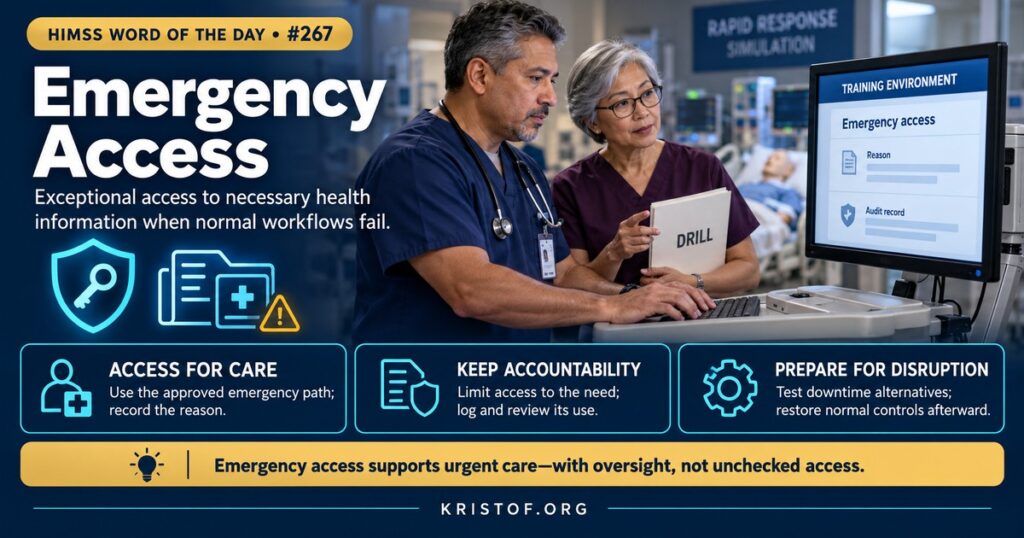
Emergency access is the granting of user rights and authorizations that allow someone to reach protected health information and applications under emergency conditions, outside normal workflows. The HIMSS Dictionary adds that emergency room access counts as a normal workflow, so the term refers to exceptional circumstances and not to routine work in an emergency department.
In practice, emergency access appears in two forms. The first is break-the-glass, a feature in which a user who is normally restricted can override a block, usually after giving a reason, with the action logged for review. The second is a broader emergency access procedure: the plan for obtaining necessary electronic protected health information when normal systems, accounts, or approvals are unavailable, such as during a system failure or disaster.
| Scenario | Normal Control | Emergency Response |
|---|---|---|
| Unconscious patient, restricted chart | Access limited to assigned team | Break-the-glass with reason, logged |
| Clinician from another unit responds to a code | Role or unit limits | Temporary access with review |
| EHR unavailable | Normal login not possible | Downtime viewer or read-only backup |
| Account lockout during a surge | Reset requires approval | Emergency account procedure with oversight |
⚠️ Exam Alert: Under the HIPAA Security Rule, an emergency access procedure is a required implementation specification under the access control standard. Automatic logoff and encryption are addressable. Break-the-glass must be paired with audit controls and review, or it becomes a loophole. It differs from the emergency mode operation plan, which is part of the contingency plan.
🌐 Why It Matters: Real-World Healthcare IT Context
Access control exists to protect patient privacy, but care cannot wait for a permission request when someone is in cardiac arrest. The law reflects both needs. The HIPAA Security Rule’s technical safeguards, at 45 CFR 164.312(a)(2)(ii), require covered entities and business associates to establish, and implement as needed, procedures for obtaining necessary electronic protected health information during an emergency. It is a required specification, not an optional one. The same section requires audit controls that record and examine activity in systems containing ePHI. Separately, the contingency plan standard at 164.308(a)(7) requires an emergency mode operation plan so that critical processes can continue while protecting the security of ePHI during emergency operations.
Research on access control repeatedly notes the role of overrides. A systematic literature review in the Journal of Medical Systems examined access control for electronic health records and reported that traditional role-based models are being extended with spatial, temporal, probabilistic, dynamic, and semantic aspects to capture context. It also noted that maintaining audit trails and providing facilities for overriding normal roles to allow full access in emergencies are common features of these models. A paper on dynamic access control for healthcare information systems took a related angle: because many access mechanisms are static, the authors proposed combining workflow information from medical guidelines, observations, and audit logs to create dynamic rules adapted to how a hospital actually works, with the aim of minimizing the use of break-the-glass access. Both papers support a practical point. A system that forces frequent overrides is poorly matched to the work, and a system with easy, unreviewed overrides weakens privacy.
Design choices matter. Prompts should be quick, because a long dialog during a code defeats the purpose. A short list of reasons helps audits without slowing staff. The override should reveal only what the situation requires, and should be limited in time. Alerts to privacy and security staff, ideally in near real time for sensitive records such as employees, public figures, and patients with restricted status, support follow-up. Reviews should sample overrides and follow up on patterns, such as one user overriding often or access to records unrelated to the user’s unit. Feedback to staff should be educational where possible and corrective where needed.
Emergency access also covers broader disruptions. If an identity system fails, a ransomware event takes systems down, or a disaster limits connectivity, organizations need documented alternatives: downtime viewers with recent patient data, printed reports, emergency accounts held in sealed storage with strong controls, and procedures to restore normal control afterward. These are tested in drills. After the event, access granted in the emergency must be reviewed and revoked, and any use of emergency accounts examined.
Common emergency access problems:
- Break-the-glass prompts so slow or confusing that staff share credentials
- Overrides granted but never reviewed
- Too many overrides because normal permissions do not fit real workflows
- Emergency accounts with weak controls or no logging
- Downtime systems that are outdated or untested
- Staff unaware of the procedure until a crisis
What supports sound emergency access:
- Fast, clear override prompts with a short reason list
- Real-time or frequent review of overrides
- Normal access rules matched to clinical workflows
- Tightly controlled, logged emergency accounts
- Regular downtime and recovery drills
- Training so staff know both the option and its audit trail
🏥 The Nurse’s Perspective: Clinical, Bedside, & Workflow
Nurses are among the most frequent users of emergency access, and among the most affected when it is poorly designed.
At the Bedside
A nurse responding to a rapid response call may need to open a chart for a patient from another unit. Choosing the emergency option, giving a truthful reason, and documenting the care provided keeps both the patient and the nurse protected. The override is for care, not curiosity: opening a record out of interest, or for a colleague or neighbor, is a privacy violation even if the system allows it.
In Clinical Workflow
Nurse managers review override reports for their units and use them to coach. A pattern of overrides may reveal a gap in assignments, float pool setup, or coverage rules that creates unnecessary friction. Charge nurses make sure staff know the downtime process and where printed emergency information is kept.
Nurse informaticists work with privacy and security teams to refine rules so that legitimate work rarely needs an override. They test emergency scenarios, including transfers, codes, and downtime, and they advise on prompt wording that is clear under stress.
In EHR Implementation (Go-Live Perspective)
An Epic Go-Live exposes gaps in access setup quickly, as nurses discover charts they cannot open. At-the-elbow support analysts teach the emergency access process and also report patterns that signal missing permissions, so that analysts can fix the access rule instead of letting staff rely on overrides. Downtime readiness, including printed forms and a tested read-only viewer, is a standard go-live checkpoint.
🎓 CAHIMS / CPHIMS & HIMSS Perspective
CAHIMS Exam Domain Mapping
Emergency access appears in security, contingency planning, and privacy questions:
| CAHIMS Domain | How Emergency Access Appears |
|---|---|
| Healthcare & Technology Environments | HIPAA Security Rule, contingency planning, patient rights |
| Clinical Informatics | Workflow-fit access rules, downtime procedures, patient safety |
| Healthcare Information & Systems Management | Break-the-glass design, audit logs, emergency accounts, backups |
| Management & Leadership | Privacy governance, policy, drills, access review |
Key Terms to Know Alongside Emergency Access
- Break-the-Glass — override of normal access limits with a logged reason
- Audit Controls — mechanisms that record and examine system activity
- Contingency Plan — policies and procedures for responding to events that damage systems
- Emergency Mode Operation Plan — procedures to continue critical processes while protecting ePHI during an emergency
- Least Privilege — giving only the access needed for a task
- Downtime Procedures — processes used when the EHR is unavailable
HIMSS Organizational Position
HIMSS supports privacy, security, and resilience in health information through its public policy work, Healthcare Cybersecurity Community, and research. Members can find related resources through the HIMSS Healthcare Cybersecurity Community page.
🔗 Explore Further: External References
- eCFR — 45 CFR 164.312, Technical Safeguards https://www.ecfr.gov/current/title-45/subtitle-A/subchapter-C/part-164/subpart-C/section-164.312
- eCFR — 45 CFR 164.308, Administrative Safeguards https://www.ecfr.gov/current/title-45/subtitle-A/subchapter-C/part-164/subpart-C/section-164.308
- Jayabalan and O’Daniel (2016), Journal of Medical Systems — Access Control and Privilege Management in Electronic Health Record: A Systematic Literature Review https://pubmed.ncbi.nlm.nih.gov/27722981/
- Røstad and Nytrø (2008), Studies in Health Technology and Informatics — Towards Dynamic Access Control for Healthcare Information Systems https://pubmed.ncbi.nlm.nih.gov/18487814/
- NIST — SP 800-66 Rev. 2, Implementing the HIPAA Security Rule https://csrc.nist.gov/pubs/sp/800/66/r2/final
Term source: HIMSS Dictionary of Health Information and Technology Terms, Acronyms, and Organizations, 6th Edition (2025). All definitions in this series are paraphrased for editorial purposes. Readers are encouraged to consult the primary source for exact language.
Eric Andrew Kristof, RN, CAHIMS is a Healthcare IT professional and HIMSS Arkansas Chapter member based in Hot Springs Village, AR, with hands-on Epic Go-Live experience and a diverse healthcare and IT background. He writes at kristof.org at the intersection of clinical care and healthcare technology.
Leave a Reply