By Eric Andrew Kristof, RN, CAHIMS | Healthcare IT Professional | HIMSS Arkansas Chapter Member
About This Series: The HIMSS Word of the Day is a running blog series drawing from the HIMSS Dictionary of Health Information and Technology Terms, Acronyms, and Organizations, 6th Edition (2025) — the authoritative reference for healthcare IT professionals and the primary study resource for CAHIMS and CPHIMS certification. Each post paraphrases the term in plain language, grounds it in real-world healthcare IT context, and adds a bedside nursing perspective you won’t find in a textbook.
📖 The Term: Virtual Reality (VR)
Source: HIMSS Dictionary of Health Information and Technology Terms, Acronyms, and Organizations, 6th Edition (2025)
🔍 Plain-Language Definition
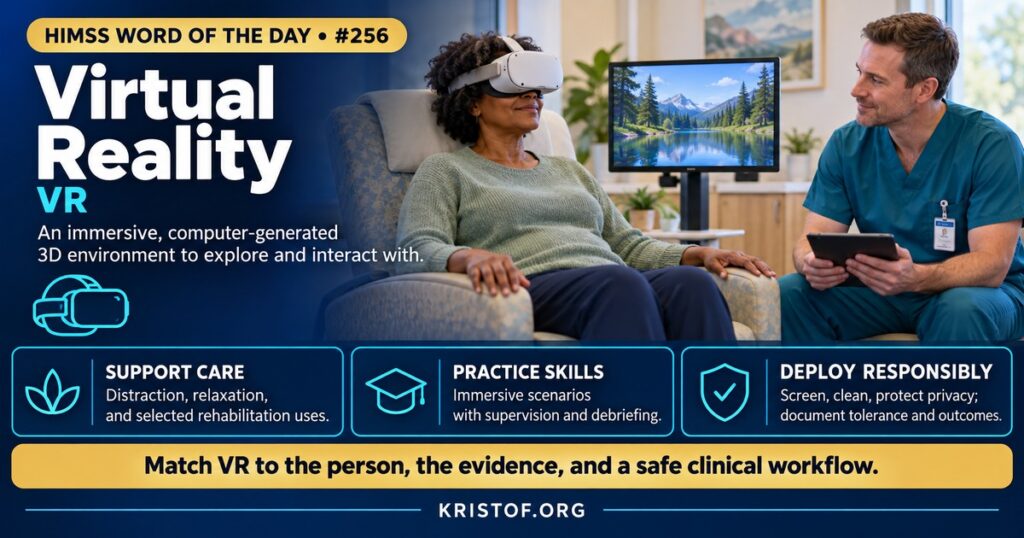
Virtual reality (VR) is a digitally created, three-dimensional setting that a person can explore and manipulate as though it were physically present, using specialized equipment. The HIMSS Dictionary mentions examples such as a helmet with a built-in screen or gloves fitted with sensors. Today the equipment is usually a head-mounted display with hand controllers, either tethered to a computer or standalone.
In health care, VR has two broad uses. Patient-facing uses include distraction during painful procedures, anxiety reduction, rehabilitation exercises, and exposure-based therapies. Clinician-facing uses include surgical planning, simulation training, and communication skills practice. VR is related to, but different from, augmented reality, which overlays digital content on the real world.
| VR Use | Purpose | Example |
|---|---|---|
| Distraction | Reduce pain and anxiety during procedures | Immersive scene during IV insertion |
| Rehabilitation | Motivate exercise and track movement | Balance and limb exercises in the ICU |
| Mental health | Support exposure and relaxation therapies | Controlled exposure for phobias or PTSD |
| Education | Practice skills safely | Nursing communication scenarios |
| Planning | Visualize anatomy before surgery | 3D models from imaging |
⚠️ Exam Alert: VR replaces the user’s view with a computer-generated environment, while augmented reality overlays content on the real world. VR for pain acts mainly through distraction and attention, and is considered a non-pharmacologic adjunct, not a replacement for analgesics.
🌐 Why It Matters: Real-World Healthcare IT Context
Interest in VR has grown because it offers a low-risk, non-drug way to address pain, anxiety, and distress, and because headsets have become affordable and portable. The evidence is growing but varies in strength, so informatics and clinical teams should read it carefully.
A 2026 systematic review and meta-analysis of randomized trials in elective orthopaedic surgery found 23 trials with 1,224 patients. VR was associated with a statistically significant reduction in acute postoperative pain compared with control, with a mean difference of 0.59 points, and with lower perioperative anxiety. Subgroup analysis suggested the pain benefit was restricted to major surgery and not minor procedures, and heterogeneity was high. For peripheral intravenous catheterization, a 2026 meta-analysis of 14 randomized trials with 1,405 participants found that VR may reduce pain, anxiety, and fear, but certainty of evidence was low for pain and anxiety and moderate for fear, with substantial heterogeneity. The authors called for better-designed trials.
In the intensive care unit, a 2026 meta-analysis covered 20 trials with 1,551 adult patients. VR improved anxiety, depression, PTSD scores, sleep quality, and lower-limb function in selected groups, but showed no significant effect on pain score or bedside balance. The authors rated the evidence as very low to moderate certainty and called for standardized protocols, objective outcome measures, and adequately powered multicenter trials. Together these reviews support cautious optimism: VR looks helpful for anxiety and distress in several settings and possibly for pain in some, but trials are small, methods differ, and blinding is difficult because patients know when they are wearing a headset.
Deployment involves informatics and operational work that is easy to overlook. Headsets must be cleaned between patients according to infection prevention policy. Software needs vetting for content, privacy, and data collection, since headsets can record movement, voice, or eye tracking. Devices need network and update management and clear ownership for charging, storage, and loss. Patients with motion sickness, seizure history, facial wounds, or isolation precautions may not be suitable, and screening criteria should be written down. Documentation should capture use, duration, tolerance, and outcomes, ideally in structured form so programs can be evaluated.
Education applications raise their own questions. Systematic reviews of VR and AI-supported communication training in nursing education suggest growing use, but the strength of evidence on skill transfer varies. Organizations should treat VR training as a complement to, not a substitute for, supervised practice.
Governance matters. A VR program benefits from a clinical sponsor, a safety review, a defined evaluation plan, and a decision rule for continuing or stopping. Vendors should disclose what data are collected and how they are stored, and contracts should address privacy requirements for any patient information.
Common VR deployment problems:
- Devices not cleaned or tracked, creating infection and loss risks
- Software that collects data without clear privacy review
- Use without screening for motion sickness or other contraindications
- No documentation of use, so outcomes cannot be evaluated
- Enthusiasm outrunning the evidence for a specific indication
- Programs that depend on one champion and fade when that person leaves
What supports effective VR programs:
- Written patient selection and exclusion criteria
- Infection prevention procedures for headsets and accessories
- Vendor privacy and security review
- Structured documentation of use and response
- An evaluation plan with outcome measures and stop criteria
- Training and support for staff using the equipment
🏥 The Nurse’s Perspective: Clinical, Bedside, & Workflow
Nurses are often the ones who offer, fit, and supervise VR, so their practical judgment determines whether it works.
At the Bedside
Before an IV start or a dressing change, a nurse can explain what the headset will do, check for dizziness or nausea history, and fit it comfortably. During the procedure, the nurse watches the patient’s reaction and stops if distress rises. Afterward, documenting tolerance and any effect on pain or anxiety builds the local evidence.
In the ICU, VR sessions need coordination with sedation, lines, and monitoring, and patient safety comes first.
In Clinical Workflow
Unit leaders decide where devices are stored, who cleans them, and how staff are trained. Nurse educators use VR for skills practice and communication training, and they build debriefing into each session. Pediatric and oncology units often lead because distraction tools fit their patient populations.
Nurse informaticists help add VR use to documentation flowsheets, define simple outcome measures, and work with privacy and security teams on app review and data handling.
In EHR Implementation (Go-Live Perspective)
An Epic Go-Live is not usually about VR, but the lesson carries over: new technology needs workflow, documentation, and support designed before launch. If VR is part of a unit’s patient experience program, analysts add a flowsheet or note template so use can be recorded, and at-the-elbow support helps staff find it. Early feedback from nurses about headset handling and documentation steps shapes the next iteration.
🎓 CAHIMS / CPHIMS & HIMSS Perspective
CAHIMS Exam Domain Mapping
VR appears in emerging technology, patient experience, and education questions:
| CAHIMS Domain | How VR Appears |
|---|---|
| Healthcare & Technology Environments | Emerging technologies, patient-facing digital tools |
| Clinical Informatics | Non-pharmacologic interventions, documentation, outcomes measurement |
| Healthcare Information & Systems Management | Device management, network needs, privacy and security review |
| Management & Leadership | Program governance, evidence review, business case, training |
Key Terms to Know Alongside VR
- Augmented Reality (AR) — digital content overlaid on the real world
- Head-Mounted Display (HMD) — headset that presents a virtual environment
- Immersion — degree to which a user feels present in a virtual environment
- Simulation-Based Education — structured practice using models or virtual scenarios
- Non-Pharmacologic Intervention — treatment approach that does not use medication
- Digital Therapeutic — software-based intervention intended to treat a condition
HIMSS Organizational Position
HIMSS supports the evaluation and responsible adoption of emerging technologies through its research, education, and community work. Members can find related resources through the HIMSS Resource Center.
🔗 Explore Further: External References
- Boronczyk et al. (2026), International Journal of Orthopaedic and Trauma Nursing — What Is the Impact of Virtual Reality on Pain in Elective Orthopaedic Patients? A Systematic Review and Meta-Analysis of Randomised Controlled Trials https://pubmed.ncbi.nlm.nih.gov/42914879/
- Cao et al. (2026), BMJ Open — Effect of Virtual Reality on Pain, Anxiety and Fear During Peripheral Venous Catheterisation: A Systematic Review and Meta-Analysis of Randomised Controlled Trials https://pubmed.ncbi.nlm.nih.gov/42901582/
- Sun et al. (2026), Medicine — The Overall Effects of Virtual Reality Interventions on ICU Patients: A Systematic Review and Meta-Analysis https://pubmed.ncbi.nlm.nih.gov/42937747/
- Raj et al. (2026), BMC Nursing — Artificial Intelligence and Virtual Reality-Based Communication Skills Training in Nursing Education: A Systematic Review With Implications https://pubmed.ncbi.nlm.nih.gov/42839241/
- Liao et al. (2026), Nursing in Critical Care — Intensive Care Unit Patients’ Perspectives and Experiences in Using Virtual Reality Technology: A Qualitative Meta-Synthesis https://pubmed.ncbi.nlm.nih.gov/42885891/
Term source: HIMSS Dictionary of Health Information and Technology Terms, Acronyms, and Organizations, 6th Edition (2025). All definitions in this series are paraphrased for editorial purposes. Readers are encouraged to consult the primary source for exact language.
Eric Andrew Kristof, RN, CAHIMS is a Healthcare IT professional and HIMSS Arkansas Chapter member based in Hot Springs Village, AR, with hands-on Epic Go-Live experience and a diverse healthcare and IT background. He writes at kristof.org at the intersection of clinical care and healthcare technology.
Leave a Reply