By Eric Andrew Kristof, RN, CAHIMS | Healthcare IT Professional | HIMSS Arkansas Chapter Member
About This Series: The HIMSS Word of the Day is a running blog series drawing from the HIMSS Dictionary of Health Information and Technology Terms, Acronyms, and Organizations, 6th Edition (2025) — the authoritative reference for healthcare IT professionals and the primary study resource for CAHIMS and CPHIMS certification. Each post paraphrases the term in plain language, grounds it in real-world healthcare IT context, and adds a bedside nursing perspective you won’t find in a textbook.
📖 The Term: Digital Twin
Source: HIMSS Dictionary of Health Information and Technology Terms, Acronyms, and Organizations, 6th Edition (2025)
🔍 Plain-Language Definition
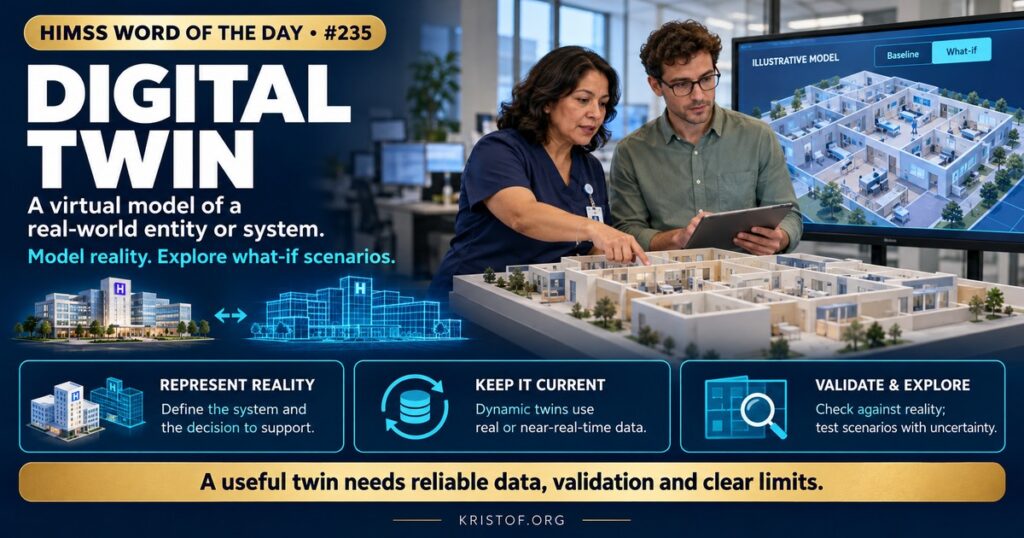
A digital twin is a virtual model standing in for a real-world entity or system. The HIMSS Dictionary separates two types. A static twin, also called a simulation, depicts the entity at a specific point in time. A dynamic twin stays linked to the physical entity so that it reflects the current state in real or near-real time. The dictionary lists uses such as forecasting health under certain conditions, training staff, capturing requirements for something new, predicting the effect of a change, comparing lifecycle plans, trying risky scenarios with no patients involved, gauging risk, and running several what-if cases in parallel.
A National Academies consensus report published in 2024 describes a digital twin as coupling computational models with a physical counterpart. It also stresses that a twin must be built and judged with attention to verification, validation, and uncertainty quantification, meaning that the model must be checked for correct construction, tested against reality, and accompanied by an honest statement of how uncertain its predictions are.
| Type | Linked to Live Data? | Example in Health Care |
|---|---|---|
| Static twin (simulation) | No | Model of a new unit layout built from last year’s data |
| Dynamic twin | Yes | Emergency department model updated with current arrivals and bed status |
| Process twin | Often | Patient flow or operating room scheduling model |
| Asset twin | Yes | Model of a medical device or HVAC system for maintenance |
| Patient or organ twin | Yes, with patient data | Virtual human model used to test treatments |
⚠️ Exam Alert: A simulation becomes a dynamic digital twin when it is continuously fed by real data from the physical system. A twin is a model, so its value depends on validation. Predictive analytics forecast an outcome, while a twin lets users test interventions in a virtual copy.
🌐 Why It Matters: Real-World Healthcare IT Context
Hospitals are complex systems where changes carry real consequences. Opening a new unit, changing triage, moving discharge times, or planning for a respiratory surge can all backfire in ways that are hard to predict. A digital twin offers a way to try the change on a model first. That is why interest has grown in operations such as bed management, emergency department flow, operating room scheduling, staffing, and equipment maintenance.
A 2026 systematic review of digital twins in hospital operations screened Scopus publications from 2021 to 2026 and found 70 relevant articles. The review reported an emerging trend toward AI-based twins for real-time monitoring, predictive maintenance of medical devices, and surgical planning, and it identified challenges in data integration and in the ethics of virtual health models. An emergency department study from the same year built a data-driven digital twin from 41,818 visits. The model was calibrated on January to September data and tested on October and November visits. In the test period of 7,596 visits, observed median length of stay was 266 minutes, and the twin’s simulated median was 276 minutes. When arrivals were increased by 20 percent in simulation, performance deteriorated nonlinearly, with more than 90 percent of visits exceeding eight hours. Reducing post-triage waiting time produced the largest improvement from a single change, and the combined intervention did better still. The authors presented this as a framework for testing operational resilience, not as proof of a specific result at any other site.
Those two examples show what a good twin does: it reproduces observed performance on data it has not seen, and then it is used to ask what-if questions. They also show the limits. A twin built for one department reflects that department’s data and processes. It can be wrong when conditions move outside the range of the data, and it can leave out factors, such as staff skill mix or patient acuity, that were not modeled.
The National Academies report emphasizes that rigor is what separates a credible twin from a decorative one. A twin that cannot show how closely it matches reality, or how uncertain its forecasts are, should be treated as a visualization. In health care, this matters even more when a twin touches individual patient decisions, because errors have direct consequences and because patient data raise privacy questions. A twin that combines device, EHR, and sensor data inherits all the data quality, consent, and security issues of those sources.
Practical questions help decide whether a twin is worth building. What decision will it support? What data feed it, how fresh and accurate are they, and who owns them? How was it validated, and how often is it rechecked? Who acts on its recommendations, and what happens when it is wrong? A modest model that answers a real operational question is often more useful than an ambitious one with no clear user.
Common digital twin problems:
- Calling any dashboard or animation a twin
- No documented validation against real outcomes
- Poor or delayed data feeds that make the twin stale
- Models built without input from the people who run the process
- Output presented without uncertainty
- Unclear ownership of the twin after the pilot ends
What supports credible digital twins:
- A specific decision or question the twin is built to inform
- Validation on data not used to build the model
- Reliable, governed data pipelines
- Clinical and operational stakeholders in design and review
- Scenario testing with transparent assumptions
- Privacy and security review of the data sources
🏥 The Nurse’s Perspective: Clinical, Bedside, & Workflow
Nurses know the real flow of a unit better than any model, and their knowledge determines whether a twin reflects reality.
At the Bedside
A twin that predicts bed demand or discharge timing will only be as accurate as the assumptions about how care is delivered. Nurses can say when a model ignores factors such as isolation needs, transport delays, or the time it takes to prepare a safe discharge. Their feedback helps catch gaps before the model drives decisions.
When a twin recommends a change in staffing or patient placement, nurses need to understand the reasoning and have a path to raise concerns.
In Clinical Workflow
Nurse managers and house supervisors are natural users of operational twins for capacity planning, surge preparation, and scheduling. They can test scenarios such as a flu season increase or a change in discharge lounge hours, then compare results with their own judgment.
Nurse informaticists take part in design and validation, checking that nursing activities and acuity are represented and that outputs are understandable to charge nurses. They also push for governance so that model changes are documented.
In EHR Implementation (Go-Live Perspective)
An Epic Go-Live often creates a spike in volume and workflow change that planners want to anticipate. Capacity and staffing models built from pre-go-live data may not match the early weeks, when documentation takes longer. At-the-elbow support analysts see these differences directly, and their observations help planners adjust assumptions instead of trusting an outdated model.
🎓 CAHIMS / CPHIMS & HIMSS Perspective
CAHIMS Exam Domain Mapping
Digital twins appear in analytics, operations, and emerging technology questions:
| CAHIMS Domain | How Digital Twins Appear |
|---|---|
| Healthcare & Technology Environments | Emerging technologies, IoT, AI, privacy and ethics |
| Clinical Informatics | Patient flow, decision support, modeling clinical processes |
| Healthcare Information & Systems Management | Data integration, sensors, model maintenance, security |
| Management & Leadership | Capacity planning, governance, validation, business case |
Key Terms to Know Alongside Digital Twin
- Simulation — model of a system at a point in time or under assumed conditions
- Dynamic Twin — twin kept current by live data from the physical system
- Validation — testing a model against real-world data or outcomes
- Uncertainty Quantification — measuring how uncertain a model’s predictions are
- Internet of Things (IoT) — connected devices that supply data to twins
- What-If Analysis — testing alternative scenarios in a model
HIMSS Organizational Position
HIMSS supports the responsible use of data, analytics, and emerging technology through its research, education, and community work. Members can find related resources through the HIMSS Resource Center.
🔗 Explore Further: External References
- National Academies — Foundational Research Gaps and Future Directions for Digital Twins (Consensus Study Report, 2024) https://www.nationalacademies.org/projects/DEPS-BMSA-21-03/publication/26894
- NIST — Digital Twins https://www.nist.gov/digital-twins
- El-Mawla et al. (2026), Bioengineering — Digital Twins for Hospital and Healthcare Operations: A Systematic Review of Resource Allocation, Infection Control, and Workflow Optimization https://pubmed.ncbi.nlm.nih.gov/42791944/
- Vallée et al. (2026), Internal and Emergency Medicine — A Data-Driven Digital Twin of Emergency Department Flow to Quantify Congestion Dynamics and Test Operational Resilience https://pubmed.ncbi.nlm.nih.gov/42802186/
- Krishnamurthi et al. (2026), Journal of the American Medical Informatics Association — Designing Evaluation Rubrics for the Development of Virtual Human Twins in Healthcare https://pubmed.ncbi.nlm.nih.gov/42896603/
Term source: HIMSS Dictionary of Health Information and Technology Terms, Acronyms, and Organizations, 6th Edition (2025). All definitions in this series are paraphrased for editorial purposes. Readers are encouraged to consult the primary source for exact language.
Eric Andrew Kristof, RN, CAHIMS is a Healthcare IT professional and HIMSS Arkansas Chapter member based in Hot Springs Village, AR, with hands-on Epic Go-Live experience and a diverse healthcare and IT background. He writes at kristof.org at the intersection of clinical care and healthcare technology.
Leave a Reply