By Eric Andrew Kristof, RN, CAHIMS | Healthcare IT Professional | HIMSS Arkansas Chapter Member
About This Series: The HIMSS Word of the Day is a running blog series drawing from the HIMSS Dictionary of Health Information and Technology Terms, Acronyms, and Organizations, 6th Edition (2025) — the authoritative reference for healthcare IT professionals and the primary study resource for CAHIMS and CPHIMS certification. Each post paraphrases the term in plain language, grounds it in real-world healthcare IT context, and adds a bedside nursing perspective you won’t find in a textbook.
📖 The Term: Trigger Event
Source: HIMSS Dictionary of Health Information and Technology Terms, Acronyms, and Organizations, 6th Edition (2025)
🔍 Plain-Language Definition
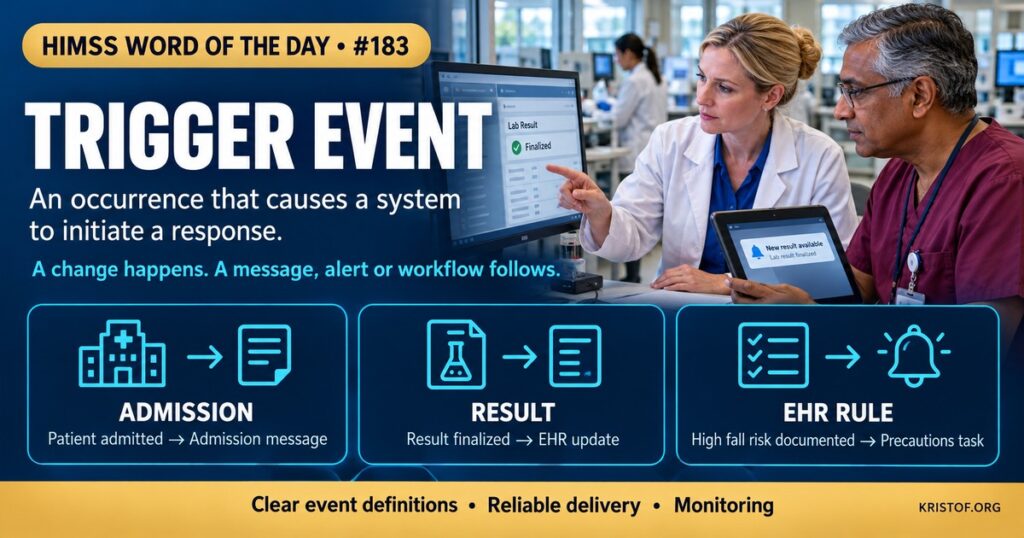
A trigger event is a real-world or system occurrence that causes a system to initiate a response, such as sending a message to another system, firing an alert, starting a workflow, or notifying a user or application.
The HIMSS Dictionary defines a trigger event simply as an event that causes a system to initiate a response.
| Context | Example Trigger Event | Resulting Action |
|---|---|---|
| HL7 Version 2 ADT | Patient admitted (ADT^A01) | Admission message sent to lab, pharmacy, and dietary systems |
| HL7 Version 2 Orders | New order placed (ORM or OML) | Order transmitted to the laboratory or radiology system |
| HL7 Version 2 Results | Result finalized (ORU) | Result sent to the EHR |
| FHIR Subscriptions | A resource changes that matches subscription criteria | Notification sent to a subscribing application |
| CDS Hooks | A hook such as order-sign occurs in the EHR | Decision support service returns cards to the clinician |
| EHR Rules | Documentation of a high fall risk score | Fall precautions task created |
⚠️ Exam Alert: In HL7 Version 2, a trigger event code (such as A01 for admit or A03 for discharge) combined with a message type (such as ADT) defines what happened and what message is sent. FHIR subscriptions notify applications when resources change. CDS Hooks invoke decision support at defined workflow points. A trigger tool in patient safety is a different concept used to find adverse events.
🌐 Why It Matters: Real-World Healthcare IT Context
Much of healthcare interoperability is event-driven. Systems need to react when something happens: a patient arrives, moves, or leaves; an order is placed or canceled; a result is finalized; a medication is administered. Trigger events define those moments precisely so systems can respond consistently.
HL7 Version 2 formalized trigger events decades ago. Each message type has associated trigger events. ADT messages, for example, include events for admission, transfer, discharge, registration, and updates to patient information. Interface engines route messages based on these triggers, and receiving systems update records accordingly. Admission, discharge, and transfer notifications to primary care practices and care managers rely on these same triggers.
Precise definitions matter. If organizations use trigger events differently, such as sending an update event when an admit was expected, receiving systems may misinterpret what happened. Interface specifications document which trigger events are sent and when, and testing confirms correct behavior.
FHIR brings trigger concepts to modern APIs. FHIR subscriptions allow applications to request notifications when resources that meet certain criteria change, supporting real-time alerts without constant polling. This approach supports use cases such as notifying care managers of admissions or alerting apps when new results arrive.
CDS Hooks applies triggers to decision support. Defined hooks, such as when a patient chart is opened or an order is signed, allow external decision support services to provide guidance at the right moment in workflow. Da Vinci prior authorization guides use these hooks to check coverage requirements during ordering.
Within EHRs, rule engines use triggers to create tasks, alerts, and notifications, such as prompting reassessment after a medication or alerting a care team to a critical result. Well-designed triggers fire at the right time with the right information; poorly designed triggers contribute to alert fatigue.
The term has a separate meaning in patient safety. Trigger tools, such as the IHI Global Trigger Tool, use clues in medical records, such as administration of a reversal agent or an abnormal lab value, to identify possible adverse events for review. These triggers support safety measurement rather than system messaging.
Event-driven architectures are spreading beyond traditional interfaces. Modern platforms publish events, such as a patient arriving or a bed becoming clean, to streams that many applications can consume, supporting real-time dashboards, capacity management, and automation. These designs depend on the same discipline of clearly defined events, reliable delivery, and monitoring that HL7 trigger events have always required.
Reliability is essential. Missed or duplicated trigger events can lead to missing results, duplicate orders, or incorrect patient locations. Monitoring interface queues and validating event handling help catch problems.
Common trigger event problems:
- Events sent with the wrong type or timing
- Missed events that leave systems out of sync
- Duplicate events creating duplicate orders or records
- Alerts triggered at the wrong point in workflow
- Inconsistent use of events across organizations
- Notifications that overwhelm recipients
Practices for reliable trigger events:
- Clear interface specifications for each event
- Testing of event sequences, including corrections and cancellations
- Monitoring for missing or duplicate messages
- Designing alert triggers with clinical input
- Using standards such as FHIR subscriptions and CDS Hooks
- Filtering notifications to what recipients need
🏥 The Nurse’s Perspective: Clinical, Bedside, & Workflow
Nurses experience the results of trigger events throughout every shift.
At the Bedside
When a patient is admitted or transferred, ADT trigger events update locations in pharmacy, dietary, laboratory, and nurse call systems. If a transfer is documented late or incorrectly, medications, meals, and specimens may go to the wrong place.
Alerts and tasks triggered by documentation, such as fall risk scores or sepsis screening, prompt nursing actions. Understanding what triggers an alert helps nurses respond appropriately and identify alerts that fire incorrectly.
In Clinical Workflow
Timely documentation of events, such as discharge or transfer, ensures that downstream systems and teams receive accurate information. A discharge recorded hours late can delay bed cleaning and admission of the next patient.
Care coordination nurses in primary care may receive admission and discharge notifications triggered by hospital ADT events, allowing them to follow up with patients promptly.
When expected results or notifications do not arrive, nurses should report the gap, since missing trigger events may affect other patients as well.
Temporary patient locations, such as hallway beds or procedure areas, should be documented accurately so location-based triggers route results, medications, and notifications to the right place.
In EHR Implementation (Go-Live Perspective)
During an Epic Go-Live, interface teams test trigger events for registration, orders, results, and transfers across all connected systems. Testing includes corrections, such as canceling an admission or merging records, which often reveal defects.
At-the-elbow support analysts help nurses understand how documentation actions, such as signing a transfer, affect other systems, and route interface problems to integration teams.
🎓 CAHIMS / CPHIMS & HIMSS Perspective
CAHIMS Exam Domain Mapping
Trigger events appear in interoperability and decision support questions:
| CAHIMS Domain | How Trigger Events Appear |
|---|---|
| Healthcare & Technology Environments | Event-driven interoperability; notification requirements |
| Clinical Informatics | Alerts, tasks, timely documentation, safety trigger tools |
| Healthcare Information & Systems Management | HL7 Version 2 events, FHIR subscriptions, CDS Hooks, interface testing |
| Management & Leadership | Integration governance, alert stewardship |
Key Terms to Know Alongside Trigger Event
- HL7 Version 2 — a messaging standard that defines message types and trigger events
- ADT Message — admission, discharge, and transfer messages that communicate patient movements
- FHIR Subscription — a mechanism for notifying applications when resources change
- CDS Hooks — a standard for invoking decision support at defined workflow points
- Interface Engine — middleware that routes and transforms messages
- Trigger Tool — a patient safety method that uses record clues to find adverse events
HIMSS Organizational Position
HIMSS supports event-driven, standards-based interoperability through its education and collaboration with IHE and HL7-related initiatives. Members can find related education and research through the HIMSS Resource Center.
🔗 Explore Further: External References
- HL7 International — HL7 Version 2 Product Suite https://www.hl7.org/implement/standards/product_brief.cfm?product_id=185
- HL7 — FHIR Subscriptions https://hl7.org/fhir/subscriptions.html
- HL7 — CDS Hooks https://cds-hooks.hl7.org/
- IHE International — Profiles https://www.ihe.net/resources/profiles/
- Institute for Healthcare Improvement https://www.ihi.org/
- HIMSS — Public Policy & Advocacy https://www.himss.org/public-policy-advocacy-overview
Term source: HIMSS Dictionary of Health Information and Technology Terms, Acronyms, and Organizations, 6th Edition (2025). All definitions in this series are paraphrased for editorial purposes. Readers are encouraged to consult the primary source for exact language.
Eric Andrew Kristof, RN, CAHIMS is a Healthcare IT professional and HIMSS Arkansas Chapter member based in Hot Springs Village, AR, with hands-on Epic Go-Live experience and a diverse healthcare and IT background. He writes at kristof.org at the intersection of clinical care and healthcare technology.
Leave a Reply