By Eric Andrew Kristof, RN, CAHIMS | Healthcare IT Professional | HIMSS Arkansas Chapter Member
About This Series: The HIMSS Word of the Day is a running blog series drawing from the HIMSS Dictionary of Health Information and Technology Terms, Acronyms, and Organizations, 6th Edition (2025) — the authoritative reference for healthcare IT professionals and the primary study resource for CAHIMS and CPHIMS certification. Each post paraphrases the term in plain language, grounds it in real-world healthcare IT context, and adds a bedside nursing perspective you won’t find in a textbook.
📖 The Term: Nursing Minimum Data Set (NMDS)
Source: HIMSS Dictionary of Health Information and Technology Terms, Acronyms, and Organizations, 6th Edition (2025)
🔍 Plain-Language Definition
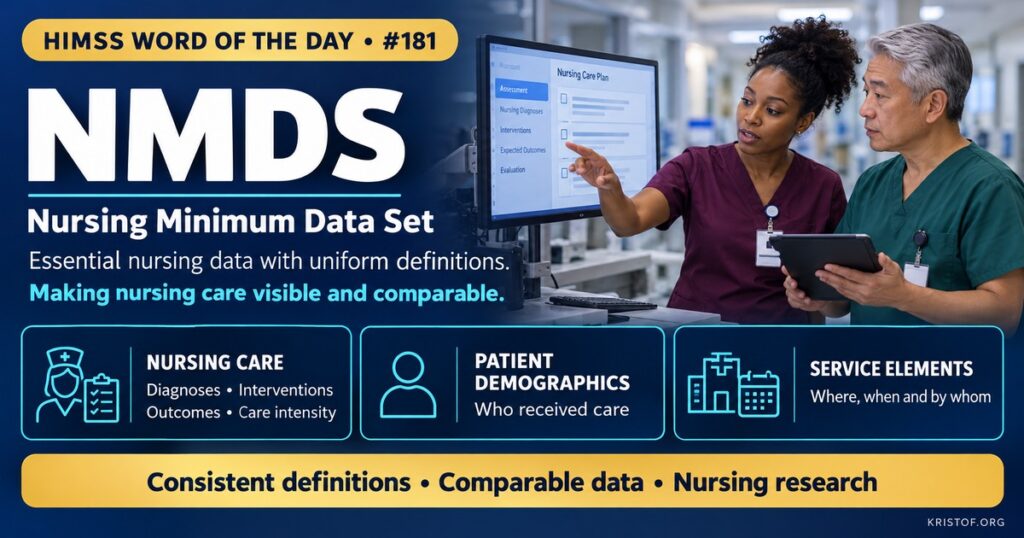
The Nursing Minimum Data Set (NMDS) is a standardized set of essential nursing data elements with uniform definitions, designed to be collected consistently across settings so that nursing care can be described, compared, and studied.
The HIMSS Dictionary describes the NMDS in two ways. It calls the NMDS the foundation for nursing language development, because it identified four uniquely nursing components, diagnoses, interventions, outcomes, and the intensity of care, to add to the Uniform Hospital Discharge Data Set. It also describes the NMDS as a core set of nursing information items with uniform definitions and categories, intended as an abstraction tool for collecting consistent, comparable, minimum nursing data.
| NMDS Category | Elements | Purpose |
|---|---|---|
| Nursing Care Elements | Nursing diagnosis, nursing intervention, nursing outcome, intensity of nursing care | Describe what nurses assess, do, and achieve |
| Patient Demographic Elements | Personal identification, date of birth, sex, race and ethnicity, residence | Describe who received care |
| Service Elements | Facility identifier, health record number, unique RN identifier, admission or encounter date, discharge or termination date, disposition, expected payer | Describe where and when care occurred |
⚠️ Exam Alert: The NMDS defines essential nursing data elements, not a terminology itself. Standardized nursing terminologies provide codes and terms for diagnoses, interventions, and outcomes. The Nursing Management Minimum Data Set (NMMDS) focuses on nursing administrative and environmental data, such as staffing and unit characteristics. The UHDDS is the hospital discharge data set the NMDS was designed to complement.
🌐 Why It Matters: Real-World Healthcare IT Context
For much of healthcare history, nursing care was invisible in large data sets. Discharge abstracts captured medical diagnoses and procedures, but not the assessments, interventions, and outcomes that define nursing practice. That made it hard to study nursing’s contribution to outcomes, compare care across settings, or support policy decisions about nursing resources.
The NMDS emerged in the 1980s through work led by Harriet Werley and colleagues, who convened experts to identify the minimum nursing data that should be collected routinely. A 1991 article in the American Journal of Public Health described the NMDS as the first attempt to standardize the collection of essential nursing data and outlined its benefits for comparing nursing care across populations, settings, geographic areas, and time.
The NMDS identified 16 elements in three categories: nursing care, patient demographics, and service elements. Its nursing care elements helped drive development and recognition of standardized nursing terminologies used to code diagnoses, interventions, and outcomes.
A companion data set addresses management. The Nursing Management Minimum Data Set defines essential data about the nursing care environment, nursing resources, and financial resources, such as staffing, nurse characteristics, and unit type. Researchers have updated NMMDS elements and mapped them to LOINC, supporting standardized reporting in EHRs.
Why this matters today: modern EHRs capture vast amounts of nursing documentation, but without standard definitions and codes, that data is difficult to aggregate or compare. The NMDS principle, that a small set of well-defined, consistently collected elements enables meaningful analysis, remains highly relevant to nursing quality measurement, staffing research, and value-based care.
Standardized nursing data supports many uses. It can show how nursing interventions relate to outcomes like falls and pressure injuries, demonstrate nursing’s value in value-based payment, support workforce planning, and enable research using big data.
Interoperability depends on it. When nursing data elements are mapped to standards such as SNOMED CT and LOINC, they can travel with patients across transitions and be included in national data sets.
The unique RN identifier element anticipated a long-standing interest in attributing care to individual nurses, which supports analysis of nursing contributions and has been discussed alongside proposals to use national identifiers for nurses.
International work continues the idea. Several countries have developed their own nursing minimum data sets, and international nursing informatics groups have explored how essential nursing data can be compared across health systems, reinforcing the original goal of making nursing visible wherever care is delivered.
Common challenges with nursing data:
- Free-text documentation that cannot be aggregated
- Locally defined flowsheet rows without standard codes
- Inconsistent use of nursing terminologies across organizations
- Limited inclusion of nursing data in national data sets
- Difficulty attributing care to individual nurses
- Documentation burden that competes with data quality
What supports standardized nursing data:
- Mapping flowsheet data to standard terminologies
- Consistent data definitions across units and facilities
- Inclusion of nursing elements in data warehouses
- Use of NMMDS elements for staffing and environment data
- Nurse informaticist leadership in data governance
- Research that links nursing data to outcomes
🏥 The Nurse’s Perspective: Clinical, Bedside, & Workflow
The NMDS is about making nursing work count, literally, in health data.
At the Bedside
Every structured assessment, intervention, and outcome a nurse documents can contribute to data that shows the impact of nursing care. Using defined fields and lists, rather than free text, makes that documentation usable for quality and research.
Documentation should remain clinically meaningful. The goal of minimum data sets is to collect essential information efficiently, not to add burden, so well-designed templates capture key elements without duplication.
In Clinical Workflow
Nurse leaders use data on staffing, skill mix, and unit characteristics, the kinds of elements described in the NMMDS, to plan resources and study relationships between staffing and outcomes.
Nursing quality programs rely on standardized data for nurse-sensitive indicators. Consistent definitions across units allow fair comparisons and benchmarking.
Nurse informaticists map local documentation to standard terminologies, helping nursing data flow into enterprise data warehouses and external reports.
Nurse researchers use standardized nursing data to study outcomes and demonstrate nursing’s value, strengthening the case for evidence-based staffing and practice.
In EHR Implementation (Go-Live Perspective)
During an Epic Go-Live, nursing documentation build is an opportunity to align flowsheets and care plans with standard terminologies and essential data elements. Decisions made at build time affect data quality for years.
At-the-elbow support analysts can reinforce documentation in structured fields and gather feedback on templates that encourage free-text workarounds.
🎓 CAHIMS / CPHIMS & HIMSS Perspective
CAHIMS Exam Domain Mapping
The NMDS appears in nursing informatics and data standards questions:
| CAHIMS Domain | How the NMDS Appears |
|---|---|
| Healthcare & Technology Environments | History of nursing informatics; national data sets |
| Clinical Informatics | Nursing documentation, terminologies, nurse-sensitive indicators |
| Healthcare Information & Systems Management | Data elements, mapping to LOINC and SNOMED CT, data warehouses |
| Management & Leadership | Staffing data, nursing value, data governance |
Key Terms to Know Alongside NMDS
- Uniform Hospital Discharge Data Set (UHDDS) — standard data elements for inpatient discharges
- Nursing Management Minimum Data Set (NMMDS) — essential nursing management and environment data
- Standardized Nursing Terminology — coded terms for nursing diagnoses, interventions, and outcomes
- Nurse-Sensitive Indicator — a measure reflecting the quality of nursing care
- Data Element — a defined unit of data with a specific meaning
- LOINC — a standard for identifying observations, including many nursing assessments
HIMSS Organizational Position
HIMSS supports standardized nursing data and nursing informatics through its Nursing Informatics Community, education, and interoperability work. Members can find related education and research through the HIMSS Resource Center.
🔗 Explore Further: External References
- Werley et al. (1991), American Journal of Public Health — The Nursing Minimum Data Set: Abstraction Tool for Standardized, Comparable, Essential Data https://pubmed.ncbi.nlm.nih.gov/2003618/
- Westra et al. (2010), Journal of Nursing Administration — Achieving Meaningful Use of EHRs Through the Integration of the Nursing Management Minimum Data Set https://pubmed.ncbi.nlm.nih.gov/20661064/
- University of Minnesota School of Nursing — Center for Nursing Informatics https://nursing.umn.edu/centers/center-nursing-informatics
- SNOMED International https://www.snomed.org/
- ONC — Interoperability Standards Platform https://isp.healthit.gov/
- HIMSS — Nursing Informatics Community https://www.himss.org/networking/communities/nursing-informatics/
Term source: HIMSS Dictionary of Health Information and Technology Terms, Acronyms, and Organizations, 6th Edition (2025). All definitions in this series are paraphrased for editorial purposes. Readers are encouraged to consult the primary source for exact language.
Eric Andrew Kristof, RN, CAHIMS is a Healthcare IT professional and HIMSS Arkansas Chapter member based in Hot Springs Village, AR, with hands-on Epic Go-Live experience and a diverse healthcare and IT background. He writes at kristof.org at the intersection of clinical care and healthcare technology.
Leave a Reply