By Eric Andrew Kristof, RN, CAHIMS | Healthcare IT Professional | HIMSS Arkansas Chapter Member
About This Series: The HIMSS Word of the Day is a running blog series drawing from the HIMSS Dictionary of Health Information and Technology Terms, Acronyms, and Organizations, 6th Edition (2025) — the authoritative reference for healthcare IT professionals and the primary study resource for CAHIMS and CPHIMS certification. Each post paraphrases the term in plain language, grounds it in real-world healthcare IT context, and adds a bedside nursing perspective you won’t find in a textbook.
📖 The Term: Deep Learning
Source: HIMSS Dictionary of Health Information and Technology Terms, Acronyms, and Organizations, 6th Edition (2025)
🔍 Plain-Language Definition
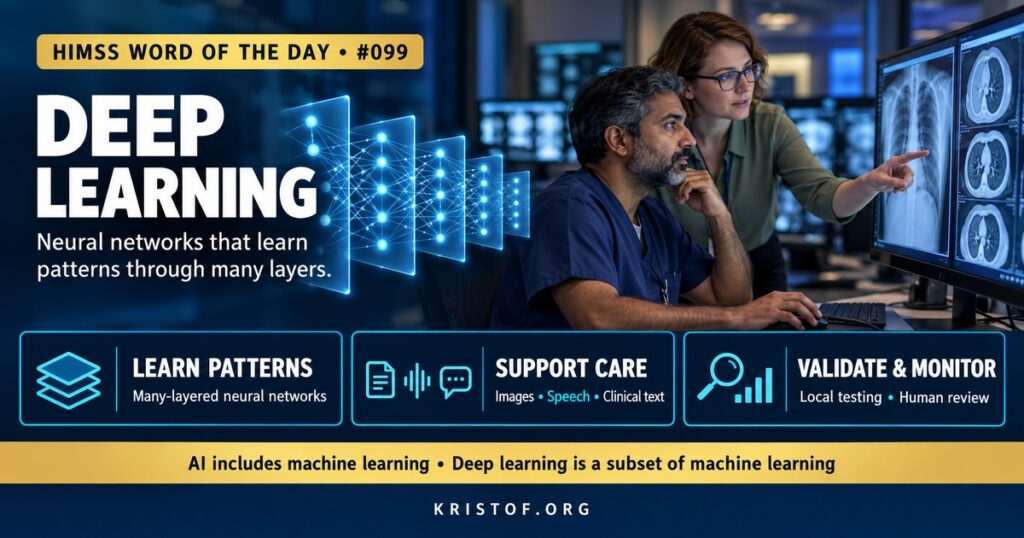
Deep learning is a type of machine learning that uses artificial neural networks with many layers to learn patterns directly from data. Instead of relying on people to define which features matter, a deep learning model discovers useful features on its own as information passes through successive layers.
The HIMSS Dictionary describes deep learning as an iterative AI approach that layers machine learning algorithms into a hierarchy that grows in complexity and abstraction, with each level building on what the previous layer learned. Its example is image recognition: early layers might learn color patterns, later layers learn shapes, and the top layers combine those features to recognize the actual object. The Dictionary calls deep learning the most sophisticated AI architecture currently in use.
| Concept | What It Means | Healthcare Example |
|---|---|---|
| Neural Network | Interconnected layers of mathematical units that transform inputs into outputs | A model that takes an image and outputs a probability of disease |
| Convolutional Neural Network (CNN) | A network design suited to images | Detecting diabetic retinopathy in retinal photographs |
| Recurrent and Transformer Models | Designs suited to sequences such as text, speech, and time series | Speech recognition and large language models |
| Training Data | Labeled examples the model learns from | Thousands of images graded by specialists |
| Validation | Testing performance on data the model has not seen | Evaluating the model at a different hospital |
⚠️ Exam Alert: Artificial intelligence is the broad field. Machine learning is a subset that learns from data. Deep learning is a subset of machine learning using many-layered neural networks. Large language models are deep learning models trained on text. Deep learning typically needs large labeled data sets and significant computing power, and it is often harder to explain than simpler models.
🌐 Why It Matters: Real-World Healthcare IT Context
Deep learning transformed medical image analysis. A 2016 study in JAMA by Varun Gulshan and colleagues developed a deep learning algorithm to detect referable diabetic retinopathy from retinal photographs. In two validation data sets, it achieved areas under the curve of 0.991 and 0.990, with high sensitivity and specificity, while the authors noted that further research was needed to show clinical feasibility and improved outcomes. A 2017 study in Nature by Andre Esteva and colleagues trained a convolutional neural network on about 129,000 clinical images and compared its classification of skin lesions with that of board-certified dermatologists.
Those studies helped launch a wave of clinical AI. Many of the AI-enabled medical devices on FDA’s public list analyze images, and radiology accounts for the largest share. Deep learning also powers speech recognition, ambient documentation, language models that summarize and draft text, and models that analyze waveforms such as ECGs.
Deep learning has important limitations. Models can learn shortcuts from their training data, such as associating image artifacts or hospital-specific markers with disease, and then fail elsewhere. Performance may differ across patient populations, devices, and settings. Many models are difficult to explain, which makes errors harder to detect. These concerns are why regulators, professional societies, and frameworks such as NIST’s AI Risk Management Framework emphasize validation, monitoring, transparency, and human oversight.
Computing and data infrastructure are practical requirements. Training deep learning models takes large labeled data sets and specialized hardware, so many health systems license models from vendors rather than building their own. Licensing does not remove responsibility: organizations still need to understand intended use, validate performance on their own patients, and monitor results over time.
Common deep learning pitfalls in healthcare:
- Training data that underrepresents certain populations
- Models validated at one site and deployed elsewhere without local testing
- Performance drift when imaging equipment, workflows, or populations change
- Overreliance on model output without clinical judgment
- Limited explanation of how the model reached a result
- Unclear accountability when AI-supported decisions go wrong
Practices for responsible use:
- Clear intended use and target population for each model
- External and local validation before deployment
- Ongoing monitoring of performance and fairness
- Human review of outputs, especially for high-stakes decisions
- Transparency with clinicians about model purpose and limits
- Governance committees that oversee AI selection and use
🏥 The Nurse’s Perspective: Clinical, Bedside, & Workflow
Nurses increasingly work alongside deep learning tools, often without seeing the model itself.
At the Bedside
Deep learning powers some deterioration prediction tools, imaging triage systems, and speech-based documentation. When a model flags a patient as high risk or highlights a finding, nurses combine that signal with their own assessment. A flag is a reason to look more closely, not a substitute for clinical judgment, and a patient who looks unwell deserves attention even if the model is quiet.
Ambient documentation and AI-drafted text are another deep learning application. Reviewing drafts carefully, correcting errors, and signing only accurate content keeps the legal record trustworthy.
In Clinical Workflow
Nurses contribute to the data that trains and evaluates models. Accurate vital signs, assessments, and outcomes documentation make future models more reliable, while inconsistent documentation can teach models the wrong patterns.
Nurses also provide feedback that reveals model problems. Reports that an alert fires for the wrong patients, misses obvious deterioration, or behaves differently on certain units help governance teams investigate and improve tools.
In EHR Implementation (Go-Live Perspective)
During an Epic implementation, predictive models and AI features may be introduced in stages, often running silently before being shown to clinicians so teams can check performance on local data. Changes in documentation workflows at Go-Live can affect model inputs, so monitoring after Go-Live is important.
At-the-elbow support analysts can help clinicians understand where AI-generated scores or text appear, how they are labeled, and how to report concerns. Clear communication about what a model does, and does not do, builds appropriate trust.
🎓 CAHIMS / CPHIMS & HIMSS Perspective
CAHIMS Exam Domain Mapping
Deep learning appears in AI and data questions:
| CAHIMS Domain | How Deep Learning Appears |
|---|---|
| Healthcare & Technology Environments | AI trends; FDA oversight of AI-enabled devices; imaging and language applications |
| Clinical Informatics | Clinical use of AI outputs; human oversight; documentation tools |
| Healthcare Information & Systems Management | Training data, validation, deployment, monitoring, computing infrastructure |
| Management & Leadership | AI governance, risk management, fairness, accountability |
Key Terms to Know Alongside Deep Learning
- Neural Network — a model composed of layers of connected units that transform inputs into outputs
- Convolutional Neural Network (CNN) — a neural network architecture well suited to image analysis
- Training Data — the labeled examples used to teach a model
- Overfitting — when a model learns training data too closely and performs poorly on new data
- Explainability — the degree to which a model’s reasoning can be understood by people
- Model Drift — a decline in model performance over time as data or conditions change
HIMSS Organizational Position
HIMSS addresses deep learning as part of its broader work on artificial intelligence in healthcare, emphasizing responsible adoption, governance, and workforce readiness. Members can find related education and research through the HIMSS Resource Center.
🔗 Explore Further: External References
- Gulshan et al. (2016), JAMA — Deep Learning Algorithm for Detection of Diabetic Retinopathy https://pubmed.ncbi.nlm.nih.gov/27898976/
- Esteva et al. (2017), Nature — Dermatologist-Level Classification of Skin Cancer With Deep Neural Networks https://pubmed.ncbi.nlm.nih.gov/28117445/
- LeCun, Bengio, and Hinton (2015), Nature — Deep Learning https://pubmed.ncbi.nlm.nih.gov/26017442/
- FDA — Artificial Intelligence-Enabled Medical Devices https://www.fda.gov/medical-devices/digital-health-center-excellence/artificial-intelligence-enabled-medical-devices
- NIST — AI Risk Management Framework https://www.nist.gov/itl/ai-risk-management-framework
- FDA — Good Machine Learning Practice for Medical Device Development https://www.fda.gov/medical-devices/artificial-intelligence-enabled-medical-devices/good-machine-learning-practice-medical-device-development-guiding-principles
Term source: HIMSS Dictionary of Health Information and Technology Terms, Acronyms, and Organizations, 6th Edition (2025). All definitions in this series are paraphrased for editorial purposes. Readers are encouraged to consult the primary source for exact language.
Eric Andrew Kristof, RN, CAHIMS is a Healthcare IT professional and HIMSS Arkansas Chapter member based in Hot Springs Village, AR, with hands-on Epic Go-Live experience and a diverse healthcare and IT background. He writes at kristof.org at the intersection of clinical care and healthcare technology.
Leave a Reply