By Eric Andrew Kristof, RN, CAHIMS | Healthcare IT Professional | HIMSS Arkansas Chapter Member
About This Series: The HIMSS Word of the Day is a running blog series drawing from the HIMSS Dictionary of Health Information and Technology Terms, Acronyms, and Organizations, 6th Edition (2025) — the authoritative reference for healthcare IT professionals and the primary study resource for CAHIMS and CPHIMS certification. Each post paraphrases the term in plain language, grounds it in real-world healthcare IT context, and adds a bedside nursing perspective you won’t find in a textbook.
📖 The Term: Unstructured Data
Source: HIMSS Dictionary of Health Information and Technology Terms, Acronyms, and Organizations, 6th Edition (2025)
🔍 Plain-Language Definition
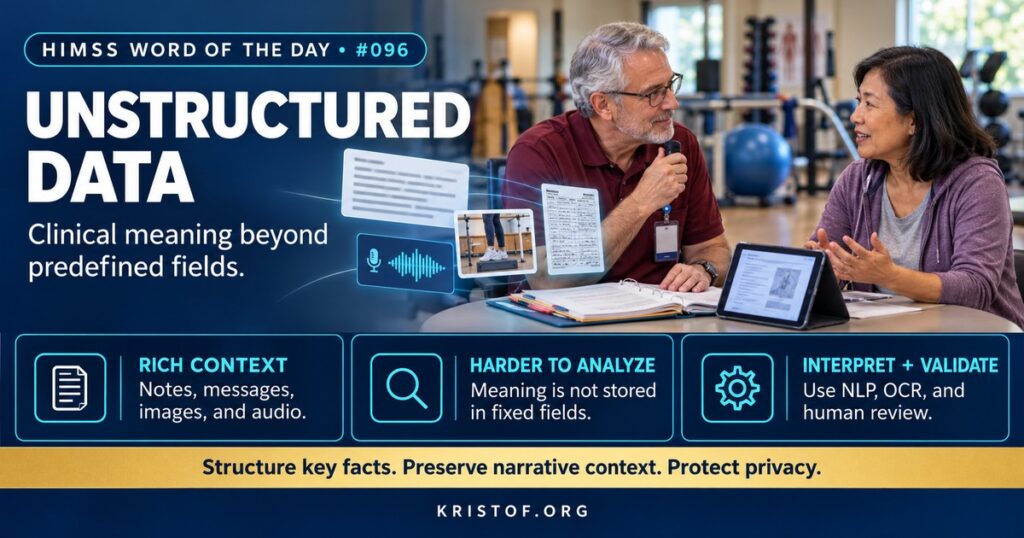
Unstructured data is information that does not follow a predefined data model or consistent format. In healthcare, it includes narrative clinical notes, scanned paper documents, faxed records, images, audio and video, and patient messages.
The HIMSS Dictionary describes unstructured data as data without a recognizable structure, unorganized and raw, which may be textual or non-textual. It also notes that some data is loosely structured: the source has a structure, but not every item in the data set follows it consistently.
| Data Type | Description | Healthcare Example |
|---|---|---|
| Structured | Defined fields with consistent formats and codes | Vital signs, coded allergies, lab results |
| Semi-Structured | Some organization, but flexible content | Note templates with headings and free-text sections; FHIR resources containing narrative |
| Unstructured Text | Free-form language | Progress notes, discharge narratives, portal messages |
| Unstructured Non-Text | Images, audio, video, and scanned files | Wound photos, ECG tracings stored as images, scanned consent forms |
⚠️ Exam Alert: Unstructured data lacks a predefined format. Structured data fits defined fields and codes. Semi-structured data has partial organization, such as headings or tags. Unstructured data is not low value; it often contains the richest context, but it requires people or tools such as natural language processing to interpret it at scale.
🌐 Why It Matters: Real-World Healthcare IT Context
Much of what clinicians know about a patient lives in narrative text and documents. A note explains why a medication was stopped, what the family wants, how the patient responded to teaching, or why a clinician is worried. Outside records often arrive as scanned PDFs or faxes. Imaging and pathology produce enormous non-text files. Patient portal messages describe symptoms in patients’ own words.
That richness is also the challenge. Computers cannot easily search, count, or act on unstructured data. A decision support rule cannot fire on an allergy mentioned only in a note. A quality measure cannot count a screening documented only in narrative. Researchers cannot easily pool data from millions of notes without processing tools.
Natural language processing and AI are changing that. Tools can extract problems, medications, symptoms, and social needs from text; summarize long records; classify patient messages; and draft documentation from conversations. Computer vision analyzes images. These tools make unstructured data far more usable, but they introduce questions about accuracy, bias, and oversight, and their output needs validation.
Patient-generated text is a growing category. Portal messages, symptom descriptions, and survey comments arrive in patients’ own words, often with spelling variations and informal language. Organizations use classification tools to route messages to the right team and flag urgent concerns, but those tools must be monitored carefully so that a message describing an emergency is never delayed by misclassification.
Unstructured data also raises privacy challenges. Identifiers appear throughout notes and documents in unpredictable places, making de-identification harder than for structured fields. Scanned documents may contain sensitive information that is not labeled or protected the way structured data is.
Storage and retention are practical concerns too. Images, scanned documents, and audio consume large amounts of storage, and organizations must keep them according to retention policies while protecting them as carefully as structured data.
Common challenges with unstructured data:
- Important facts recorded only in narrative, invisible to alerts and reports
- Scanned outside records that are hard to search
- Inconsistent abbreviations and shorthand
- Copy-forward text that hides what is new
- Identifiers scattered throughout notes, complicating de-identification
- Large storage volumes for images and documents
Practices that make unstructured data more useful:
- Structure for high-value data, narrative for reasoning and context
- Clear note templates with consistent headings
- Indexing and labeling of scanned documents by type and date
- Validated NLP tools with clinician review of outputs
- De-identification approaches designed for free text and images
- Governance for AI tools that read or generate text
🏥 The Nurse’s Perspective: Clinical, Bedside, & Workflow
Nurses create and rely on unstructured data throughout every shift.
At the Bedside
Nursing narrative notes capture what flowsheets cannot: a change in mental status, a patient’s fear before surgery, a family conflict, or a concern that does not fit a checkbox. That context helps the next nurse and the provider understand the patient. Clear, concise narrative that focuses on what changed and what was done is more useful than long, copied text.
Images are unstructured data too. Wound photos taken with approved devices and attached to the correct encounter help track healing over time, but they need consistent labeling so they can be found later.
Abbreviations deserve care in narrative. Ambiguous shorthand can confuse both colleagues and NLP tools, so many organizations maintain do-not-use lists and encourage clear, complete wording for critical information.
In Clinical Workflow
Important information should not live only in narrative. If an allergy, a fall, or a skin injury is mentioned in a note, it should also be recorded in the structured place designed for it, so alerts, care plans, and reports reflect it. Narrative and structure work best together.
Outside documents often arrive as scanned files. Nurses reviewing transfer records may need to search through long PDFs for medication lists or recent results. Organizations that index scanned documents by type and date make that work faster and safer.
Voice is becoming another unstructured source. Dictated notes and ambient recordings capture clinical conversations in audio form before they are converted to text, and both the audio and the resulting text need the same privacy protections as the rest of the record.
In EHR Implementation (Go-Live Perspective)
During an Epic Go-Live, legacy documents and notes are often migrated or archived as unstructured files. Clinicians need to know where historical notes and scanned documents live and how to search them.
At-the-elbow support analysts frequently help nurses find scanned documents, attach images correctly, and use note templates that combine structure with narrative. Feedback about hard-to-find documents helps HIM and build teams improve indexing.
🎓 CAHIMS / CPHIMS & HIMSS Perspective
CAHIMS Exam Domain Mapping
Unstructured data appears in data management and AI questions:
| CAHIMS Domain | How Unstructured Data Appears |
|---|---|
| Healthcare & Technology Environments | AI and NLP trends; growth of imaging and document data |
| Clinical Informatics | Balancing narrative and structured documentation; note design |
| Healthcare Information & Systems Management | Document management, NLP, data lakes, storage, de-identification |
| Management & Leadership | AI governance, privacy, storage costs, analytics strategy |
Key Terms to Know Alongside Unstructured Data
- Structured Data — data recorded in defined fields using standard formats and codes
- Semi-Structured Data — data with partial organization, such as tags or headings
- Natural Language Processing (NLP) — methods for extracting meaning from human language
- Optical Character Recognition (OCR) — technology that converts images of text into machine-readable text
- Document Management System — software that stores, indexes, and retrieves documents
- Data Lake — a repository that stores large volumes of raw data in many formats
HIMSS Organizational Position
HIMSS addresses unstructured data through its work on analytics, AI, and documentation burden, encouraging responsible use of NLP and AI to unlock clinical text while maintaining privacy and accuracy. Members can find related education and research through the HIMSS Resource Center.
🔗 Explore Further: External References
- Rosenbloom et al. (2011), JAMIA — Data From Clinical Notes: The Tension Between Structure and Flexible Documentation https://pubmed.ncbi.nlm.nih.gov/21233086/
- Apache cTAKES — Clinical Text Analysis and Knowledge Extraction System https://ctakes.apache.org/
- HHS — Guidance Regarding Methods for De-identification https://www.hhs.gov/hipaa/for-professionals/special-topics/de-identification/index.html
- NIST — AI Risk Management Framework https://www.nist.gov/itl/ai-risk-management-framework
- NIST — Big Data at NIST https://www.nist.gov/itl/big-data-nist
- DICOM Standard — About DICOM https://www.dicomstandard.org/about
Term source: HIMSS Dictionary of Health Information and Technology Terms, Acronyms, and Organizations, 6th Edition (2025). All definitions in this series are paraphrased for editorial purposes. Readers are encouraged to consult the primary source for exact language.
Eric Andrew Kristof, RN, CAHIMS is a Healthcare IT professional and HIMSS Arkansas Chapter member based in Hot Springs Village, AR, with hands-on Epic Go-Live experience and a diverse healthcare and IT background. He writes at kristof.org at the intersection of clinical care and healthcare technology.
Leave a Reply