By Eric Andrew Kristof, RN, CAHIMS | Healthcare IT Professional | HIMSS Arkansas Chapter Member
About This Series: The HIMSS Word of the Day is a running blog series drawing from the HIMSS Dictionary of Health Information and Technology Terms, Acronyms, and Organizations, 6th Edition (2025) — the authoritative reference for healthcare IT professionals and the primary study resource for CAHIMS and CPHIMS certification. Each post paraphrases the term in plain language, grounds it in real-world healthcare IT context, and adds a bedside nursing perspective you won’t find in a textbook.
📖 The Term: The Joint Commission
Source: HIMSS Dictionary of Health Information and Technology Terms, Acronyms, and Organizations, 6th Edition (2025)
🔍 Plain-Language Definition
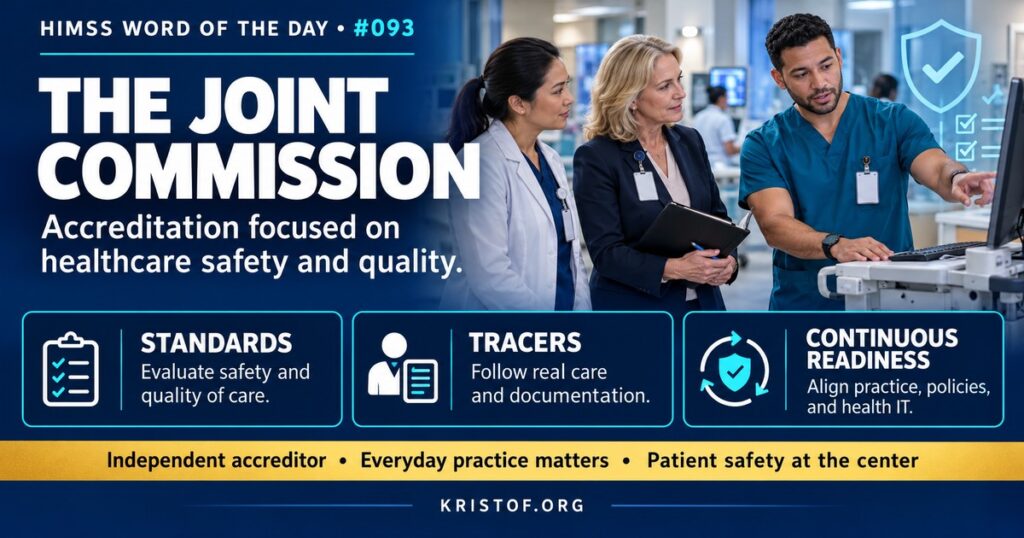
The Joint Commission is a U.S. organization that evaluates healthcare organizations against standards for safety and quality and grants accreditation and certification to those that meet them. Hospitals, ambulatory care centers, behavioral health organizations, home care agencies, laboratories, nursing care centers, and other providers can seek its accreditation.
The HIMSS Dictionary describes The Joint Commission as an independent nonprofit that accredits and certifies roughly 21,000 U.S. healthcare organizations and programs. It notes that Joint Commission accreditation and certification are widely recognized as a sign of quality and of an organization’s commitment to meeting performance standards.
Accreditation has both reputational and regulatory significance:
| Concept | What It Means | Why It Matters |
|---|---|---|
| Accreditation | Recognition that an organization meets the accreditor’s standards | Signals quality to patients, payers, and partners |
| Deemed Status | CMS recognizes an approved accreditor’s survey as evidence of meeting Medicare requirements | Lets accredited hospitals participate in Medicare without a separate state survey for certification |
| Survey | An on-site evaluation, typically unannounced | Tests everyday practice, not just written policies |
| Tracer Methodology | Surveyors follow individual patients or processes across departments | Reveals how care, communication, and documentation work in reality |
| National Patient Safety Goals | Specific safety priorities with defined requirements | Focuses attention on areas such as patient identification and medication safety |
⚠️ Exam Alert: The Joint Commission is a private accrediting organization. CMS sets the Conditions of Participation for Medicare. Deemed status links the two: CMS approves certain accrediting organizations whose standards meet or exceed Medicare requirements. The Joint Commission is one of several such accrediting organizations, not a government agency.
🌐 Why It Matters: Real-World Healthcare IT Context
Accreditation shapes how hospitals operate. To maintain it, organizations must demonstrate compliance with standards covering leadership, infection prevention, medication management, the environment of care, information management, staffing and competence, patient rights, and more. Much of the evidence comes from medical records, policies, and data.
CMS approves accrediting organizations to provide deemed status for Medicare participation. According to CMS, organizations with deeming authority must meet requirements in federal regulations, and their standards must meet or exceed Medicare’s. CMS also conducts validation surveys and complaint investigations to oversee them.
The survey process emphasizes real practice. Surveyors use tracers to follow patients through their care, interviewing staff, observing processes, and reviewing documentation along the way. A single tracer might start in the emergency department, continue through imaging and an inpatient unit, and end with discharge planning, revealing how well information moves between teams.
Health IT plays a central role. Surveyors review documentation of assessments, care plans, medication administration, restraints, pain management, education, and consent. Systems that make required documentation easy to find, consistent, and complete support compliance. Systems that bury information or allow incomplete documentation create risk.
The Joint Commission also addresses technology directly. Its standards and safety communications have discussed issues such as safe use of health IT, alarm safety, and secure communication of orders, all areas where design and governance matter.
Health IT can make readiness continuous rather than episodic. Reports that track timely reassessment, restraint documentation, high-risk medication practices, and education completion let leaders see compliance every week instead of discovering gaps during a survey. Structured documentation is what makes those reports possible, which is one more reason to capture key items in defined fields rather than narrative alone.
Common survey findings related to documentation and IT:
- Incomplete or inconsistent assessments and reassessments
- Care plans that are not individualized or updated
- Missing documentation of patient education or teach-back
- Medication orders or administration records that do not match policy
- Verbal orders or texting practices that do not meet requirements
- Downtime procedures that staff cannot describe
Characteristics of survey-ready organizations:
- Continuous readiness rather than last-minute preparation
- Documentation tools aligned with policies and standards
- Reports that monitor key compliance measures over time
- Staff who can explain their processes confidently
- Mock tracers that test documentation and handoffs
- Clear ownership for each standard area
🏥 The Nurse’s Perspective: Clinical, Bedside, & Workflow
Nurses are central to survey readiness because so much of what surveyors observe and review is nursing practice.
At the Bedside
During a tracer, surveyors may ask a nurse to walk through a patient’s care: how the patient was identified, how pain was assessed and reassessed, how medications were verified, what education was provided, and how the care plan reflects the patient’s goals. Nurses who can explain their practice and show where it is documented demonstrate that the organization’s processes work.
Patient identification, medication safety, alarm management, infection prevention, and fall prevention are frequent topics, and nursing practice is at the heart of each.
In Clinical Workflow
Documentation tells the story of care to surveyors who were not there. Assessments documented on time, reassessments after interventions, clear restraint documentation, and complete handoff communication all show that standards are met in everyday work, not just on paper.
Nurses also help identify gaps before a survey. Mock tracers, chart audits, and unit huddles that review safety goals help teams find and fix problems while there is still time to improve.
Communication standards are another frequent topic. Requirements for how orders are communicated, including restrictions on texting orders through unsecured channels and expectations for verbal order read-back, shape the secure messaging and order entry tools nurses use every day.
In EHR Implementation (Go-Live Perspective)
An Epic Go-Live can affect survey readiness if required documentation moves to unfamiliar places or if policies are not updated to match new workflows. Organizations often align policies, documentation tools, and reports during implementation so that compliance evidence remains easy to produce.
At-the-elbow support analysts can help nurses find where required items are documented in the new system, such as restraint monitoring, pain reassessment, and patient education. After Go-Live, compliance reports help leaders confirm that new workflows still meet standards.
🎓 CAHIMS / CPHIMS & HIMSS Perspective
CAHIMS Exam Domain Mapping
The Joint Commission appears in regulatory and quality questions:
| CAHIMS Domain | How The Joint Commission Appears |
|---|---|
| Healthcare & Technology Environments | Accreditation, deemed status, CMS Conditions of Participation, patient safety goals |
| Clinical Informatics | Documentation supporting standards; tracers; alarm and medication safety |
| Healthcare Information & Systems Management | Compliance reporting, downtime procedures, information management standards |
| Management & Leadership | Survey readiness, policy alignment, quality programs, accountability |
Key Terms to Know Alongside The Joint Commission
- Accreditation — formal recognition that an organization meets established standards
- Deemed Status — CMS recognition that an accredited organization meets Medicare requirements
- Conditions of Participation (CoPs) — federal requirements that providers must meet to participate in Medicare and Medicaid
- Tracer Methodology — a survey approach that follows patients or processes through the organization
- National Patient Safety Goals — specific safety requirements emphasized by The Joint Commission
- Sentinel Event — a patient safety event resulting in death, permanent harm, or severe temporary harm
HIMSS Organizational Position
HIMSS addresses accreditation through its focus on patient safety, quality, and the role of health IT in supporting compliance, and its maturity models emphasize technology-enabled safety practices such as closed-loop medication administration. Members can find related education and research through the HIMSS Resource Center.
🔗 Explore Further: External References
- The Joint Commission https://www.jointcommission.org/
- CMS — Accrediting Organizations (AOs) https://www.cms.gov/medicare/health-safety-standards/quality-safety-oversight-general-information/accrediting-organizations-aos
- eCFR — 42 CFR 482.23, Condition of Participation: Nursing Services https://www.ecfr.gov/current/title-42/chapter-IV/subchapter-G/part-482/subpart-C/section-482.23
- AHRQ — Patient Safety and Quality Improvement https://www.ahrq.gov/patient-safety/index.html
- ONC — SAFER Guides https://healthit.gov/clinical-quality-and-safety/safer-guides/
- AHRQ PSNet — Alert Fatigue https://psnet.ahrq.gov/primer/alert-fatigue
Term source: HIMSS Dictionary of Health Information and Technology Terms, Acronyms, and Organizations, 6th Edition (2025). All definitions in this series are paraphrased for editorial purposes. Readers are encouraged to consult the primary source for exact language.
Eric Andrew Kristof, RN, CAHIMS is a Healthcare IT professional and HIMSS Arkansas Chapter member based in Hot Springs Village, AR, with hands-on Epic Go-Live experience and a diverse healthcare and IT background. He writes at kristof.org at the intersection of clinical care and healthcare technology.
Leave a Reply