By Eric Andrew Kristof, RN, CAHIMS | Healthcare IT Professional | HIMSS Arkansas Chapter Member
About This Series: The HIMSS Word of the Day is a running blog series drawing from the HIMSS Dictionary of Health Information and Technology Terms, Acronyms, and Organizations, 6th Edition (2025) — the authoritative reference for healthcare IT professionals and the primary study resource for CAHIMS and CPHIMS certification. Each post paraphrases the term in plain language, grounds it in real-world healthcare IT context, and adds a bedside nursing perspective you won’t find in a textbook.
📖 The Term: Adverse Drug Reaction (ADR)
Source: HIMSS Dictionary of Health Information and Technology Terms, Acronyms, and Organizations, 6th Edition (2025)
🔍 Plain-Language Definition
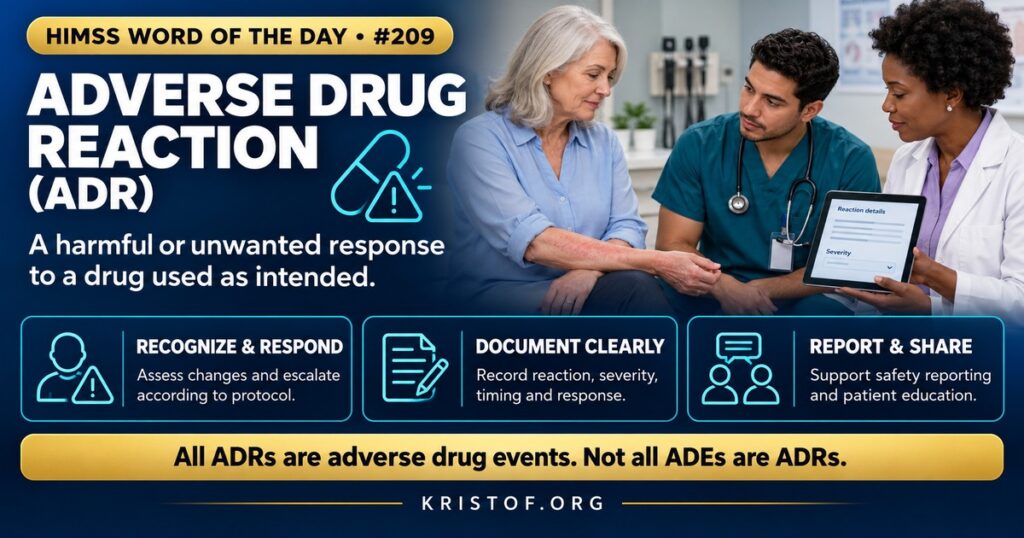
An adverse drug reaction (ADR) is an unwanted response to a therapeutic drug. The HIMSS Dictionary notes that reactions related to drugs and medical devices are important to report to the manufacturer and the FDA to help monitor the safety of products on the market, and it points readers to the related term adverse drug event.
An ADR occurs when a drug is used as intended, at normal doses, and the patient responds in a harmful or unexpected way. That separates it from an adverse drug event, a broader category that includes reactions but also harm from medication errors, overdoses, and omissions.
| Term | Meaning | Example |
|---|---|---|
| Adverse Drug Reaction (ADR) | Unwanted response to a drug used appropriately | Hives after a correctly dosed antibiotic |
| Adverse Drug Event (ADE) | Any injury related to a drug, including errors | Overdose from a wrong dose, or an ADR |
| Side Effect | Known, expected effect that is not the main purpose | Drowsiness from an antihistamine |
| Allergy | Immune-mediated reaction to a substance | Anaphylaxis after penicillin |
| Intolerance | Non-immune unpleasant reaction | Nausea with a medication |
| Medication Error | Preventable failure in the medication process | Wrong drug given |
⚠️ Exam Alert: All ADRs are adverse drug events, but not all ADEs are ADRs, because an ADE can come from an error. A medication error may or may not cause harm. In HL7 version 2, ADR is also the label for an ADT response message, so the abbreviation depends on context.
🌐 Why It Matters: Real-World Healthcare IT Context
Premarket trials involve limited numbers of patients over limited time, so many reactions appear only after a drug reaches broad use. Monitoring after approval depends heavily on reports from clinicians, patients, and manufacturers. Each report is a data point, and patterns across many reports help regulators and manufacturers detect safety signals.
Reporting expectations are often misunderstood. In the United States, the FDA’s MedWatch program receives voluntary reports from health professionals and the public using standard forms, and the FDA states that individual health professionals are not required by law to submit them. Manufacturers, importers, and device user facilities, in contrast, have mandatory reporting duties under FDA regulations. For medical devices, hospitals and similar user facilities must report device-related deaths to the FDA and the manufacturer, and serious injuries to the manufacturer. Organizations also have internal reporting systems and may participate in patient safety organizations. The FDA has been consolidating its adverse event systems, including the former FAERS, VAERS, and MAUDE, under a single Adverse Event Monitoring System that launched in 2026.
Underreporting is a persistent problem. A 2026 scoping review of studies on physicians, nurses, and pharmacists examined barriers to reporting in high-income and low- and middle-income countries. Across 44 studies, knowledge and training barriers appeared in every study in both groups. Fear of legal or punitive consequences was reported in about 72 percent of high-income-country studies and 65 percent of low- and middle-income-country studies, and time and workload barriers appeared in about 56 percent and 42 percent respectively. The pattern suggests that making reporting easy, safe, and routine matters as much as awareness.
The wider picture of medication harm comes from hospital studies. A classic prospective study of more than 4,000 admissions to two tertiary care hospitals found about 6.5 adverse drug events per 100 nonobstetrical admissions, and 28 percent of the events were judged preventable. Nurses and pharmacists were important sources of case detection through stimulated self-report. That study concerned the broader ADE category, which includes reactions, but it shows how frequent and detectable medication-related harm is in hospitals.
EHRs support ADR safety in several ways. Allergy and reaction lists record what happened, how severe it was, and what the patient experienced, so decision support can warn about related drugs. Structured entries, using standard terminologies for substances and reactions, work better than free text. Clinical decision support can also prompt clinicians to document a reaction when a rescue medication is ordered, and reports can be generated from the EHR to speed submission. Quality matters: outdated or vague allergy entries create alert fatigue, and missing entries create gaps.
Reaction documentation should distinguish true allergies from intolerances and side effects, include severity and date when possible, and be reviewed regularly. Over-labeling can limit appropriate care, since broad penicillin allergy labels that are not true allergies can lead to the use of less ideal antibiotics.
Common ADR documentation and reporting problems:
- Reactions not recorded or recorded only in free text
- Intolerances recorded as allergies, creating unnecessary alerts
- Reports delayed or never submitted
- Fear of blame discouraging reports
- Unclear ownership of who submits to external systems
- Allergy lists never reviewed or updated
What supports ADR safety:
- Structured allergy and reaction entries with severity
- Decision support tied to documented reactions
- Easy internal reporting with feedback
- Clear roles for pharmacy, nursing, and providers in external reporting
- Regular review and cleanup of allergy lists
- Education that frames reporting as protection, not blame
🏥 The Nurse’s Perspective: Clinical, Bedside, & Workflow
Nurses are often the first to see a reaction and the first to document it, so their observations shape both the patient’s care and the safety data that follows.
At the Bedside
Recognizing a reaction means knowing the drug’s common reactions, watching for changes after new medications or doses, and acting on early signs. When a reaction occurs, the priority is the patient: stop the medication per protocol, assess, notify the provider, and treat as ordered.
Documentation should capture what was observed, when it started in relation to the dose, the interventions, and the patient’s response. Entering the reaction in the allergy or adverse reaction section, with a clear description and severity, protects the patient across future encounters.
In Clinical Workflow
Reporting through the organization’s event system and, with pharmacy, to the FDA when appropriate helps surface patterns. Specific details such as lot numbers, dose, route, and timing help investigators.
Patient education closes the loop. Telling patients and families which reaction occurred and how to describe it, and making sure it is on discharge paperwork, helps prevent a repeat at another facility.
Nurse informaticists help refine allergy and reaction lists, review decision support for ADR-related alerts, and make sure reporting forms are simple enough to use during a busy shift.
In EHR Implementation (Go-Live Perspective)
An Epic Go-Live includes migration of allergy data, training on structured reaction entry, and testing of alerts that use allergy information. Cleaning and converting free-text allergies before go-live reduces noise.
At-the-elbow support analysts help nurses find the allergy and reaction sections, choose the right severity and reaction type, and report alerts that fire incorrectly.
🎓 CAHIMS / CPHIMS & HIMSS Perspective
CAHIMS Exam Domain Mapping
ADRs appear in safety, decision support, and standards questions:
| CAHIMS Domain | How ADRs Appear |
|---|---|
| Healthcare & Technology Environments | FDA reporting, pharmacovigilance, regulatory roles |
| Clinical Informatics | Allergy and reaction documentation, alerts, terminology |
| Healthcare Information & Systems Management | Reporting interfaces, allergy list data quality, alert tuning |
| Management & Leadership | Event reporting culture, medication safety governance |
Key Terms to Know Alongside ADR
- Adverse Drug Event (ADE) — injury related to a drug, including reactions and errors
- Pharmacovigilance — monitoring the safety of drugs after they reach the market
- MedWatch — FDA program for reporting problems with medical products
- Medication Error — preventable failure in ordering, dispensing, or administering a drug
- Alert Fatigue — reduced response to alerts when too many are low value
- Allergy and Reaction List — structured EHR list of substances and reactions
HIMSS Organizational Position
HIMSS supports medication safety and patient safety through education, research, and its clinical and nursing informatics communities. Members can find related resources through the HIMSS Resource Center.
🔗 Explore Further: External References
- FDA — MedWatch: The FDA Safety Information and Adverse Event Reporting Program https://www.fda.gov/safety/medwatch-fda-safety-information-and-adverse-event-reporting-program
- FDA — Medical Device Reporting (MDR): How to Report Medical Device Problems https://www.fda.gov/medical-devices/medical-device-safety/medical-device-reporting-mdr-how-report-medical-device-problems
- FDA — Adverse Event Monitoring System (AEMS) https://www.fda.gov/drugs/surveillance-post-drug-approval-activities/fda-adverse-event-monitoring-system-aems
- Ishaqui et al. (2026), Healthcare — Barriers to Adverse Drug Reaction Reporting Among Physicians, Nurses, and Pharmacists: A Scoping Review Comparing High-Income Versus Low-/Middle-Income Countries https://pubmed.ncbi.nlm.nih.gov/41975933/
- Bates et al. (1995), JAMA — Incidence of Adverse Drug Events and Potential Adverse Drug Events: Implications for Prevention https://pubmed.ncbi.nlm.nih.gov/7791255/
- AHRQ PSNet — Medication Errors and Adverse Drug Events https://psnet.ahrq.gov/primer/medication-errors-and-adverse-drug-events
Term source: HIMSS Dictionary of Health Information and Technology Terms, Acronyms, and Organizations, 6th Edition (2025). All definitions in this series are paraphrased for editorial purposes. Readers are encouraged to consult the primary source for exact language.
Eric Andrew Kristof, RN, CAHIMS is a Healthcare IT professional and HIMSS Arkansas Chapter member based in Hot Springs Village, AR, with hands-on Epic Go-Live experience and a diverse healthcare and IT background. He writes at kristof.org at the intersection of clinical care and healthcare technology.
Leave a Reply