By Eric Andrew Kristof, RN, CAHIMS | Healthcare IT Professional | HIMSS Arkansas Chapter Member
About This Series: The HIMSS Word of the Day is a running blog series drawing from the HIMSS Dictionary of Health Information and Technology Terms, Acronyms, and Organizations, 6th Edition (2025) — the authoritative reference for healthcare IT professionals and the primary study resource for CAHIMS and CPHIMS certification. Each post paraphrases the term in plain language, grounds it in real-world healthcare IT context, and adds a bedside nursing perspective you won’t find in a textbook.
📖 The Term: Administrative Code Sets
Source: HIMSS Dictionary of Health Information and Technology Terms, Acronyms, and Organizations, 6th Edition (2025)
🔍 Plain-Language Definition
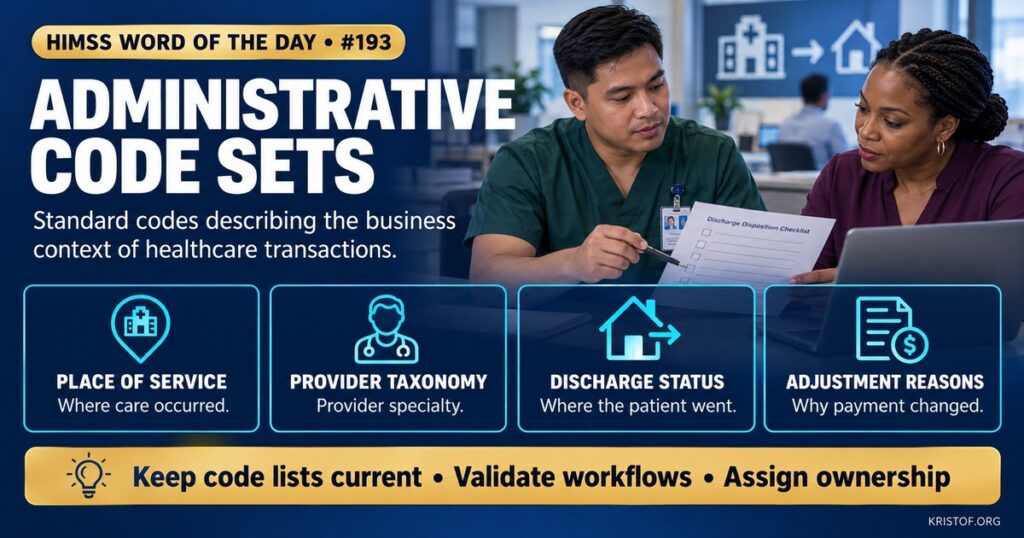
Administrative code sets are standardized lists of codes that describe a general business situation in a health care transaction rather than a medical condition or a clinical service. Under HIPAA they are sometimes called nonclinical or nonmedical code sets.
HIPAA regulations define a code set broadly as any set of codes used to encode data elements, and a code set includes both the codes and their descriptions. The HIMSS Dictionary contrasts administrative code sets with medical code sets, which classify diagnoses, procedures, drugs, and supplies.
| Category | What It Describes | Examples |
|---|---|---|
| Medical Data Code Sets | Diagnoses, procedures, drugs, supplies | ICD-10, CPT, HCPCS, CDT, NDC |
| Place of Service Codes | Where a service was delivered | Office, inpatient hospital, home, telehealth |
| Provider Taxonomy Codes | A provider’s area of specialty | Registered nurse specialty or physician specialty |
| Patient Discharge Status Codes | Where the patient went after a facility stay | Home, skilled nursing facility, another hospital |
| Claim Adjustment Reason and Remark Codes | Why a payer changed or denied payment | Used on remittance advice |
⚠️ Exam Alert: Medical data code sets describe what happened clinically. Administrative code sets describe the business context, such as the site, the provider type, or the reason for a payment adjustment. Both can appear on the same claim. Do not assume that a code on a claim is clinical just because it came from a clinical department.
🌐 Why It Matters: Real-World Healthcare IT Context
A health care claim is more than a diagnosis and a procedure. The payer also needs to know where care took place, which type of provider delivered it, how the encounter ended, and what happened to payment. Administrative code sets carry that context in a standard form so computers at the provider, clearinghouse, and payer can interpret the same value the same way.
HIPAA’s administrative simplification rules require covered entities to use adopted standards for electronic transactions. The regulation that lists the medical data code sets includes ICD-10-CM and ICD-10-PCS for diagnoses and procedures, the National Drug Code for drugs and biologics, the dental procedure code set, and the combination of HCPCS and CPT for physician and other services. CMS describes these as the code sets HHS adopted for diagnoses and procedures. Administrative values are specified differently: they come from the implementation guides and external code lists that accompany each transaction standard, and each is maintained by an organization responsible for that list.
Several examples show the pattern. CMS maintains the place of service code set used on professional claims to describe the setting where a service was provided. The National Uniform Claim Committee maintains the provider taxonomy code set, which providers select to indicate their area of specialty rather than the services rendered. The National Uniform Billing Committee maintains data specifications for institutional claims, including values such as patient discharge status. X12 publishes code lists, including the claim adjustment reason codes and remittance advice remark codes that explain why a payer adjusted or denied a payment.
These codes matter for operations as well as billing. Place of service and provider type can change how a service is paid. Discharge status can affect payment rules for some stays and feeds quality and transition-of-care reporting. Denial reason codes guide the work of revenue cycle teams and highlight patterns that clinicians can fix upstream, such as missing documentation or registration errors.
Maintenance is an ongoing task. Code sets are revised on schedules set by their maintaining organizations, and CMS provides an enforcement tool for submitting complaints about potential code set violations. Organizations need processes to update tables in the EHR, practice management, and billing systems on time, and to test the changes before they reach production.
Accuracy depends on registration and documentation. A wrong patient class, a mismatched site of care, or an outdated discharge disposition can send a claim down the wrong path even when the clinical coding is perfect.
Common administrative code set problems:
- Outdated tables after a code list revision
- Wrong place of service or patient class at registration
- Discharge status chosen late or inconsistently
- Provider taxonomy that does not match enrollment
- Denial codes reviewed rarely or not shared with clinical teams
- Confusion between clinical and administrative codes during mapping
What supports good administrative code management:
- Scheduled updates with testing before go-live
- Registration and discharge workflows that capture the right values
- Reports that connect denial reasons to their root causes
- Clear ownership between revenue cycle, informatics, and clinical teams
- Reference to the maintaining organization for each list
- Education on which fields are clinical and which are administrative
🏥 The Nurse’s Perspective: Clinical, Bedside, & Workflow
Most nurses never assign an administrative code, yet nursing workflows often supply the information behind one.
At the Bedside
Accurate documentation of where care happened and how the patient left supports the administrative side of the record. A discharge activity completed late, or a disposition chosen carelessly, can change what appears on the claim and what appears in transition-of-care reports.
Clinical details also support payment decisions indirectly. When a denial cites missing documentation, the explanation often traces back to the clinical record, so complete assessments and timely entries protect both the patient story and the claim.
In Clinical Workflow
Case managers and discharge planners work closely with disposition choices, such as home with services or a skilled nursing facility. Nurses on the unit coordinate with them so the documented plan, the transport arrangements, and the disposition value agree.
Quality and denial teams sometimes ask clinicians to review patterns. Nurses who understand that these codes describe the business context, not the clinical care, can answer questions about workflow without confusion over terminology.
Nurse informaticists often sit between clinical and revenue cycle teams. They help translate a denial pattern into a practical change, such as a required field at discharge or a clearer prompt in the registration workflow.
In EHR Implementation (Go-Live Perspective)
An Epic Go-Live includes build and testing for registration, patient class, discharge disposition lists, and billing tables. Scenario testing follows a patient from arrival to discharge to confirm that the values nurses select flow correctly into claims.
At-the-elbow support analysts see the effect of these tables when staff struggle to pick a disposition that fits a real situation. Feedback gathered in the first days helps revenue cycle and clinical leaders adjust the lists.
🎓 CAHIMS / CPHIMS & HIMSS Perspective
CAHIMS Exam Domain Mapping
Code set questions appear in standards, policy, and revenue cycle contexts:
| CAHIMS Domain | How Administrative Code Sets Appear |
|---|---|
| Healthcare & Technology Environments | HIPAA transactions and code sets, standards bodies |
| Clinical Informatics | Documentation fields that feed claims, discharge disposition |
| Healthcare Information & Systems Management | Table maintenance, interfaces, billing system updates |
| Management & Leadership | Compliance, denial management, ownership of code updates |
Key Terms to Know Alongside Administrative Code Sets
- Medical Data Code Sets — standard code lists for diagnoses, procedures, drugs, and supplies
- Place of Service (POS) — code describing the setting where a service was delivered
- Provider Taxonomy — code indicating a provider’s area of specialty
- Remittance Advice — payer explanation of how a claim was paid or adjusted
- Electronic Data Interchange (EDI) — structured electronic exchange of administrative transactions
- Administrative Simplification — HIPAA provisions that standardize transactions, code sets, and identifiers
HIMSS Organizational Position
HIMSS supports standards-based exchange of health information and education on regulatory requirements that affect health information management. Members can find related resources through the HIMSS Resource Center.
🔗 Explore Further: External References
- CMS — Code Sets Overview (HIPAA Administrative Simplification) https://www.cms.gov/priorities/key-initiatives/burden-reduction/administrative-simplification/code-sets
- eCFR — 45 CFR Part 162, Subpart J, Code Sets https://www.ecfr.gov/current/title-45/subtitle-A/subchapter-C/part-162/subpart-J
- CMS — Place of Service Codes https://www.cms.gov/medicare/coding-billing/place-of-service-codes
- NUCC — Health Care Provider Taxonomy https://nucc.org/index.php/code-sets-mainmenu-41/provider-taxonomy-mainmenu-40
- NUBC — National Uniform Billing Committee https://www.nubc.org/
- X12 — Code Lists (Claim Adjustment Reason Codes and Remittance Advice Remark Codes) https://x12.org/codes
Term source: HIMSS Dictionary of Health Information and Technology Terms, Acronyms, and Organizations, 6th Edition (2025). All definitions in this series are paraphrased for editorial purposes. Readers are encouraged to consult the primary source for exact language.
Eric Andrew Kristof, RN, CAHIMS is a Healthcare IT professional and HIMSS Arkansas Chapter member based in Hot Springs Village, AR, with hands-on Epic Go-Live experience and a diverse healthcare and IT background. He writes at kristof.org at the intersection of clinical care and healthcare technology.
Leave a Reply