By Eric Andrew Kristof, RN, CAHIMS | Healthcare IT Professional | HIMSS Arkansas Chapter Member
About This Series: The HIMSS Word of the Day is a running blog series drawing from the HIMSS Dictionary of Health Information and Technology Terms, Acronyms, and Organizations, 6th Edition (2025) — the authoritative reference for healthcare IT professionals and the primary study resource for CAHIMS and CPHIMS certification. Each post paraphrases the term in plain language, grounds it in real-world healthcare IT context, and adds a bedside nursing perspective you won’t find in a textbook.
📖 The Term: Certified EHR Technology (CEHRT)
Source: HIMSS Dictionary of Health Information and Technology Terms, Acronyms, and Organizations, 6th Edition (2025)
🔍 Plain-Language Definition
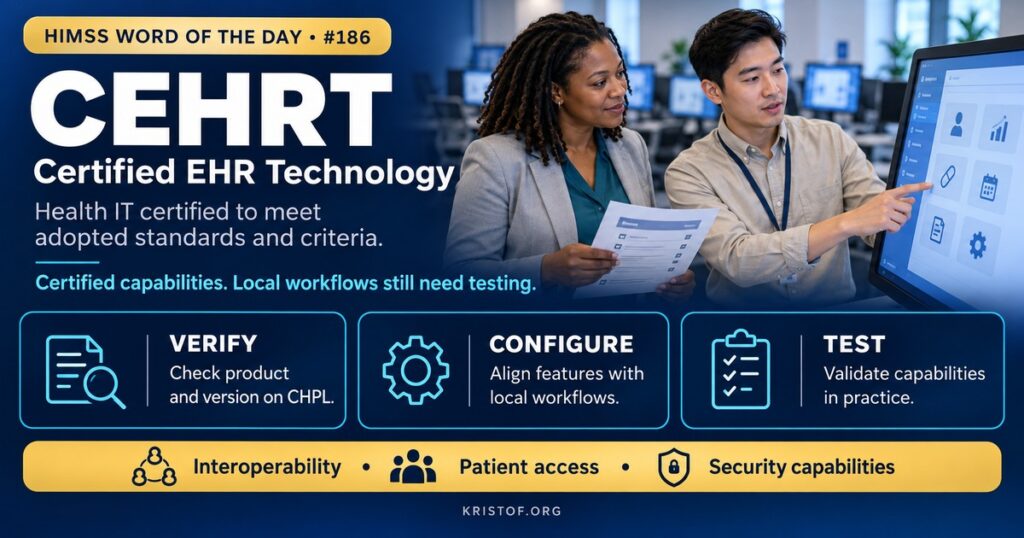
Certified EHR technology (CEHRT) is electronic health record technology that has been certified under the ONC Health IT Certification Program as meeting specific standards, implementation specifications, and certification criteria adopted by HHS, and that meets the definition CMS uses for its programs.
The HIMSS Dictionary describes CEHRT as technology meeting the structured data standards and criteria established by CMS and ONC so that it qualifies for use in CMS Promoting Interoperability programs. It explains that certification assures an EHR system or module has the technical capability, functionality, and security needed to help users meet program requirements, and helps providers and patients trust that certified products are secure, protect confidentiality, and can share information with other systems.
| CEHRT Concept | What It Means | Example |
|---|---|---|
| ONC Health IT Certification Program | Voluntary federal program certifying health IT | Testing an EHR against certification criteria |
| Certification Criteria | Specific capabilities products must demonstrate | Standardized APIs, e-prescribing, clinical decision support |
| ONC-Authorized Certification Body | Organization that certifies products and conducts surveillance | Certifying a vendor’s EHR release |
| Certified Health IT Product List (CHPL) | Public list of certified products and versions | Looking up a product’s certified criteria |
| Real-World Testing | Developers’ demonstration that capabilities work in practice | Annual plans and results for interoperability features |
| CMS CEHRT Definition | What programs require providers to use | Requirements for Promoting Interoperability and MIPS |
⚠️ Exam Alert: ONC certifies health IT; CMS requires CEHRT for certain payment programs. Certification is voluntary for developers but effectively necessary for products used in CMS programs. Certification confirms capabilities, not how well an organization configures or uses them. The CHPL is where to verify certification.
🌐 Why It Matters: Real-World Healthcare IT Context
Federal certification was created to ensure that EHRs purchased with incentive payments under the HITECH Act could support meaningful use. Over time, certification has become a baseline for interoperability and patient access capabilities across U.S. health IT.
CMS programs depend on CEHRT. The Medicare Promoting Interoperability Program for hospitals and the Promoting Interoperability category of MIPS for clinicians require use of certified technology for measures such as e-prescribing, health information exchange, and providing patients electronic access to their health information.
Certification criteria have evolved. Successive rules added requirements for standardized FHIR-based APIs, the United States Core Data for Interoperability, electronic health information export, and security capabilities. ONC’s HTI-1 rule moved the program away from numbered editions toward a single set of criteria updated over time, and added transparency requirements for decision support interventions, including predictive models. The office has since been reorganized within HHS, and certification requirements continue to change through rulemaking.
Conditions and maintenance of certification extend beyond testing. Developers must attest to requirements such as not engaging in information blocking, supporting real-world testing of interoperability features, communicating openly about usability and safety, and meeting API requirements.
The CHPL provides transparency. Organizations can look up products, versions, certified criteria, and related information. CMS program participants use certification identification numbers from the CHPL when attesting.
Certification has limits. It verifies that products can perform specific functions under test conditions. It does not guarantee usability, safety, or effective configuration in a particular organization. Local build choices, workflows, and training greatly affect outcomes. ONC’s SAFER Guides and organizational testing complement certification.
Certification also shapes the market. Requirements influence what features vendors prioritize, and the cost of certification can affect smaller developers. Specialty and post-acute settings that were not part of incentive programs have historically had fewer certified options.
Certification extends beyond EHRs. Modules such as patient portals, interface engines, clinical quality measure calculators, and API platforms can be certified for specific criteria, and organizations may combine products from different developers to meet program requirements. Tracking which certified products and versions together satisfy the CEHRT definition is an important compliance task.
Organizations must keep their certified technology current. When certification criteria change, vendors release updated versions, and providers must upgrade by program deadlines to remain compliant.
Surveillance continues after certification. ONC-authorized certification bodies investigate complaints and conduct surveillance of certified products in the field, and developers must correct nonconformities. Users who find that certified capabilities do not work as required can report concerns, contributing to program oversight.
Common CEHRT challenges:
- Keeping up with changing criteria and deadlines
- Assuming certification guarantees usability or safety
- Upgrading versions in time for program requirements
- Gaps between certified capabilities and actual use
- Certification costs for smaller developers
- Limited certified options in some care settings
What helps organizations use CEHRT well:
- Verifying products and versions on the CHPL
- Planning upgrades around program timelines
- Configuring and testing certified features in local workflows
- Using SAFER Guides and usability testing
- Monitoring interoperability performance in practice
- Engaging clinicians in optimization
🏥 The Nurse’s Perspective: Clinical, Bedside, & Workflow
Certification affects the tools nurses use, even if it is rarely visible.
At the Bedside
Certified capabilities include features nurses use daily, such as medication and allergy lists, clinical decision support, and electronic medication administration support. Certification ensures baseline functions exist, but how they are configured determines how well they support nursing work.
Patient access requirements tied to certification mean patients can view and download their information through portals and apps. Nurses often help patients use these tools.
In Clinical Workflow
Transitions of care rely on certified capabilities for exchanging summary of care documents and receiving outside information. Nurses benefit when these features are configured and used consistently.
Standardized data required by certification, such as USCDI elements, improves the chance that nursing-relevant information, like allergies, problems, and vital signs, transfers correctly between organizations.
Nurse informaticists help organizations understand which certified features exist but are not yet used, identifying opportunities for optimization.
Patient education resources and summary of care documents are often tied to program measures, so understanding where these features live helps nurses complete them consistently.
In EHR Implementation (Go-Live Perspective)
During an Epic Go-Live, organizations ensure that the certified version they implement meets program requirements and that certified features are activated and tested. Program attestation depends on using certified functions in practice.
At-the-elbow support analysts help clinicians use features tied to program measures, such as sending summaries of care and patient education resources.
🎓 CAHIMS / CPHIMS & HIMSS Perspective
CAHIMS Exam Domain Mapping
CEHRT appears in policy and systems management questions:
| CAHIMS Domain | How CEHRT Appears |
|---|---|
| Healthcare & Technology Environments | ONC certification; CMS Promoting Interoperability; HITECH history |
| Clinical Informatics | Certified clinical capabilities, patient access, transitions of care |
| Healthcare Information & Systems Management | Certification criteria, CHPL, version upgrades, APIs |
| Management & Leadership | Vendor selection, compliance planning, program attestation |
Key Terms to Know Alongside CEHRT
- ONC Health IT Certification Program — the federal program that certifies health IT
- Certified Health IT Product List (CHPL) — the public list of certified products
- Promoting Interoperability — CMS programs requiring CEHRT use
- USCDI — the standardized set of data classes and elements for exchange
- Real-World Testing — developer demonstrations of interoperability in production settings
- Information Blocking — practices that interfere with access, exchange, or use of electronic health information
HIMSS Organizational Position
HIMSS engages on certification and interoperability policy through comments on ONC and CMS rules and supports members with education on certification requirements. Members can find related education and research through the HIMSS Resource Center.
🔗 Explore Further: External References
- ONC — About the ONC Health IT Certification Program https://healthit.gov/certification-health-it/about-onc-health-it-certification-program/
- ONC — Certified Health IT Product List (CHPL) https://chpl.healthit.gov/
- CMS — Promoting Interoperability Programs https://www.cms.gov/medicare/regulations-guidance/promoting-interoperability-programs
- ONC — HTI-1 Final Rule https://healthit.gov/regulations/hti-rules/hti-1-final-rule/
- ONC — Information Blocking https://healthit.gov/information-blocking/
- HIMSS — Public Policy & Advocacy https://www.himss.org/public-policy-advocacy-overview
Term source: HIMSS Dictionary of Health Information and Technology Terms, Acronyms, and Organizations, 6th Edition (2025). All definitions in this series are paraphrased for editorial purposes. Readers are encouraged to consult the primary source for exact language.
Eric Andrew Kristof, RN, CAHIMS is a Healthcare IT professional and HIMSS Arkansas Chapter member based in Hot Springs Village, AR, with hands-on Epic Go-Live experience and a diverse healthcare and IT background. He writes at kristof.org at the intersection of clinical care and healthcare technology.
Leave a Reply