By Eric Andrew Kristof, RN, CAHIMS | Healthcare IT Professional | HIMSS Arkansas Chapter Member
About This Series: The HIMSS Word of the Day is a running blog series drawing from the HIMSS Dictionary of Health Information and Technology Terms, Acronyms, and Organizations, 6th Edition (2025) — the authoritative reference for healthcare IT professionals and the primary study resource for CAHIMS and CPHIMS certification. Each post paraphrases the term in plain language, grounds it in real-world healthcare IT context, and adds a bedside nursing perspective you won’t find in a textbook.
📖 The Term: Middleware
Source: HIMSS Dictionary of Health Information and Technology Terms, Acronyms, and Organizations, 6th Edition (2025)
🔍 Plain-Language Definition
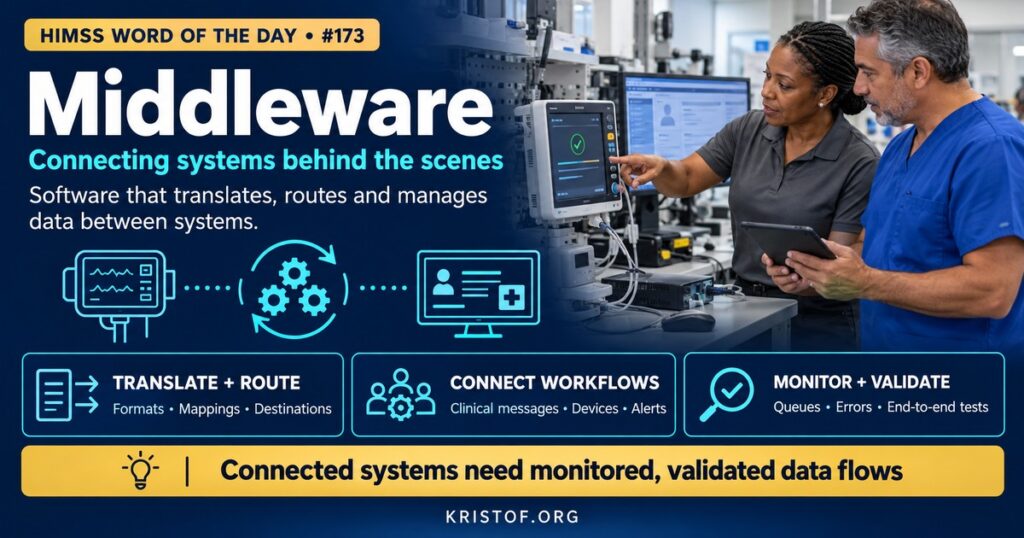
Middleware is software that sits between operating systems, applications, devices, and databases to connect them, translating, routing, and managing data and requests so that different systems can work together.
The HIMSS Dictionary describes middleware as software that acts as a conversion or translation layer and also as a consolidator and integrator. It notes that custom middleware has been built for decades to let one application interface with another built on another platform or supplied by another vendor.
| Middleware Type | What It Does | Healthcare Example |
|---|---|---|
| Interface or Integration Engine | Routes and transforms messages between systems | Converting lab results into the EHR‘s HL7 format |
| Message Broker or Queue | Delivers messages reliably between applications | Queuing orders when a receiving system is down |
| Enterprise Service Bus (ESB) | Coordinates services across an enterprise | Orchestrating calls between registration and billing services |
| API Gateway | Manages, secures, and routes API traffic | Controlling app access to FHIR APIs |
| Device Integration Middleware | Collects data from medical devices | Sending monitor vital signs to the EHR |
| Alarm and Notification Middleware | Routes alerts to the right clinician | Sending a bed exit alarm to a nurse’s phone |
⚠️ Exam Alert: Middleware is the broad category of software that connects systems. An interface engine is a specific type of middleware for clinical messaging. Device middleware connects medical devices to clinical systems. Middleware enables interoperability but adds another component that can fail.
🌐 Why It Matters: Real-World Healthcare IT Context
Hospitals run many systems from many vendors: EHRs, laboratory and radiology systems, pharmacy systems, medical devices, billing systems, and more. These systems rarely speak the same language natively. Middleware bridges the gaps, translating formats, mapping codes, and routing data so information reaches where it is needed.
Interface engines are the best-known healthcare middleware. They receive HL7 Version 2 messages, transform them, and route them to destination systems, reducing the number of point-to-point connections. Modern integration platforms also support FHIR APIs, web services, and file transfers.
Device middleware has become critical. Physiologic monitors, infusion pumps, ventilators, and other devices produce data that must reach the EHR in the right patient’s chart. Device integration middleware collects, validates, and forwards this data, and supports patient-device association.
Alarm middleware addresses alarm fatigue. Systems that route alarms from monitors, nurse call, and beds to clinicians’ mobile devices can filter, delay, or escalate alerts based on rules, helping ensure important alarms reach the right person. Poorly configured rules, however, can overwhelm clinicians or delay critical alerts.
Middleware adds both value and risk. It centralizes integration, provides monitoring and logging, and simplifies changes. But a middleware failure can silently stop data flow between many systems at once. Results might not arrive, orders might not cross, or device data might stop updating, sometimes without obvious warning to clinicians.
Monitoring is essential. Integration teams watch message queues, error rates, and connection status, and set alerts for backlogs. Clinicians should know how to recognize and report signs of interface problems.
Security applies to middleware too. Because middleware handles large volumes of PHI and connects many systems, it must be protected with access controls, encryption, patching, and logging. An attacker who compromises middleware can access or alter data across systems.
Ownership must be clear. Middleware sits between teams: application owners, integration analysts, clinical engineering, and vendors may all touch a single data flow. Without clear ownership and documentation, troubleshooting can stall while teams debate where a problem lies. Service maps that show each step in critical data flows, with named owners, shorten recovery time.
Modernization continues. Cloud integration platforms, event streaming, and API management tools are expanding what middleware can do, while organizations maintain legacy interfaces that still carry much clinical data.
Version changes in connected systems can break middleware transformations. When a vendor upgrades a laboratory system or device firmware, integration teams retest affected interfaces before and after the change.
Common middleware risks:
- Silent interface failures and message backlogs
- Mapping errors that change meaning or units
- Single points of failure for many connections
- Alarm rules that delay or overload notifications
- Limited documentation of custom transformations
- Security weaknesses in integration servers
Practices for reliable middleware:
- Continuous monitoring and alerting for queues and errors
- Documented mappings and change control
- Redundancy and failover for critical integration
- Testing of transformations with real-world scenarios
- Clinical input on alarm routing rules
- Strong security controls and patching
🏥 The Nurse’s Perspective: Clinical, Bedside, & Workflow
Middleware is invisible to most nurses until something stops arriving.
At the Bedside
Vital signs that automatically flow from monitors to the chart depend on device middleware. When values stop updating or appear in the wrong patient’s chart, nurses should report the issue promptly and document manually as needed.
Alarm notifications on mobile devices travel through alarm middleware. If alarms arrive late or not at all, reporting specifics, such as the time, device, and type of alarm, helps teams investigate.
Bed exit and nurse call alarms routed through middleware should be tested after any unit changes, such as new rooms or reassigned phones, so alerts reach the right nurse.
In Clinical Workflow
Missing lab results, orders that never reach pharmacy, or outside records that do not appear may signal an interface problem. Nurses often notice these gaps first, and quick reporting can reveal problems affecting many patients.
Nurses and clinical leaders contribute to alarm routing rules, deciding which alarms go to whom, escalation timing, and which low-value alarms can be filtered. Clinical input prevents both alarm fatigue and missed alarms.
Validating device data before it becomes part of the record remains a nursing responsibility, even when middleware transfers data automatically.
Downtime procedures should include what to do when automated device data stops flowing, such as returning to manual vital sign documentation until integration is restored.
In EHR Implementation (Go-Live Perspective)
During an Epic Go-Live, integration teams build and test hundreds of interfaces and device connections through middleware. End-to-end testing with clinical scenarios confirms that data moves correctly.
At-the-elbow support analysts help nurses report interface and device problems with useful details. Early detection of mapping errors, such as wrong units or missing results, prevents patient safety issues.
🎓 CAHIMS / CPHIMS & HIMSS Perspective
CAHIMS Exam Domain Mapping
Middleware appears in integration and infrastructure questions:
| CAHIMS Domain | How Middleware Appears |
|---|---|
| Healthcare & Technology Environments | Interoperability infrastructure; device integration trends |
| Clinical Informatics | Device data validation, alarm routing, missing results |
| Healthcare Information & Systems Management | Interface engines, message brokers, API gateways, monitoring |
| Management & Leadership | Integration strategy, vendor management, risk and redundancy |
Key Terms to Know Alongside Middleware
- Interface Engine — middleware that routes and transforms clinical messages
- HL7 Version 2 — a widely used messaging standard for clinical data
- Message Queue — a mechanism that stores messages until they can be processed
- API Gateway — a component that manages and secures API traffic
- Device Integration — automated transfer of medical device data into clinical systems
- Alarm Management — processes and tools for routing and reducing clinical alarms
HIMSS Organizational Position
HIMSS supports standards-based integration through its interoperability education and its collaboration with IHE, including work on device integration. Members can find related education and research through the HIMSS Resource Center.
🔗 Explore Further: External References
- HL7 International — HL7 Version 2 Product Suite https://www.hl7.org/implement/standards/product_brief.cfm?product_id=185
- HL7 — FHIR RESTful API https://hl7.org/fhir/http.html
- IHE International — Profiles https://www.ihe.net/resources/profiles/
- ONC — Interoperability Standards Platform https://isp.healthit.gov/
- FDA — Medical Device Cybersecurity https://www.fda.gov/medical-devices/digital-health-center-excellence/cybersecurity
- HIMSS — Public Policy & Advocacy https://www.himss.org/public-policy-advocacy-overview
Term source: HIMSS Dictionary of Health Information and Technology Terms, Acronyms, and Organizations, 6th Edition (2025). All definitions in this series are paraphrased for editorial purposes. Readers are encouraged to consult the primary source for exact language.
Eric Andrew Kristof, RN, CAHIMS is a Healthcare IT professional and HIMSS Arkansas Chapter member based in Hot Springs Village, AR, with hands-on Epic Go-Live experience and a diverse healthcare and IT background. He writes at kristof.org at the intersection of clinical care and healthcare technology.
Leave a Reply