By Eric Andrew Kristof, RN, CAHIMS | Healthcare IT Professional | HIMSS Arkansas Chapter Member
About This Series: The HIMSS Word of the Day is a running blog series drawing from the HIMSS Dictionary of Health Information and Technology Terms, Acronyms, and Organizations, 6th Edition (2025) — the authoritative reference for healthcare IT professionals and the primary study resource for CAHIMS and CPHIMS certification. Each post paraphrases the term in plain language, grounds it in real-world healthcare IT context, and adds a bedside nursing perspective you won’t find in a textbook.
📖 The Term: Unique Patient Identifier (UPI)
Source: HIMSS Dictionary of Health Information and Technology Terms, Acronyms, and Organizations, 6th Edition (2025)
🔍 Plain-Language Definition
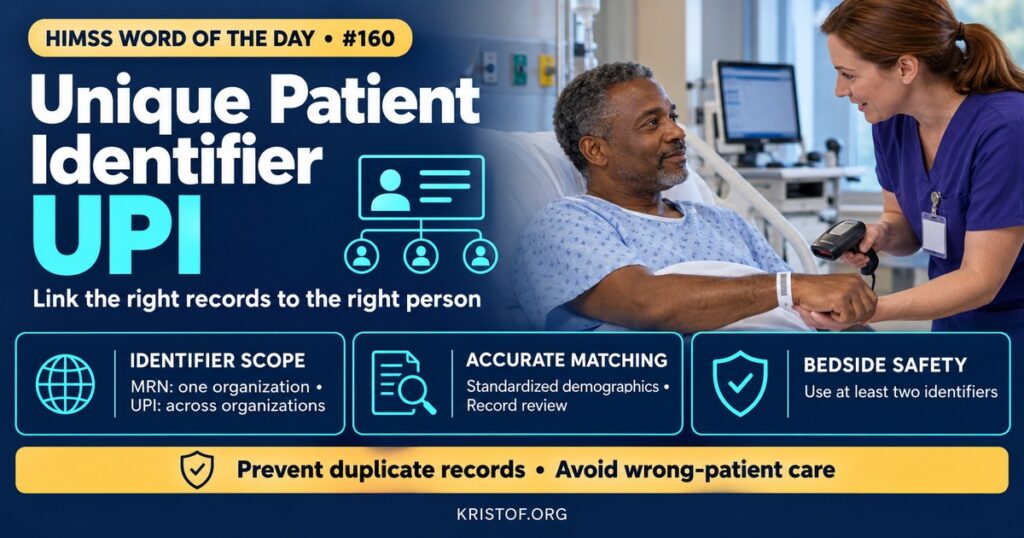
A unique patient identifier (UPI) is a value permanently assigned to an individual and used to identify that person consistently across healthcare organizations, so records from different places can be reliably linked to the right patient.
The HIMSS Dictionary explains that identity is the set of characteristics by which a person is recognized, and that a patient identifier is a value assigned to support positive identification for healthcare. It describes a unique patient identifier as a value permanently assigned to one person, unique across the entire national healthcare system and never shared with anyone else. The dictionary’s second sense describes identification and access control based on human characteristics, including biometric identifiers.
| Identification Approach | How It Works | Example |
|---|---|---|
| National Patient Identifier | One number assigned to each person nationwide | Used in some other countries’ health systems |
| Medical Record Number (MRN) | An identifier within one organization | A hospital’s MRN for a patient |
| Enterprise Master Patient Index (EMPI) | Links records across facilities within an organization | A health system matching patients across hospitals and clinics |
| Demographic Matching | Algorithms compare names, dates of birth, addresses, and other data | Health information exchange matching across organizations |
| Biometric Identification | Uses physical traits to find the right record | Palm vein scanning at registration |
| Referential Matching | Compares demographics with third-party reference data | Using historical addresses to confirm identity |
⚠️ Exam Alert: An MRN is unique within one organization; a national UPI would be unique across the healthcare system. A duplicate record is one patient with two records; an overlay is two patients merged into one record. HIPAA originally called for a unique health identifier for individuals, but federal appropriations language has blocked HHS from funding one.
🌐 Why It Matters: Real-World Healthcare IT Context
Accurate patient identification is fundamental to safety and interoperability. When records are mismatched, clinicians may see the wrong allergies, medications, or results, and a patient’s information may be missing when it matters most. Mismatches also create duplicate testing, billing problems, and privacy breaches when one patient’s information appears in another’s record.
HIPAA, enacted in 1996, called for standards for unique health identifiers, including one for individuals. Privacy concerns about creating a national identifier led Congress to include language in annual Labor-HHS appropriations bills, starting in the late 1990s, prohibiting HHS from spending funds to adopt or implement a unique patient identifier standard. The House has removed the language from its versions of the bill in several recent years, but the provision has continued in enacted law, and as of 2026, a broad coalition of healthcare organizations was still urging Congress to repeal it.
Without a national identifier, organizations rely on matching algorithms that compare demographics such as names, dates of birth, sex, addresses, and phone numbers. Matching is complicated by common names, name changes, typographical errors, missing data, and inconsistent formats. Patients without stable addresses or phones are harder to match accurately.
Federal efforts have focused on improving data quality. ONC has worked on patient identity and record matching, including Project US@, which produced a unified specification for formatting addresses in healthcare to improve matching. Standardizing demographic data elements in national data sets such as USCDI also supports better matching.
Organizations use multiple techniques. Enterprise master patient indexes link records within systems, registration practices verify identity with photo identification, and some organizations use biometrics or referential matching services. Health information exchanges and national networks apply their own matching rules, often tuned to avoid false matches even at the cost of missing some true matches.
Privacy and equity concerns remain central to the debate. Opponents of a national identifier worry about surveillance and the consequences of a single identifier being compromised, while supporters argue that the safety benefits are significant and that strong privacy protections can be built in. Some have proposed voluntary or patient-controlled identifiers as a middle path.
Digital identity work is related. Identity proofing for patient portals and apps, using standards such as NIST’s digital identity guidelines, helps ensure the right person accesses the right record online.
Common patient identification problems:
- Duplicate records created at registration
- Overlays that merge two patients’ information
- Typographical and formatting errors in demographics
- Name changes and common names
- Missing or outdated addresses and phone numbers
- Matching rules that differ across organizations
Practices that improve patient matching:
- Standardized registration procedures and data formats
- Photo identification and verification at registration
- EMPI management with regular duplicate review
- Address and demographic standardization
- Biometric or referential matching where appropriate
- Monitoring duplicate and overlay rates
🏥 The Nurse’s Perspective: Clinical, Bedside, & Workflow
Patient identification is a core nursing safety practice, and nurses often discover identification errors first.
At the Bedside
Using at least two identifiers, such as name and date of birth, before medications, procedures, specimen collection, and blood administration remains essential. Barcode wristband scanning strengthens this practice by matching the patient to the correct record and orders.
Specimen labeling at the bedside, in the presence of the patient, prevents wrong-patient results. Mislabeled specimens can lead to treatment decisions based on another patient’s data.
In Clinical Workflow
When a nurse notices information in the chart that does not fit the patient, such as an unexpected diagnosis, allergy, or medication history, it may signal a merged or mismatched record. Reporting concerns to health information management helps correct the record and protect both patients.
Patients with similar names on the same unit present special risk. Name alerts, separating rooms, and extra verification reduce errors.
Unidentified or trauma patients receive temporary identities. When their true identity is established, careful record merging prevents lost information and duplicate records.
Nurses involved in registration-adjacent roles, such as emergency triage, play a key role in collecting accurate demographic information.
In EHR Implementation (Go-Live Perspective)
During an Epic Go-Live, data conversion teams match legacy records to new patient records and resolve duplicates before cutover. Errors in this process can create overlays or split histories that clinicians must sort out later.
At-the-elbow support analysts should route suspected duplicate or merged records to health information management immediately rather than attempting fixes on the unit.
🎓 CAHIMS / CPHIMS & HIMSS Perspective
CAHIMS Exam Domain Mapping
The UPI appears in interoperability, patient safety, and policy questions:
| CAHIMS Domain | How the UPI Appears |
|---|---|
| Healthcare & Technology Environments | HIPAA identifier provisions; appropriations restriction; national policy debate |
| Clinical Informatics | Two-identifier verification, barcode scanning, specimen labeling |
| Healthcare Information & Systems Management | EMPI, matching algorithms, demographic standards, biometrics |
| Management & Leadership | Data governance, duplicate management, patient safety programs |
Key Terms to Know Alongside UPI
- Master Patient Index (MPI) — a database that maintains patient identities within an organization
- Enterprise Master Patient Index (EMPI) — an MPI spanning multiple facilities or systems
- Duplicate Record — two or more records for the same patient
- Overlay — one record containing information from two different patients
- Patient Matching — the process of linking records that belong to the same patient
- Identity Proofing — verifying that a person is who they claim to be
HIMSS Organizational Position
HIMSS supports improving patient identification and matching as part of its interoperability and patient safety policy work, and engages in the national policy debate on patient identifiers. Members can find related education and research through the HIMSS Resource Center.
🔗 Explore Further: External References
- ONC — Patient Identity and Patient Record Matching https://healthit.gov/standards-and-technology/patient-identity-and-patient-record-matching/
- ONC — United States Core Data for Interoperability (USCDI) https://isp.healthit.gov/
- NIST — SP 800-63-4, Digital Identity Guidelines https://csrc.nist.gov/pubs/sp/800/63/4/final
- HHS — HIPAA for Professionals https://www.hhs.gov/hipaa/index.html
- The Joint Commission https://www.jointcommission.org/
- HIMSS — Public Policy & Advocacy https://www.himss.org/public-policy-advocacy-overview
Term source: HIMSS Dictionary of Health Information and Technology Terms, Acronyms, and Organizations, 6th Edition (2025). All definitions in this series are paraphrased for editorial purposes. Readers are encouraged to consult the primary source for exact language.
Eric Andrew Kristof, RN, CAHIMS is a Healthcare IT professional and HIMSS Arkansas Chapter member based in Hot Springs Village, AR, with hands-on Epic Go-Live experience and a diverse healthcare and IT background. He writes at kristof.org at the intersection of clinical care and healthcare technology.
Leave a Reply