By Eric Andrew Kristof, RN, CAHIMS | Healthcare IT Professional | HIMSS Arkansas Chapter Member
About This Series: The HIMSS Word of The Day is a running blog series drawing from the HIMSS Dictionary of Health Information and Technology Terms, Acronyms, and Organizations, 6th Edition (2025) — the authoritative reference for healthcare IT professionals and the primary study resource for CAHIMS and CPHIMS certification. Each post paraphrases the term in plain language, grounds it in real-world healthcare IT context, and adds a bedside nursing perspective you won’t find in a textbook.
📖 The Term: DEEDS (Data Elements for Emergency Department Systems)
Source: HIMSS Dictionary of Health Information and Technology Terms, Acronyms, and Organizations, 6th Edition (2025)
🔍 Plain-Language Definition
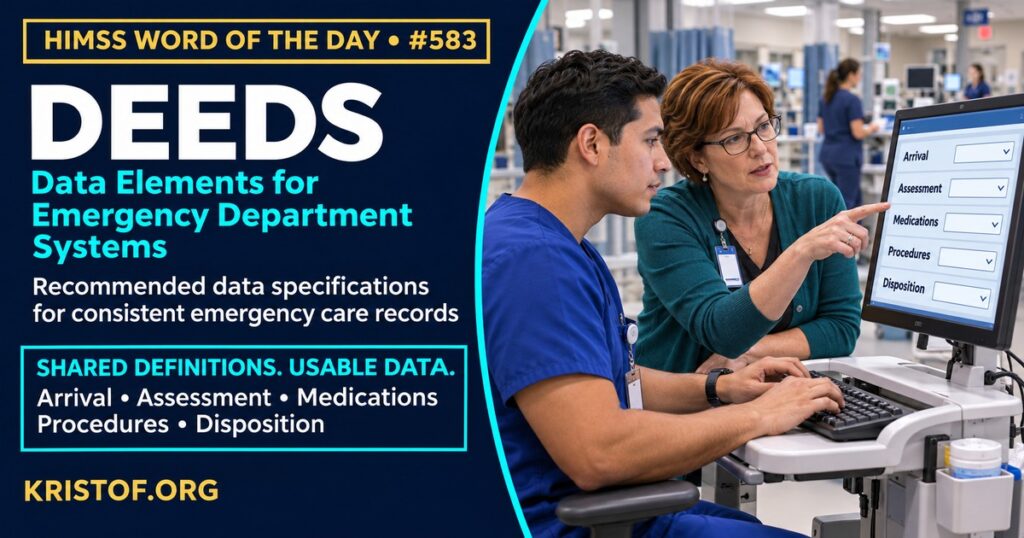
The HIMSS Dictionary describes DEEDS, short for Data Elements for Emergency Department Systems, as a recommended data set for emergency departments that the Centers for Disease Control and Prevention (CDC) published. The entry adds that a Health Level Seven (HL7) version of DEEDS followed, created to improve how emergency care data can be exchanged between systems.
That means the term points to two related efforts, and the sources use the same name for both. The first is the CDC’s Data Elements for Emergency Department Systems, Release 1.0, published in 1997. The CDC document describes recommended specifications for data recorded in hospital emergency department records, with the goal of making those data more uniform so they can be reused for purposes such as public health surveillance, research, quality improvement, and administration. The second is the HL7 specification developed later from existing emergency care data specifications.
| Version | What the sources say |
|---|---|
| CDC DEEDS, Release 1.0 (1997) | 156 data elements in eight sections, offered for voluntary use, with a stated plan for field testing and later review |
| HL7 DEEDS | A specification of 525 emergency care concepts plus 200 commonly ordered laboratory tests, balloted through HL7 and described in 2015 as submitted as an informational standard |
The table summarizes the sources named in this post and is not an official comparison.
⚠️ Exam Alert: DEEDS is a recommended set of data elements, so it is not a message format, a mandate, or a minimum data set. The CDC release states that its use is voluntary and that it does not set a minimum data set. Keep the CDC’s 1997 release separate from the later HL7 version. NEMSIS is a different effort for emergency medical services data, and ADT messages carry patient movement events, not the full set of emergency department data elements.
🌐 Why It Matters: Real-World Healthcare IT Context
Research that centers on DEEDS is limited. A PubMed search on the full name returned mostly unrelated results, and the papers below were found with narrower searches. This post therefore leans on the CDC document itself, read through the CDC’s online archive, plus three papers whose limits are noted. The CDC archive file is long, so only its opening portion was read for this post.
What the CDC release contains. The 1997 document, produced by the CDC’s National Center for Injury Prevention and Control, lists 156 data elements in eight sections, running from patient identification through arrival and first assessment, history and physical examination, procedures and results, medications, and disposition and diagnosis. Each element is specified in a consistent format that includes a definition, data type, permitted values, and references to related standards. The document says its data types follow HL7 Version 2.3 and an ASTM standard for transferring clinical observations. It grew out of a national workshop held in Atlanta in January 1996, which the document says drew about 160 participants, including people from federal agencies and professional associations. It describes Release 1.0 as a starting point, with field testing and a later review expected. These are the document’s own statements about its purpose and process.
The summary report. Pollock and colleagues, in the Journal of Emergency Nursing (1998), summarized the release, and the same report ran in Annals of Emergency Medicine. The abstract argues that variations in how data are entered impede the use of emergency department records for direct patient care and deter their reuse. It says wide adoption of the recommended specifications could substantially reduce problems such as data incompatibility and the high costs of collecting, linking, and using data. That is a statement of the goal and the expected benefit, not a measurement of results.
The HL7 version. McClay and colleagues, in the Journal of the American Medical Informatics Association (2015), described how HL7 DEEDS was created and balloted. The authors collected existing data exchange specifications, organized them by the workflow of emergency care, and mapped the concepts to existing standards for vocabulary, data types, and the HL7 information model. The result contains 525 concepts related to emergency care, plus 200 of the most commonly ordered laboratory tests, each with a unique identifier and a LOINC mapping. The authors call it the first set of common emergency department data elements to undergo rigorous standards development, and they say the availability of the standard should contribute to improved interoperability. The paper describes development and balloting. It does not measure how much interoperability improved.
A German comparison. Brammen and colleagues, in Studies in Health Technology and Informatics (2018), compared the German Emergency Department Medical Record with HL7 DEEDS, which the abstract says HL7 approved in 2013 for use in the United States. Using a terminology mapping method from ISO/TR 12300, they found significant differences in certain domains, and they concluded that the results support developing an international standard for emergency department data elements. This was a comparison of definitions, not a study of deployed systems.
Where it stands now. The sources read for this post do not establish the current HL7 publication status of DEEDS, so it is worth checking HL7 directly before relying on a particular version.
Common DEEDS problems:
- Treating the CDC release as a required standard or a minimum data set, when the document describes voluntary use
- Mixing up the 1997 CDC release with the later HL7 specification
- Assuming wide adoption, when the 1998 summary describes benefits that depend on adoption
- Local emergency department fields that map poorly onto shared definitions, as the German comparison found in certain domains
- Treating a list of data elements as if it were also a message format or document standard
- Relying on an older version without checking the current status
What supports emergency department data standardization:
- A definition, data type, and permitted values for every data element
- Standard data types and code mappings, such as the LOINC mappings in the HL7 version
- Development with many stakeholders, as in the 1996 national workshop
- A formal review and ballot process for the specification
- Terminology mapping methods for comparing definitions between systems, as used in the German comparison
- Planned review and revision over time
🏥 The Nurse’s Perspective: Clinical, Bedside, & Workflow
For emergency nurses, DEEDS addresses a familiar problem: the same finding can be recorded in different ways, which makes it hard to compare, reuse, or exchange.
At the Bedside
Emergency nurses document arrival, first assessment, medications, procedures, and disposition, and several DEEDS sections cover those same topics. Consistent entries help later readers, including the next clinician and reviewers of the record, interpret what was recorded. The 1998 summary appeared in the Journal of Emergency Nursing as well as in Annals of Emergency Medicine, which reflects how broadly emergency department records are used.
In Clinical Workflow
Nurse informaticists often help decide which fields staff must complete and how options in a picklist are worded. Shared definitions give those decisions a reference point, particularly when an emergency department reports data to outside agencies or compares its data with another site. Staff input matters because a field that does not match the real workflow tends to be filled in inconsistently.
In EHR Implementation (Go-Live Perspective)
During an Epic Go-Live in an emergency department, analysts at the elbow see how arrival and assessment documentation works under pressure. Build teams may map local fields to standard definitions for reporting and exchange, though practices vary by organization and vendor. Emergency nurses who test workflows can point out where a standard field does not match what actually happens at triage or discharge.
🎓 CAHIMS / CPHIMS & HIMSS Perspective
CAHIMS Exam Domain Mapping
DEEDS connects data standards, emergency care, and reuse of data:
| CAHIMS Domain | How DEEDS Appears |
|---|---|
| Healthcare & Technology Environments | Emergency department record systems, data standards bodies, and public health reporting |
| Clinical Informatics | Standard data elements, terminology mapping, and consistent documentation |
| Healthcare Information & Systems Management | Data definitions, coding, interfaces, and secondary use of records |
| Management & Leadership | Standards adoption, stakeholder input, and reporting obligations |
Key Terms to Know Alongside DEEDS
- HL7 V2 — a widely used family of standards for exchanging clinical and administrative messages
- LOINC (Logical Observation Identifiers Names and Codes) — a code system for laboratory and clinical observations
- ADT (Admission, Discharge, and Transfer) — events that track a patient’s movement through a facility
- Interoperability — the ability of systems to exchange and use information
- Semantic interoperability — exchange in which the meaning of the data is preserved
- Minimum data set — a defined core group of data elements collected in a standard way
HIMSS Organizational Position
HIMSS offers education and research on health information and technology topics through its Resource Center. Members can find related information on the HIMSS Resource Center page.
🧭 More HIMSS Word of The Day Terms
Related terms in the Interoperability and Standards series:
Browse all Interoperability and Standards terms or the A–Z glossary.
🔗 Explore Further: External References
- CDC — Data Elements for Emergency Department Systems, Release 1.0 (DEEDS), 1997 https://stacks.cdc.gov/view/cdc/6575/cdc_6575_DS1.pdf
- Pollock et al. (1998), Journal of emergency nursing — Data elements for emergency department systems, release 1.0 (DEEDS): a summary report. DEEDS Writing Committee https://pubmed.ncbi.nlm.nih.gov/9534532/
- McClay et al. (2015), Journal of the American Medical Informatics Association — Standard for improving emergency information interoperability: the HL7 data elements for emergency department systems https://pubmed.ncbi.nlm.nih.gov/25769684/
- Brammen et al. (2018), Studies in health technology and informatics — Comparing the German Emergency Department Medical Record with the US HL7 Data Elements for Emergency Department Systems https://pubmed.ncbi.nlm.nih.gov/29677954/
- HIMSS — Resource Center https://www.himss.org/resource-center
Term source: HIMSS Dictionary of Health Information and Technology Terms, Acronyms, and Organizations, 6th Edition (2025). All definitions in this series are paraphrased for editorial purposes. Readers are encouraged to consult the primary source for exact language.
Eric Andrew Kristof, RN, CAHIMS is a Healthcare IT professional and HIMSS Arkansas Chapter member based in Hot Springs Village, AR, with hands-on Epic Go-Live experience and a diverse healthcare and IT background. He writes at kristof.org at the intersection of clinical care and healthcare technology.
Leave a Reply