By Eric Andrew Kristof, RN, CAHIMS | Healthcare IT Professional | HIMSS Arkansas Chapter Member
About This Series: The HIMSS Word of The Day is a running blog series drawing from the HIMSS Dictionary of Health Information and Technology Terms, Acronyms, and Organizations, 6th Edition (2025) — the authoritative reference for healthcare IT professionals and the primary study resource for CAHIMS and CPHIMS certification. Each post paraphrases the term in plain language, grounds it in real-world healthcare IT context, and adds a bedside nursing perspective you won’t find in a textbook.
📖 The Term: PCDH (Patient-Centered Data Home)
Source: HIMSS Dictionary of Health Information and Technology Terms, Acronyms, and Organizations, 6th Edition (2025)
🔍 Plain-Language Definition
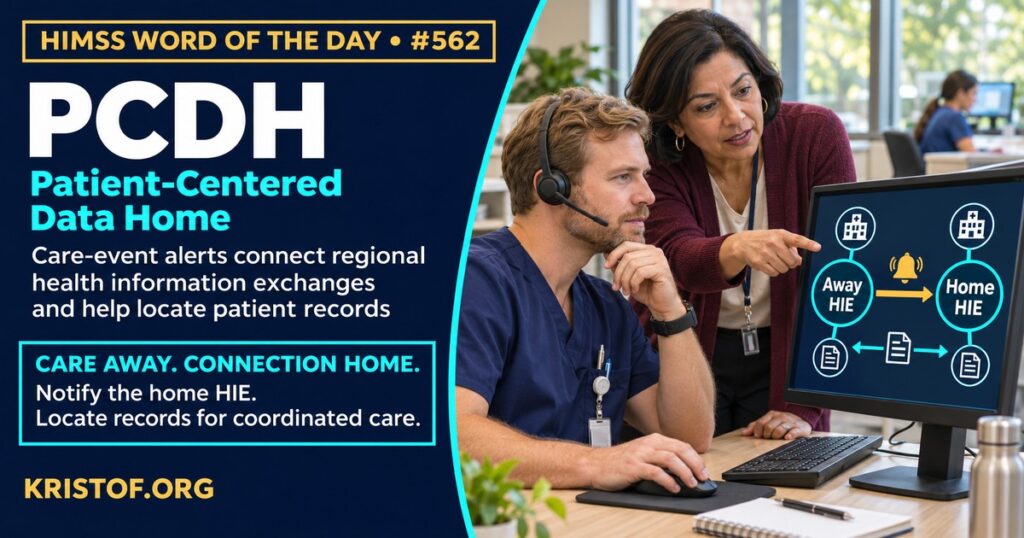
The HIMSS Dictionary describes the Patient-Centered Data Home (PCDH) as a scalable, low-cost way for health information exchanges (HIEs) to trade patient data with one another. The model runs on alerts that fire when a care episode occurs. An alert tells the patient’s home exchange that treatment took place elsewhere and points to where the records sit. A provider can then send a basic query and reach current information across state and regional boundaries. The Dictionary attributes PCDH to the Strategic Health Information Exchange Collaborative (SHIEC).
A HIMSS interoperability directory entry for PCDH lists it under Civitas Networks for Health and describes that organization as formerly SHIEC. Civitas also describes PCDH on its own site as a member-led initiative. The Dictionary entry predates that name change, so the older name is still the one printed there.
In practice, the flow described on the Civitas page has five steps. A patient receives care outside the usual home region. The exchange serving the away facility sends an alert to the patient’s home exchange, based on ZIP code matching. The home exchange confirms that it has records and notifies the patient’s usual care providers. Clinical information then moves between the two exchanges, and both care teams end up with updated information.
| Related term | How it relates to PCDH |
|---|---|
| Home HIE | The exchange for the region where the patient lives, assigned from ZIP codes |
| Away HIE | The exchange serving the facility where the patient was treated |
| ADT message | The admission, discharge, or transfer message that signals the care event |
| Event notification | An automated alert that a patient had an encounter somewhere |
| Query-based exchange | A provider asks another system for records; PCDH can lead into one |
The table is a teaching sketch and not an official taxonomy. Exchanges use their own local names.
⚠️ Exam Alert: PCDH is an alert-and-locate model among exchanges, triggered by a care event and a ZIP code. It is not a single national database, and the “data home” is an HIE, not a patient’s residence or a personal health record. It also differs from query-first networks. In a 2020 press release, the North Carolina Health Information Exchange Authority said eHealth Exchange and Carequality depend on a query started by the treating provider, while PCDH pushes information based on the patient’s home ZIP code. TEFCA is a separate federal framework for network-to-network exchange, not a synonym for PCDH.
🌐 Why It Matters: Real-World Healthcare IT Context
Evidence that studies PCDH itself is thin. A PubMed search run for this post found one peer-reviewed article directly about PCDH, so the sources below also include studies of event notification in general, which is the mechanism PCDH relies on. Each article was checked against its published abstract, and the study type is noted. Organizational statements are labeled as the organization’s own.
A regional pilot. Williams and Grannis, in Frontiers in Digital Health (2022), characterized PCDH through the Indiana Health Information Exchange’s part in the Heartland Region pilot, which included exchanges in Indiana, Ohio, Michigan, Kentucky, and Tennessee. They collected admission, discharge, and transfer (ADT) transactions among seven exchanges from December 2016 through December 2017, captured about 1.5 million transactions, and summarized them descriptively. Most patients were female, aged 56 to 75, and seen as outpatients, and the leading reasons for visits were labs, screening, and abdominal pain. The authors estimate that about 80 percent of records could be matched with other records, and they conclude that PCDH is practical and feasible. This was a descriptive analysis of one regional pilot and did not test patient outcomes.
Alerts to primary care. Dixon and colleagues, in the Journal of the American Medical Informatics Association (2021), deployed event notification alerts at two Veterans Affairs medical centers from 2016 to 2019. The alerts used regional exchange networks to tell primary care teams when older patients were hospitalized or seen in emergency departments outside the VA. In a concurrent cohort comparison, veterans whose teams received alerts were about four times more likely to have a phone contact within 7 days and about twice as likely to have an in-person visit within 30 days. There was no significant difference in 30-day hospital or emergency department use. This was not specific to PCDH, it was not randomized, and the authors say the process may need optimizing to scale.
Do alerts lead to queries? Vest and colleagues, in JAMIA Open (2019), examined system logs from three community health information organizations. About 5 percent of event notifications were followed by a query-based exchange use within 30 days, and the odds were higher for older patients and for alerts triggered by a discharge. The authors read the result as support for using alerts and queries together.
Organizational statements. In a 2020 press release, NC HealthConnex described going live on the national PCDH network and said that, nationally, more than 1 billion event notifications had been exchanged, with 45 participating exchanges serving 177 million patients in PCDH regions. These are the organization’s own figures as of that release and were not independently checked here. Civitas Networks for Health, on its current PCDH page, describes exchanges keeping local governance while taking part in the national model.
Common PCDH problems:
- Thin direct evidence, with one peer-reviewed article on PCDH itself found in the search for this post
- Patient matching across exchanges, since the pilot study reports an estimated 80 percent of records matched
- Reliance on ZIP code to assign a home region, which suggests that a missing or wrong ZIP code in an ADT message could misroute an alert (an inference from how the flow is described)
- Alerts that do not lead to action, since only about 1 in 20 notifications in the 2019 log study was followed by a query within 30 days
- No significant change in 30-day readmission in the VA event-notification study
What supports a useful PCDH:
- ADT messages that already flow from hospitals and clinics
- A home region assigned from ZIP codes, as the HIMSS directory entry describes
- Local governance that exchanges keep while joining a national model, as Civitas describes
- Alerts that reach the team that follows the patient, which the VA study linked to more timely follow-up
- An alert that points to where records sit, so a provider can query when needed
- A shared national agreement and governance council, which Civitas names on its PCDH page
🏥 The Nurse’s Perspective: Clinical, Bedside, & Workflow
For nurses, PCDH matters at registration, at the handoff back to a home care team, and in interface testing.
At the Bedside
A patient treated away from home starts the chain at check-in. Demographics and a ZIP code captured at registration or triage feed the ADT message that can trigger an alert, so accurate address fields carry more weight than they appear to. How an alert reaches a nurse, if at all, depends on the local EHR and the exchange. Nurses may also be the people who explain to a patient why a home clinic knows about a visit elsewhere, which is a good moment to point to privacy and consent practices at that organization.
In Clinical Workflow
On the home side, an alert is only useful if someone acts on it. In many practices, care coordinators or nurses take on post-visit follow-up, and the VA study linked event alerts to more timely phone contact and visits. A nurse informaticist can ask a practical set of questions: who receives alerts, where they appear, what the expected response time is, and how an alert is documented once handled. The 2019 log study suggests that most alerts will not lead to a record query, so the workflow should not assume they will.
In EHR Implementation (Go-Live Perspective)
During an Epic Go-Live, analysts at the elbow see how a small field can ripple downstream. For PCDH, the ADT interface and the completeness of ZIP code and demographic fields deserve test cases before go-live, along with routing of inbound alerts to the right inbox or work list. Staff also need to know whether an alert can be sent from the exchange to the EHR or only appears in an exchange portal, because the answer changes the training.
🎓 CAHIMS / CPHIMS & HIMSS Perspective
CAHIMS Exam Domain Mapping
PCDH connects exchange architecture, clinical follow-up, and governance:
| CAHIMS Domain | How PCDH Appears |
|---|---|
| Healthcare & Technology Environments | Regional HIEs, national networks, and the role of ADT feeds |
| Clinical Informatics | Alerts that support care coordination and follow-up after care elsewhere |
| Healthcare Information & Systems Management | Patient matching, interfaces, ZIP code data quality, and privacy |
| Management & Leadership | Governance across independent exchanges, agreements, and measuring value |
Key Terms to Know Alongside PCDH
- HIE (Health Information Exchange) — organization or process that moves health information among providers
- ADT (Admission, Discharge, and Transfer) — messages that report patient registration and movement events
- MPI (Master Patient Index) — database that links patient identities across systems
- TEFCA (Trusted Exchange Framework and Common Agreement) — federal framework for nationwide network-to-network exchange
- Care transitions — movement of a patient between settings or levels of care
- Direct messaging — secure, directed exchange of health information between known parties
HIMSS Organizational Position
HIMSS offers education and research on health information and technology topics through its Resource Center. Members can find related information on the HIMSS Resource Center page.
🧭 More HIMSS Word of The Day Terms
Related terms in the Interoperability and Standards series:
- Fast Healthcare Interoperability Resources (FHIR)
- CCMM (Continuity of Care Maturity Model)
- Affinity Domain Policy
- XDS (Cross-Enterprise Document Sharing)
Browse all Interoperability and Standards terms or the A–Z glossary.
🔗 Explore Further: External References
- Williams and Grannis (2022), Frontiers in digital health — Patient-Centered Data Home: A Path Towards National Interoperability https://pubmed.ncbi.nlm.nih.gov/35911616/
- Dixon et al. (2021), Journal of the American Medical Informatics Association : JAMIA — Impact of event notification services on timely follow-up and rehospitalization among primary care patients at two Veterans Affairs Medical Centers https://pubmed.ncbi.nlm.nih.gov/34597411/
- Vest et al. (2019), JAMIA open — Usage of query-based health information exchange after event notifications https://pubmed.ncbi.nlm.nih.gov/31984363/
- NC HealthConnex (2020) — NC HealthConnex goes live on national Patient Centered Data Home network https://hiea.nc.gov/news/press-releases/2020/06/10/nc-healthconnex-goes-live-national-patient-centered-data-home-network
- Civitas Networks for Health — Patient Centered Data Home https://civitasforhealth.org/patient-centered-data-home/
- HIMSS — Patient Centered Data Home (PCDH) https://himss.org/node/140282
- HIMSS — Resource Center https://www.himss.org/resource-center
Term source: HIMSS Dictionary of Health Information and Technology Terms, Acronyms, and Organizations, 6th Edition (2025). All definitions in this series are paraphrased for editorial purposes. Readers are encouraged to consult the primary source for exact language.
Eric Andrew Kristof, RN, CAHIMS is a Healthcare IT professional and HIMSS Arkansas Chapter member based in Hot Springs Village, AR, with hands-on Epic Go-Live experience and a diverse healthcare and IT background. He writes at kristof.org at the intersection of clinical care and healthcare technology.
Leave a Reply