By Eric Andrew Kristof, RN, CAHIMS | Healthcare IT Professional | HIMSS Arkansas Chapter Member
About This Series: The HIMSS Word of the Day is a running blog series drawing from the HIMSS Dictionary of Health Information and Technology Terms, Acronyms, and Organizations, 6th Edition (2025) — the authoritative reference for healthcare IT professionals and the primary study resource for CAHIMS and CPHIMS certification. Each post paraphrases the term in plain language, grounds it in real-world healthcare IT context, and adds a bedside nursing perspective you won’t find in a textbook.
📖 The Term: Nursing Information System
Source: HIMSS Dictionary of Health Information and Technology Terms, Acronyms, and Organizations, 6th Edition (2025)
🔍 Plain-Language Definition
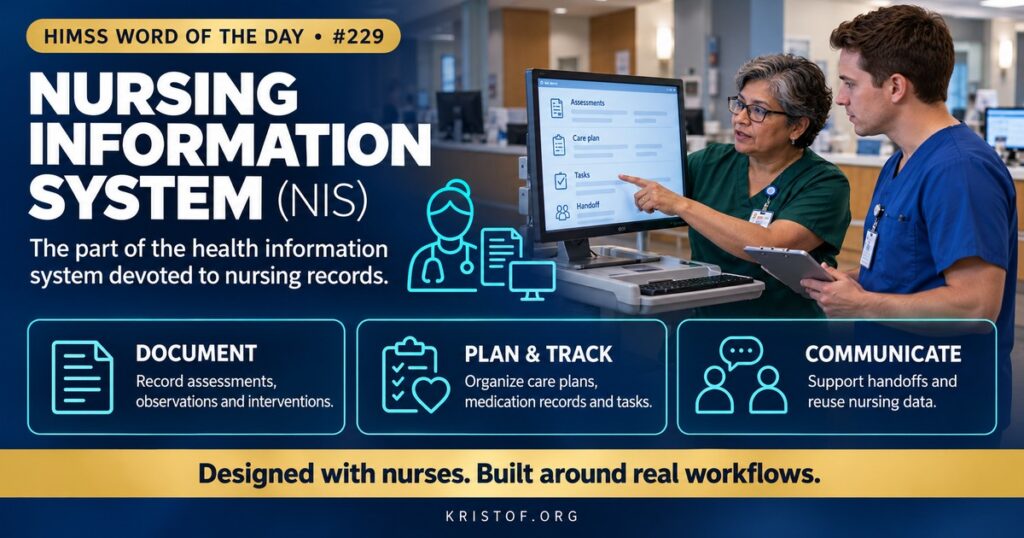
A nursing information system (NIS) is the portion of the health information system devoted to nursing documentation, particularly keeping the nursing record. The HIMSS Dictionary treats it as a component within the larger healthcare information system rather than a stand-alone product. In current practice it is usually a set of modules inside the EHR, sometimes called a clinical nursing information system (CNIS), covering assessments, flowsheets, care plans, medication administration, handoff tools, and tasks.
The system supports several nursing functions: recording observations and interventions, planning and tracking care, documenting medication administration, communicating at shift change, and feeding data to quality reporting, staffing, and research.
| NIS Function | What It Supports | Example |
|---|---|---|
| Assessment and Flowsheets | Recording observations over time | Vital signs, pain, skin, intake and output |
| Care Planning | Goals, problems, and interventions | Fall prevention plan with tasks |
| Medication Administration | Safe administration with verification | Barcode scanning at the bedside |
| Task and Worklist Management | Organizing what is due | Overdue reassessment prompts |
| Handoff and Communication | Shift report and team messages | Structured summary for the next nurse |
| Reporting and Analytics | Reuse of nursing data | Pressure injury and fall metrics |
⚠️ Exam Alert: A nursing information system is a functional part of the broader health information system, usually delivered within the EHR. It is not the same as a nursing terminology, which supplies the standard language, or the Nursing Minimum Data Set, which defines core data elements for nursing care.
🌐 Why It Matters: Real-World Healthcare IT Context
Nursing is the largest group of clinicians in most hospitals, and nursing documentation is a major share of the record. The quality of the nursing information system therefore shapes time at the bedside, patient safety, and the usefulness of data for the whole organization. A well-designed system reduces duplicate entry, prompts timely reassessment, and makes the nursing perspective visible to other clinicians. A poorly designed one adds clicks, hides important information, and encourages workarounds.
Recent research from China gives a window into safety. A multicenter cross-sectional study of 1,311 clinical nurses from 12 tertiary hospitals found that 52.78 percent had experienced near-miss events in nursing information system tasks in the previous three months. Near-misses are incidents with potential for harm that do not result in harm and serve as frontline sentinels for risk. Information transmission was the most vulnerable process, with 931 occurrences. The study used a human-machine-environment framework and measured nurse informatics competency, system effectiveness, and workplace interruptions as influences. The findings suggest that safety in a nursing information system depends on people, technology, and the work environment together.
A qualitative study from a tertiary hospital interviewed 22 participants, 15 nurses and 7 nurse managers, about how the system works in practice. It described the system as both an enforcer and a barrier. On the positive side, structured documentation reduced manual burden, prevented errors, and ensured full-process traceability by embedding rules. On the negative side, generic knowledge content did not match specialty-specific needs and poor data integration forced nurses back to manual monitoring, hence the title phrase that it has to be done manually. Junior nurses used the structured framework as an operational guide, while experienced nurses adapted and worked around it. Workarounds are not a sign of bad nurses; they are evidence about where the design and the work diverge.
Mobile systems extend the nursing information system to the point of care. A 2026 systematic review and meta-analysis of six quasi-experimental studies with 4,617 patients found that mobile nursing information systems were associated with modestly higher patient satisfaction with nursing care, with a risk ratio of 1.13, though heterogeneity was substantial and the certainty of the evidence was low. The finding suggests possible benefit but not proof, and local workflow and device design likely matter.
Equity and standards also matter. A 2026 commentary on the digital divide in nursing argued that clinical nursing information systems and standardized nursing terminologies enhance care quality, promote interoperability, and enable measurable nursing outcomes, but that adoption is inconsistent, particularly in low- and middle-income countries. It called for staged roadmaps that combine infrastructure, open-source models, terminology localization, privacy safeguards, and training.
Standardized terminologies help the system turn documentation into comparable data. When nursing assessments and interventions are coded consistently, they can be exchanged, analyzed, and compared across units and organizations, which supports quality measurement and research on nursing’s contribution to outcomes.
Common nursing information system problems:
- Documentation designed around billing or regulation rather than nursing work
- Too many fields, duplicate entry, and hidden screens
- Poor integration with devices, labs, and other systems that forces manual entry
- Interruptions during documentation that lead to errors
- Content that does not fit specialty units
- Training that ends at go-live
What supports a strong nursing information system:
- Nurse-led design, testing, and governance
- Structured data aligned to standard nursing terminologies
- Device and system integration to reduce manual entry
- Workflow-based layouts with minimal clicks
- Safety reporting that includes near-misses in system use
- Ongoing optimization informed by nurse feedback
🏥 The Nurse’s Perspective: Clinical, Bedside, & Workflow
The nursing information system is where much of nursing work becomes visible to the rest of the organization.
At the Bedside
Documenting an assessment, scanning a medication, updating a plan, and handing off to the next shift all happen in the system. When it works, nurses spend more time with patients. When it does not, they carry paper notes, document later from memory, or enter the same data twice. The near-miss data suggest that information transmission steps, such as handoff and communication of orders, deserve special care.
Interruptions are a safety issue too. Documenting in a quiet moment, using hand-off tools consistently, and asking for help when a screen is confusing all protect accuracy.
In Clinical Workflow
Nurse managers and educators watch for signs that the system does not fit: late documentation, frequent paper backups, or repeated questions on the same screen. They bring these to governance groups as evidence rather than complaints.
Nurse informaticists lead optimization. They observe workflows, review safety reports, work with analysts to simplify screens, and ensure that terminology and content match specialty needs. They also help evaluate mobile devices and bedside tools so that technology supports, rather than interrupts, care.
In EHR Implementation (Go-Live Perspective)
An Epic Go-Live is largely a nursing information system go-live, since nurses are the heaviest users. Training reflects real workflows, super users coach on the units, and at-the-elbow support analysts help in the moment. The most valuable output is the list of friction points they collect, which becomes the optimization backlog after go-live.
🎓 CAHIMS / CPHIMS & HIMSS Perspective
CAHIMS Exam Domain Mapping
The nursing information system appears in clinical informatics, usability, and safety questions:
| CAHIMS Domain | How the NIS Appears |
|---|---|
| Healthcare & Technology Environments | Role of nursing documentation in health IT, standards and terminologies |
| Clinical Informatics | Nursing workflow, documentation design, decision support, handoff |
| Healthcare Information & Systems Management | Integration with devices and EHR modules, mobile solutions, support |
| Management & Leadership | Governance, training, optimization, safety culture |
Key Terms to Know Alongside the Nursing Information System
- Nursing Informatics — specialty integrating nursing science with information and analytical science
- Standardized Nursing Terminology — controlled vocabulary for nursing diagnoses, interventions, and outcomes
- Flowsheet — structured record of repeated observations over time
- Near-Miss — event with potential for harm that does not reach the patient
- Workaround — informal method used to bypass a system limitation
- Barcode Medication Administration — verification of patient and drug at the bedside
HIMSS Organizational Position
HIMSS supports nursing informatics through its Nursing Informatics Community, the TIGER Global Community, education, and research. Members can find related resources through the HIMSS Resource Center and community pages.
🔗 Explore Further: External References
- Du et al. (2025), BMC Nursing — Influencing Factors of Self-Reported Near-Miss in Clinical Nursing Information System Tasks Among Nurses: A Multicenter Cross-Sectional Study https://pubmed.ncbi.nlm.nih.gov/40696341/
- Su et al. (2026), Asian Nursing Research — “It Has to Be Done Manually”: A Qualitative Study of Clinical Nursing Information System as Both Enforcer and Barrier in Nursing Work https://pubmed.ncbi.nlm.nih.gov/42697429/
- Qiu et al. (2026), BMC Nursing — The Impact of Mobile Nursing Information Systems on Patient Satisfaction With Nursing Care: A Systematic Review and Meta-Analysis https://pubmed.ncbi.nlm.nih.gov/42415004/
- Ghimire et al. (2026), Health Informatics Journal — A Call to Action to Close the Global Digital Divide in Nursing: Clinical Nursing Information Systems and Standardized Terminologies in Low and Middle-Income Countries https://pubmed.ncbi.nlm.nih.gov/41637723/
- HIMSS — Nursing Informatics Community https://www.himss.org/networking/communities/nursing-informatics/
- HIMSS — TIGER Global Community https://www.himss.org/networking/communities/tiger/
Term source: HIMSS Dictionary of Health Information and Technology Terms, Acronyms, and Organizations, 6th Edition (2025). All definitions in this series are paraphrased for editorial purposes. Readers are encouraged to consult the primary source for exact language.
Eric Andrew Kristof, RN, CAHIMS is a Healthcare IT professional and HIMSS Arkansas Chapter member based in Hot Springs Village, AR, with hands-on Epic Go-Live experience and a diverse healthcare and IT background. He writes at kristof.org at the intersection of clinical care and healthcare technology.
Leave a Reply