By Eric Andrew Kristof, RN, CAHIMS | Healthcare IT Professional | HIMSS Arkansas Chapter Member
About This Series: The HIMSS Word of the Day is a running blog series drawing from the HIMSS Dictionary of Health Information and Technology Terms, Acronyms, and Organizations, 6th Edition (2025) — the authoritative reference for healthcare IT professionals and the primary study resource for CAHIMS and CPHIMS certification. Each post paraphrases the term in plain language, grounds it in real-world healthcare IT context, and adds a bedside nursing perspective you won’t find in a textbook.
📖 The Term: Atomic Data
Source: HIMSS Dictionary of Health Information and Technology Terms, Acronyms, and Organizations, 6th Edition (2025)
🔍 Plain-Language Definition
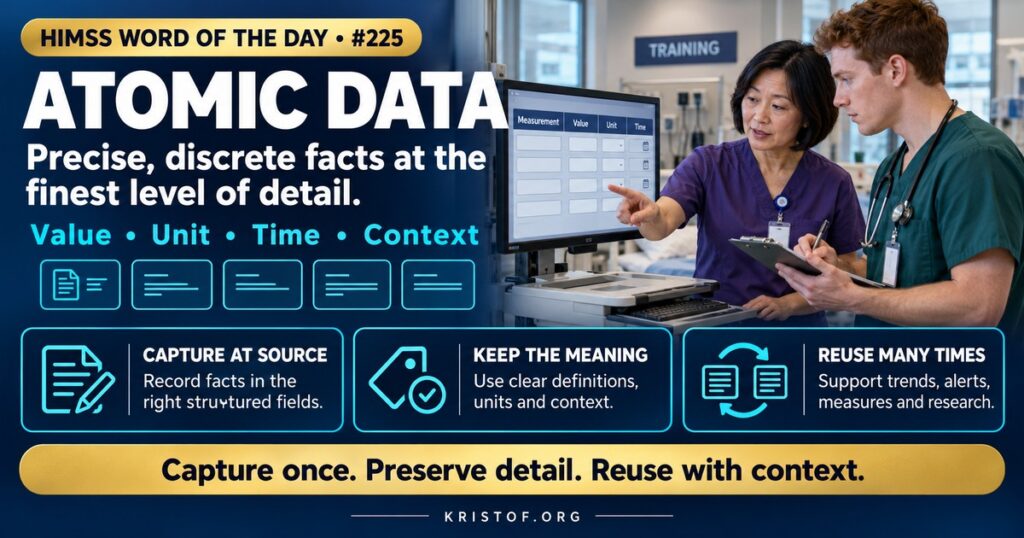
Atomic data, also called atomic level data, are data elements at the lowest level of detail that a system holds. The HIMSS Dictionary frames the idea in terms of a data warehouse: the elemental, precise facts captured at the source during care can be arranged in many ways, and each is captured one time but put to use repeatedly.
A systolic blood pressure of 128 with a unit, a time, a body site, and a method is atomic. A sentence in a note saying that the patient’s pressure was a little high is not. Because atomic data stand alone as coded, structured elements, systems can sort them, graph them, compare them, trigger rules from them, and roll them up into averages and counts without anyone having to read text.
| Level | Example | What It Supports |
|---|---|---|
| Atomic (Discrete) Data | Weight 82 kg, recorded at 08:15, with a standard code | Trends, alerts, calculations, measures |
| Summarized Data | Average weight for the month | Reports and dashboards |
| Semi-Structured Data | A template note with a few fields and free text | Human reading, limited analysis |
| Free Text | Narrative paragraph | Nuance and context; hard to compute |
| Image or Scanned Document | Photo of a paper form | Storage and viewing |
⚠️ Exam Alert: Atomic data are at the finest level of detail and can be rolled up into summaries; summaries cannot be broken back down into atomic data. Capturing data once at the source and reusing it many times is the central benefit. Free text is valuable for nuance but is not atomic.
🌐 Why It Matters: Real-World Healthcare IT Context
Most health data are used far beyond the moment they are entered. A single set of vital signs informs bedside decisions, early warning scores, the daily summary, a sepsis alert, a quality measure, and a research dataset. If the values are captured as atomic data with consistent meaning, each use is possible without retyping. If they are captured only in text or scanned documents, each use requires manual abstraction.
Standards depend on atomic data. In HL7 FHIR, the Observation resource captures measurements and assertions as individual items with a code, a value, units, a time, and a subject. Its documented uses include vital signs, laboratory data, imaging results, clinical findings, device measurements, clinical assessment tools such as the Glasgow Coma Score, and social history such as tobacco use. Most observations are simple name and value pairs with metadata, though some group other observations together. The United States Core Data for Interoperability, which defines the data classes and elements that certified systems should be able to exchange, is likewise built from discrete elements. Without atomic data, there is nothing standard to exchange.
Research confirms both the promise and the work involved. A systematic review of how structuring the electronic health record affects secondary use of patient data analyzed 85 original articles published between 1975 and 2010. It found that structured record applications could be divided into those that document data at the point of care and those that retrieve data afterward through what it called post hoc structuring, and that about two thirds of the articles concerned methods still under development. The takeaway is that structuring is a design decision with tradeoffs, not a switch to flip. Another paper looked at locally built ICU nursing flowsheets and stressed that an unambiguous and consistent representation is the foundation of data reuse. The authors built a conceptual model to clarify what each flowsheet item meant, and they found that experienced nurses’ knowledge was critical to interpret and verify those meanings.
That second finding matters for every organization. Two units may label a field the same way and mean different things, or label it differently and mean the same thing. If those fields feed one report, the report misleads. Governance means defining each element, choosing a standard code where one exists, setting allowed values, and deciding who may change it. This is slow work, but it pays back every time a dashboard, a registry, or a model uses the data.
Atomic data have limits. Over-structuring burdens clinicians with checkboxes and drop-downs that do not match how they think, and it can squeeze out the context that makes a record meaningful. The best designs capture the data needed for care and reuse at the point of care, with minimal extra effort, and leave room for narrative where nuance matters. Natural language processing can help extract structure from text, but it adds uncertainty that must be validated.
Data warehouses and analytics platforms are where atomic data accumulate. Many analytics maturity models, including the HIMSS Analytics Maturity Assessment Model, assume that organizations can reliably capture, integrate, and govern data at a fine grain before they can move to more advanced analytics.
Common atomic data problems:
- Important information captured only in free text or scanned documents
- The same concept recorded in several places with different codes
- Fields whose meaning differs across units or sites
- Excessive required fields that encourage default or dummy entries
- Local codes that cannot map to standards
- Data entered after the fact so time stamps are wrong
What supports strong atomic data capture:
- Clinical definitions for each data element, owned by named stewards
- Standard terminologies and value sets where available
- Documentation built around workflow so capture is natural
- Validation rules and units at the point of entry
- Data quality monitoring with feedback to units
- Free-text fields kept for context, not for core facts
🏥 The Nurse’s Perspective: Clinical, Bedside, & Workflow
Nursing documentation is one of the largest sources of atomic data in the EHR, and nurses often understand best what each value means.
At the Bedside
Entering a pain score, a fall risk assessment, an intake and output total, or a wound measurement in its structured field means that the value can appear in trends, trigger a reassessment reminder, and feed quality reporting. Putting the same value only in a narrative note keeps it from doing any of that. When a needed field is missing or does not fit the situation, nurses help by describing the gap rather than inventing a workaround that will not be counted.
Accuracy matters at this level. A mistyped unit or a value placed in the wrong row can distort an early warning score.
In Clinical Workflow
Nurse leaders and informaticists work together to define what each flowsheet row measures, who documents it, and how often. When two units use the same row for different practices, they either align the practice or create separate rows. Clinical review of reports built on this data catches problems that analysts alone would miss.
Nurse informaticists also advocate for the nursing perspective when organizations decide what to standardize, ensuring that data meaningful to nursing care are captured in a way that can be analyzed and compared.
In EHR Implementation (Go-Live Perspective)
An Epic Go-Live typically converts many flowsheet and assessment items, each with a specific meaning and mapping. Analysts validate the mappings against clinical definitions before go-live, and at-the-elbow support analysts help nurses find the right structured field in the moment. Patterns of free-text workarounds are good evidence of build gaps and feed the optimization list.
🎓 CAHIMS / CPHIMS & HIMSS Perspective
CAHIMS Exam Domain Mapping
Atomic data appear in data management, standards, and analytics questions:
| CAHIMS Domain | How Atomic Data Appear |
|---|---|
| Healthcare & Technology Environments | Data standards, interoperability requirements |
| Clinical Informatics | Structured documentation, clinical definitions, reuse of clinical data |
| Healthcare Information & Systems Management | Data warehouses, data quality, governance |
| Management & Leadership | Data stewardship, analytics strategy, change management |
Key Terms to Know Alongside Atomic Data
- Discrete Data — individually stored, coded data elements usable by systems
- Free Text — narrative that is not structured for computation
- Data Granularity — level of detail at which data are stored
- Secondary Use — using data for purposes other than the care it was captured for
- Data Steward — person accountable for a data element’s definition and quality
- Value Set — defined list of allowed codes for a data element
HIMSS Organizational Position
HIMSS supports data-driven health care through its Analytics Maturity Assessment Model, research, and education. Members can find related resources through the HIMSS Resource Center and the AMAM page.
🔗 Explore Further: External References
- HL7 — FHIR Observation Resource https://hl7.org/fhir/observation.html
- ONC — United States Core Data for Interoperability (USCDI) https://isp.healthit.gov/united-states-core-data-interoperability-uscdi
- Vuokko et al. (2017), International Journal of Medical Informatics — Impacts of Structuring the Electronic Health Record: Results of a Systematic Literature Review From the Perspective of Secondary Use of Patient Data https://pubmed.ncbi.nlm.nih.gov/27919387/
- Kim (2008), CIN: Computers, Informatics, Nursing — The First Step Toward Data Reuse: Disambiguating Concept Representation of the Locally Developed ICU Nursing Flowsheets https://pubmed.ncbi.nlm.nih.gov/18769183/
- HIMSS — Analytics Maturity Assessment Model (AMAM) https://www.himss.org/maturity-models/amam
- ONC — USCDI+ https://healthit.gov/standards-and-technology/uscdi-plus/
Term source: HIMSS Dictionary of Health Information and Technology Terms, Acronyms, and Organizations, 6th Edition (2025). All definitions in this series are paraphrased for editorial purposes. Readers are encouraged to consult the primary source for exact language.
Eric Andrew Kristof, RN, CAHIMS is a Healthcare IT professional and HIMSS Arkansas Chapter member based in Hot Springs Village, AR, with hands-on Epic Go-Live experience and a diverse healthcare and IT background. He writes at kristof.org at the intersection of clinical care and healthcare technology.
Leave a Reply