By Eric Andrew Kristof, RN, CAHIMS | Healthcare IT Professional | HIMSS Arkansas Chapter Member
About This Series: The HIMSS Word of the Day is a running blog series drawing from the HIMSS Dictionary of Health Information and Technology Terms, Acronyms, and Organizations, 6th Edition (2025) — the authoritative reference for healthcare IT professionals and the primary study resource for CAHIMS and CPHIMS certification. Each post paraphrases the term in plain language, grounds it in real-world healthcare IT context, and adds a bedside nursing perspective you won’t find in a textbook.
📖 The Term: Gap Analysis
Source: HIMSS Dictionary of Health Information and Technology Terms, Acronyms, and Organizations, 6th Edition (2025)
🔍 Plain-Language Definition
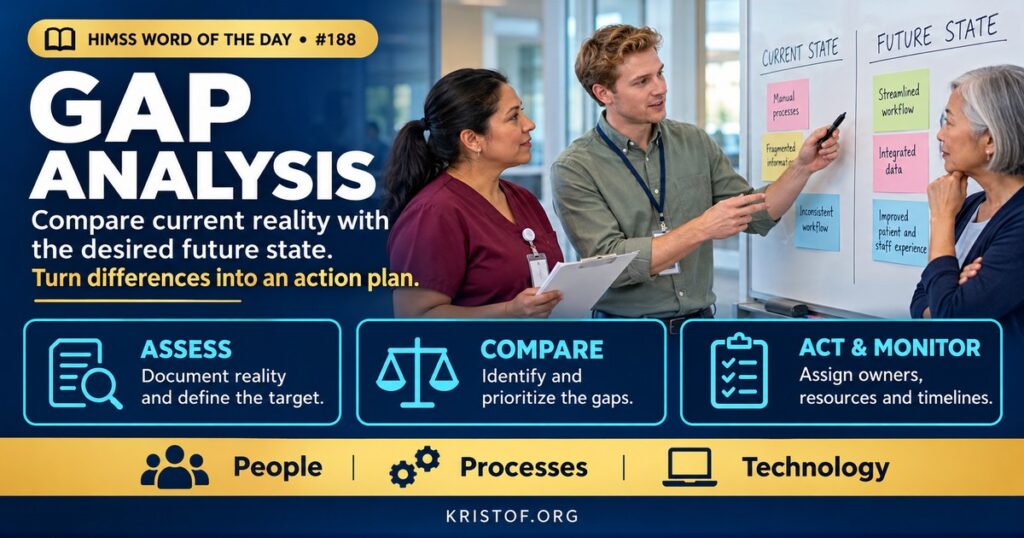
Gap analysis is a structured comparison between an organization’s current state and a desired future state, used to identify the differences, or gaps, and determine the actions, resources, and priorities needed to close them.
The HIMSS Dictionary describes gap analysis as comparing a current condition with the desired state, and notes that in process analysis the term also describes the difference between current-state and future-state processes.
| Gap Analysis Step | What Happens | Health IT Example |
|---|---|---|
| Define the Future State | Set goals, requirements, or standards | Target workflows, regulatory requirements, or maturity level |
| Assess the Current State | Document how things work today | Observing workflows and inventorying systems |
| Identify Gaps | Compare current and future states | Missing capabilities, inconsistent processes, unmet controls |
| Prioritize | Rank gaps by risk, impact, and effort | Patient safety gaps first |
| Plan Actions | Define remedies, owners, and timelines | Build changes, training, policy updates |
| Monitor | Track progress and reassess | Periodic reassessment against targets |
⚠️ Exam Alert: Gap analysis compares current state to desired state. A risk analysis assesses threats, vulnerabilities, likelihood, and impact. A fit-gap analysis compares requirements to a product’s capabilities. Value stream mapping documents process flow and waste, often supplying current-state detail for a gap analysis.
🌐 Why It Matters: Real-World Healthcare IT Context
Gap analysis is one of the most widely used tools in health IT planning because nearly every initiative involves moving from one state to another. It turns broad goals into specific, actionable work.
During system selection, fit-gap analysis compares an organization’s requirements with what each vendor’s product can do. Gaps may be addressed through configuration, customization, workarounds, process change, or a different product. Understanding gaps early informs decisions and contracts.
During implementation, workflow gap analysis compares current workflows with the future-state workflows supported by the new system. Gaps reveal where policies, roles, training, or build must change. Current-state documentation often comes from observation and tools such as process maps and value stream mapping.
Cybersecurity and compliance programs rely on gap assessments. Organizations compare their controls with frameworks such as the NIST Cybersecurity Framework or with regulatory requirements, identify missing or weak controls, and plan improvements. A gap assessment can inform, but does not replace, the risk analysis HIPAA requires.
Regulatory change prompts gap analysis. When new rules arrive, such as updated interoperability, privacy, or quality reporting requirements, organizations compare current capabilities with new obligations to plan compliance work and budgets.
Maturity models provide structured future states. Frameworks such as HIMSS’s adoption and maturity models describe progressive stages of capability, allowing organizations to see where they stand and what is needed to advance.
Workforce and skills gaps belong in the picture. New systems and processes may require competencies that staff do not yet have, such as data literacy, new device skills, or informatics roles. A skills gap analysis helps organizations plan training, hiring, and support before go-live rather than discovering gaps under pressure.
Quality improvement uses gap analysis too. Comparing current performance on measures with targets or benchmarks highlights where improvement efforts should focus.
Data strengthens gap analysis. Metrics such as task times, error rates, alert override rates, or audit findings help quantify gaps rather than relying only on opinions. Quantified gaps make it easier to prioritize, justify resources, and measure whether closing actions worked. Where data is lacking, short observation studies or sampling can provide enough evidence to guide decisions.
Accuracy depends on honest current-state assessment. Organizations often describe workflows as policies say they should happen rather than how they actually happen. Direct observation and frontline input reveal workarounds and informal practices that matter.
Stakeholder involvement shapes acceptance. When the people affected by a change help identify gaps, they are more likely to support the actions needed to close them. Gap analyses conducted only by consultants or leaders may miss practical issues and face resistance during implementation.
Common gap analysis pitfalls:
- Describing the ideal current state rather than reality
- Vague future-state definitions
- Too many gaps without prioritization
- No owners or timelines for closing gaps
- Ignoring people and process gaps in favor of technology
- Failing to reassess after changes
Practices for useful gap analysis:
- Clear, measurable future-state definitions
- Direct observation and frontline input for current state
- Risk-based prioritization of gaps
- Action plans with owners, resources, and deadlines
- Attention to technology, process, and people
- Regular reassessment and progress tracking
🏥 The Nurse’s Perspective: Clinical, Bedside, & Workflow
Nurses provide the real-world detail that makes gap analysis accurate.
At the Bedside
Frontline nurses know how work actually happens, including workarounds, informal communication, and steps not captured in policy. Sharing this knowledge during current-state assessments prevents gaps from being overlooked.
When new systems or processes are introduced, nurses often discover practical gaps, such as missing supplies, unclear handoffs, or screens that do not match workflow. Reporting these quickly helps teams close them.
Nurse leaders can use simple tools, such as a table of current practice, desired practice, gap, and owner, to guide unit-level improvement work.
In Clinical Workflow
Nurse informaticists frequently lead workflow gap analyses for EHR implementations and optimizations, comparing current nursing processes with system capabilities and best practices.
Nursing quality councils use gap analysis to compare current performance with goals, such as fall prevention or pressure injury rates, and to plan targeted interventions.
Regulatory and accreditation readiness efforts often include nursing gap assessments, comparing policies and documentation with standards.
Gap closure plans should include training and communication, since many gaps involve people and processes rather than technology alone.
Celebrating closed gaps matters too. Sharing progress with frontline teams shows that their input led to real change and encourages continued participation.
Post-Go-Live optimization surveys of nurses are a practical gap analysis, comparing what nurses need from the system with what it currently provides.
In EHR Implementation (Go-Live Perspective)
Before an Epic Go-Live, workflow validation sessions compare future-state workflows with real practice, revealing gaps in build, policy, and training. After Go-Live, issue tracking functions as an ongoing gap analysis between expected and actual system use.
At-the-elbow support analysts capture gaps observed on units, such as missing order sets or confusing documentation, and route them for prioritization.
🎓 CAHIMS / CPHIMS & HIMSS Perspective
CAHIMS Exam Domain Mapping
Gap analysis appears in project management and systems analysis questions:
| CAHIMS Domain | How Gap Analysis Appears |
|---|---|
| Healthcare & Technology Environments | Regulatory readiness; maturity models; frameworks |
| Clinical Informatics | Workflow analysis, current and future state, nursing processes |
| Healthcare Information & Systems Management | Fit-gap analysis, requirements, system selection and configuration |
| Management & Leadership | Strategic planning, prioritization, resource allocation |
Key Terms to Know Alongside Gap Analysis
- Current State — how processes and systems work today
- Future State — the desired processes and capabilities
- Fit-Gap Analysis — comparing requirements with a product’s capabilities
- Requirements — documented needs a system or process must meet
- Maturity Model — a framework describing stages of capability
- Workflow Analysis — study of how tasks and information move through processes
HIMSS Organizational Position
HIMSS supports structured assessment and improvement through its maturity models, education, and CPHIMS certification, which covers systems analysis and planning. Members can find related education and research through the HIMSS Resource Center.
🔗 Explore Further: External References
- NIST — Cybersecurity Framework https://www.nist.gov/cyberframework
- Lean Enterprise Institute — Value Stream Mapping https://www.lean.org/lexicon-terms/value-stream-mapping/
- Institute for Healthcare Improvement — Model for Improvement https://www.ihi.org/library/model-for-improvement
- ONC — SAFER Guides https://healthit.gov/clinical-quality-and-safety/safer-guides/
- HHS — Guidance on Risk Analysis https://www.hhs.gov/hipaa/for-professionals/security/guidance/guidance-risk-analysis/index.html
- HIMSS — Certifications (CAHIMS and CPHIMS) https://www.himss.org/certifications
Term source: HIMSS Dictionary of Health Information and Technology Terms, Acronyms, and Organizations, 6th Edition (2025). All definitions in this series are paraphrased for editorial purposes. Readers are encouraged to consult the primary source for exact language.
Eric Andrew Kristof, RN, CAHIMS is a Healthcare IT professional and HIMSS Arkansas Chapter member based in Hot Springs Village, AR, with hands-on Epic Go-Live experience and a diverse healthcare and IT background. He writes at kristof.org at the intersection of clinical care and healthcare technology.
Leave a Reply