By Eric Andrew Kristof, RN, CAHIMS | Healthcare IT Professional | HIMSS Arkansas Chapter Member
About This Series: The HIMSS Word of the Day is a running blog series drawing from the HIMSS Dictionary of Health Information and Technology Terms, Acronyms, and Organizations, 6th Edition (2025) — the authoritative reference for healthcare IT professionals and the primary study resource for CAHIMS and CPHIMS certification. Each post paraphrases the term in plain language, grounds it in real-world healthcare IT context, and adds a bedside nursing perspective you won’t find in a textbook.
📖 The Term: Regression Testing
Source: HIMSS Dictionary of Health Information and Technology Terms, Acronyms, and Organizations, 6th Edition (2025)
🔍 Plain-Language Definition
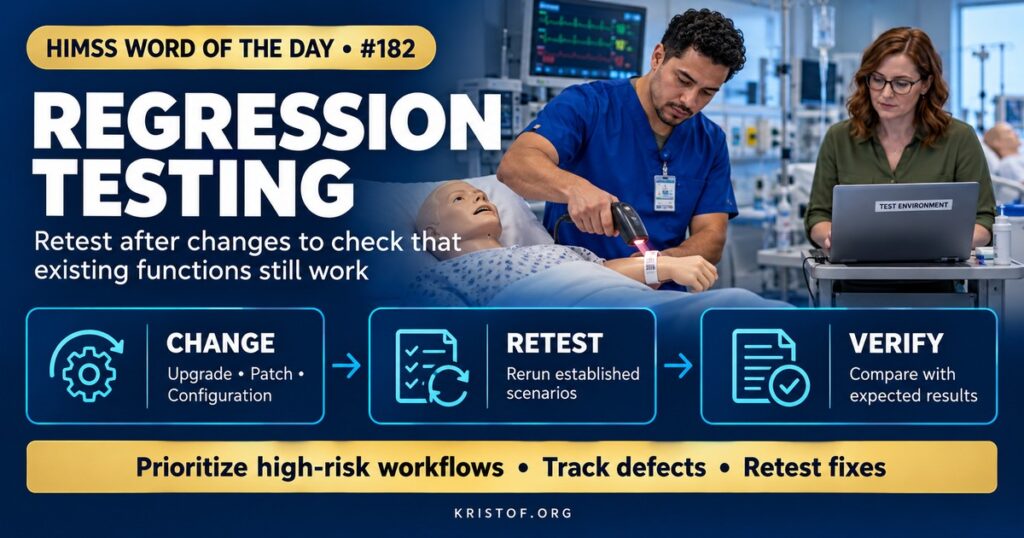
Regression testing is the process of retesting software after it has been changed, whether through new code, configuration, upgrades, or changes in connected systems, to confirm that previously working functions still work and that no new defects have been introduced.
The HIMSS Dictionary describes regression testing in two ways: as testing changes to programs to make sure older functions still work with the new changes, which is a normal part of development, and as running earlier tests again on a program after it has been modified, to find defects that the changes, whether in that program or in other connected or even unrelated components, may have introduced or exposed.
| Testing Type | Purpose | Health IT Example |
|---|---|---|
| Unit Testing | Tests individual components | A single rule or calculation |
| Functional Testing | Tests that a feature works as designed | A new order set behaves as built |
| Integrated Testing | Tests workflows across modules and systems | Order to pharmacy to administration to billing |
| Regression Testing | Retests existing functions after changes | Verifying medication workflows after an upgrade |
| User Acceptance Testing (UAT) | Confirms users can complete their work | Nurses performing realistic scenarios |
| Performance Testing | Tests speed and capacity | Response time with many concurrent users |
⚠️ Exam Alert: Regression testing looks for unintended effects of changes on existing functionality. Functional testing verifies new features. Integrated testing checks end-to-end workflows across systems. Regression testing is needed after upgrades, patches, configuration changes, and interface changes.
🌐 Why It Matters: Real-World Healthcare IT Context
Health IT changes constantly. EHR vendors release regular upgrades, organizations modify build to meet new needs, regulatory changes require updates, security patches are applied, and connected systems such as laboratory, pharmacy, and device platforms change on their own schedules. Every change can affect existing workflows in unexpected ways.
Unintended effects can harm patients. An upgrade might change a default value, alter how an alert fires, break an interface mapping, or change how information displays. Patient safety research and ONC’s SAFER Guides emphasize testing and configuration management as essential practices for safe health IT.
Regression testing protects high-risk workflows first. Organizations prioritize scenarios involving medication ordering, verification, and administration, critical results, blood products, allergies, patient identification, and interfaces. Comprehensive coverage of every function is rarely possible, so risk-based prioritization focuses effort where failures would cause the most harm.
Test scripts are built around clinical scenarios. Effective scripts walk through realistic patient journeys, such as admission, ordering, medication administration, documentation, transfer, and discharge, rather than testing isolated screens. Scripts should include expected results so testers know whether the system behaved correctly.
Automation helps but does not replace people. Automated testing tools can repeatedly execute scripted scenarios, catching regressions quickly after each change. However, many clinical workflows involve judgment, devices, and multiple systems that are difficult to automate, so manual testing by knowledgeable users remains important.
Testing environments matter. Test systems should mirror production as closely as possible, including build, interfaces, and representative test patients. Differences between test and production environments can hide defects.
Software development guidance supports these practices. NIST’s Secure Software Development Framework and FDA’s general principles of software validation describe testing and verification as integral to the software life cycle, including retesting after changes.
Vendor releases create a recurring rhythm. Many EHR vendors deliver upgrades on a regular schedule, along with smaller fixes in between. Organizations review release notes, decide which new features to activate, and plan regression testing windows before each upgrade reaches production. Building a repeatable upgrade process, with standard test scripts and clinical testers scheduled in advance, makes each cycle faster and safer.
Documentation and defect management close the loop. Test results, defects, fixes, and retests are tracked so organizations can decide whether a change is ready for release and have evidence of what was tested.
Downstream systems need attention too. A change in the EHR can break reports, dashboards, quality measures, and data warehouse loads, so regression testing should include analytics and reporting, not just clinical screens.
Common regression testing gaps:
- Too little time between vendor release and go-live
- Test scripts that are outdated or incomplete
- Test environments that differ from production
- Missing interface and device testing
- Limited clinical participation in testing
- No retest after defect fixes
Practices for effective regression testing:
- Risk-based prioritization of high-impact workflows
- Maintained libraries of scenario-based test scripts
- Automated testing for repeatable scenarios
- Clinician participation in integrated and acceptance testing
- Production-like test environments
- Clear defect tracking and release criteria
🏥 The Nurse’s Perspective: Clinical, Bedside, & Workflow
Nurses make strong testers because they know how workflows really happen.
At the Bedside
Nurses who participate in testing can catch problems that technical testers miss, such as a scan that requires an extra unexpected step, a flowsheet row that disappears, or an alert that fires at the wrong time during medication administration.
After upgrades, nurses are often the first to notice unexpected changes in daily work. Reporting changes promptly, with specific details and screenshots when possible, helps teams decide whether a behavior is intended or a defect.
In Clinical Workflow
Nurse informaticists and super users frequently write and maintain test scripts for nursing workflows, such as admission assessments, medication administration, intake and output, and care plans.
Testing should include edge cases common in real care, such as holding a medication, documenting a late dose, transferring a patient mid-shift, or recording a refusal. These scenarios often reveal defects.
Communication about upgrades, including what changed and what was tested, helps nurses trust new versions and know what to watch for.
Testers who document exact steps, patient scenarios, and screenshots when they find a problem help analysts reproduce and fix defects quickly.
In EHR Implementation (Go-Live Perspective)
Before an Epic Go-Live, integrated testing and regression testing cycles verify that workflows work end to end. After Go-Live, ongoing upgrades and optimization changes require regression testing to protect stabilized workflows.
At-the-elbow support analysts help capture issues reported by nurses after changes, distinguishing training questions from true regressions and routing defects to the right teams quickly.
🎓 CAHIMS / CPHIMS & HIMSS Perspective
CAHIMS Exam Domain Mapping
Regression testing appears in systems life cycle and quality questions:
| CAHIMS Domain | How Regression Testing Appears |
|---|---|
| Healthcare & Technology Environments | Safe health IT practices; software validation guidance |
| Clinical Informatics | Workflow testing, clinician participation, patient safety |
| Healthcare Information & Systems Management | Test planning, automation, environments, defect management |
| Management & Leadership | Change management, release decisions, risk management |
Key Terms to Know Alongside Regression Testing
- Integrated Testing — end-to-end testing across modules and systems
- User Acceptance Testing (UAT) — confirming that users can complete their work in the system
- Test Script — documented steps and expected results for a test
- Defect — a problem found during testing that must be fixed
- Change Management — processes for controlling and communicating system changes
- Systems Development Life Cycle (SDLC) — the phases of planning, building, testing, and maintaining systems
HIMSS Organizational Position
HIMSS supports safe health IT implementation and optimization through education and its CPHIMS certification, which covers systems analysis, testing, and life cycle management. Members can find related education and research through the HIMSS Resource Center.
🔗 Explore Further: External References
- ONC — SAFER Guides https://healthit.gov/clinical-quality-and-safety/safer-guides/
- NIST — SP 800-218, Secure Software Development Framework (SSDF) https://csrc.nist.gov/pubs/sp/800/218/final
- FDA — General Principles of Software Validation https://www.fda.gov/regulatory-information/search-fda-guidance-documents/general-principles-software-validation
- NIST — Health IT Usability https://www.nist.gov/programs-projects/health-information-technology-usability
- AHRQ PSNet — Medication Errors and Adverse Drug Events https://psnet.ahrq.gov/primer/medication-errors-and-adverse-drug-events
- HIMSS — Certifications (CAHIMS and CPHIMS) https://www.himss.org/certifications
Term source: HIMSS Dictionary of Health Information and Technology Terms, Acronyms, and Organizations, 6th Edition (2025). All definitions in this series are paraphrased for editorial purposes. Readers are encouraged to consult the primary source for exact language.
Eric Andrew Kristof, RN, CAHIMS is a Healthcare IT professional and HIMSS Arkansas Chapter member based in Hot Springs Village, AR, with hands-on Epic Go-Live experience and a diverse healthcare and IT background. He writes at kristof.org at the intersection of clinical care and healthcare technology.
Leave a Reply