By Eric Andrew Kristof, RN, CAHIMS | Healthcare IT Professional | HIMSS Arkansas Chapter Member
About This Series: The HIMSS Word of the Day is a running blog series drawing from the HIMSS Dictionary of Health Information and Technology Terms, Acronyms, and Organizations, 6th Edition (2025) — the authoritative reference for healthcare IT professionals and the primary study resource for CAHIMS and CPHIMS certification. Each post paraphrases the term in plain language, grounds it in real-world healthcare IT context, and adds a bedside nursing perspective you won’t find in a textbook.
📖 The Term: Capitation
Source: HIMSS Dictionary of Health Information and Technology Terms, Acronyms, and Organizations, 6th Edition (2025)
🔍 Plain-Language Definition
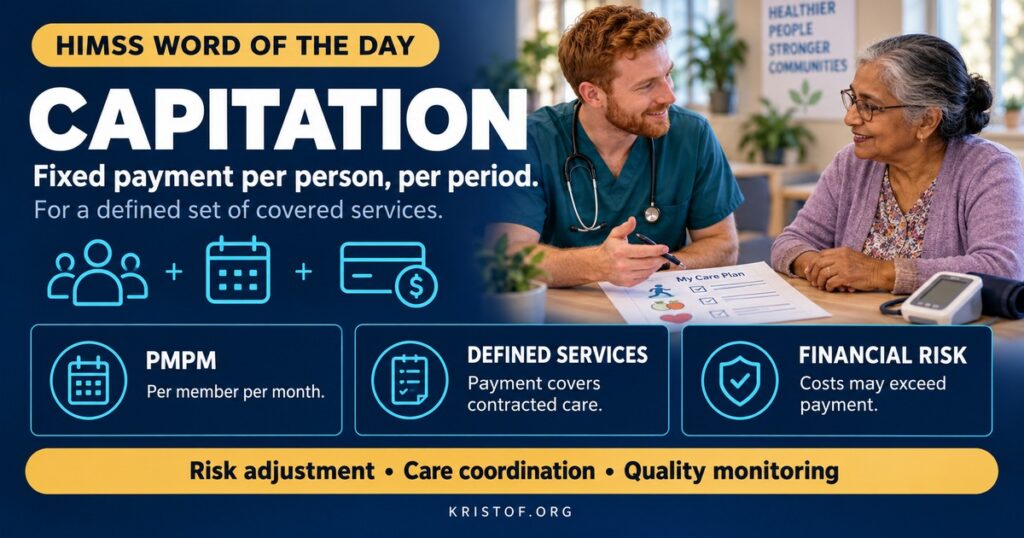
Capitation is a payment method in which a health plan or payer pays a provider or provider organization a fixed amount per enrolled person for a set period, usually per member per month, to cover a defined set of services, regardless of how much care each person actually uses.
The HIMSS Dictionary describes capitation as a fixed amount agreed in advance and paid to a provider for each member, covering certain contracted services over a given period. It explains that the amount depends on the number of people on the provider’s patient list rather than on the volume or type of services delivered.
| Capitation Type | What It Covers | Example |
|---|---|---|
| Primary Care Capitation | Primary care services for attributed patients | A practice paid a monthly amount per patient for office care |
| Partial or Professional Capitation | Defined professional services | A medical group covering physician services but not hospital care |
| Global Capitation | Nearly all services, including hospital care | A provider organization responsible for total cost of care |
| Sub-Capitation | A capitated organization pays another provider per member | A medical group sub-capitating a behavioral health provider |
| Plan-Level Capitation | Government pays health plans per enrollee | Medicare Advantage and Medicaid managed care plans |
⚠️ Exam Alert: Capitation pays per person per period; fee-for-service pays per service. Capitation shifts financial risk to the provider or plan. Risk adjustment modifies payments for expected health needs. PMPM means per member per month. Under capitation, unnecessary services become costs rather than revenue.
🌐 Why It Matters: Real-World Healthcare IT Context
Capitation changes incentives. Instead of earning more by delivering more services, providers receive a predictable amount and benefit when patients stay healthy and avoid unnecessary care. This can encourage prevention, care coordination, and efficient use of resources.
It also creates risks. If payments are not sufficient for the population’s needs, providers lose money. Critics have long worried that capitation could encourage withholding needed care or avoiding sicker patients. Quality measurement, patient protections, and risk adjustment are designed to counter these risks.
Capitation is common at the plan level. CMS pays Medicare Advantage plans a monthly, risk-adjusted amount for each enrollee, and states pay Medicaid managed care plans on a capitated basis. Plans may then pay providers fee-for-service, capitation, or a mix. The Health Care Payment Learning & Action Network places population-based payments such as capitation in its most advanced category of alternative payment models.
Risk adjustment is essential. Payments are adjusted for expected costs based on factors such as age, diagnoses, and other characteristics. In Medicare Advantage, CMS uses hierarchical condition category models that rely on documented diagnoses. Accurate, complete documentation of chronic conditions therefore affects payment, and oversight agencies scrutinize coding practices to prevent inappropriate inflation of risk scores.
Data and analytics make capitation manageable. Organizations need to know which patients are attributed to them, what care they receive inside and outside the organization, projected costs, and quality performance. Claims data from payers, EHR data, care management tools, and predictive models help identify high-risk patients and track spending.
Care delivery models evolve under capitation. Capitated organizations often invest in care management, nurse-led outreach, behavioral health integration, home visits, telehealth, and services fee-for-service rarely paid for, because these can reduce avoidable hospitalizations.
Stop-loss and reinsurance protect against extreme costs. Because a few patients with catastrophic illness can generate very high costs, capitated providers often purchase protection or negotiate risk corridors.
Encounter data still matters. Even when providers are not paid per service, payers and regulators need records of the services delivered, called encounter data, to monitor quality, set future rates, and calculate risk adjustment. Capitated organizations must maintain complete coding and reporting of services, which means fee-for-service style documentation and claims infrastructure remain important.
Capitation is not all-or-nothing. Many organizations combine capitated primary care with fee-for-service specialty care, or gradually expand the scope of capitation as their capabilities grow.
Patient experience is part of the equation. Capitated organizations that invest in access, such as same-day appointments, nurse advice lines, and home visits, often find these services reduce costly emergency visits while improving satisfaction.
Common capitation challenges:
- Payments that do not match population needs
- Incomplete data on care received elsewhere
- Risk adjustment complexity and compliance scrutiny
- Concerns about underuse of needed services
- Financial exposure from high-cost patients
- Investment needed in care management and analytics
What supports success under capitation:
- Accurate attribution and timely claims data
- Complete, compliant documentation of conditions
- Population health analytics and risk stratification
- Strong care management and primary care access
- Quality monitoring to prevent underuse
- Stop-loss protection and financial planning
🏥 The Nurse’s Perspective: Clinical, Bedside, & Workflow
Capitated organizations depend heavily on nurses to keep patients healthy and out of the hospital.
At the Bedside
In capitated primary care, nurses play central roles in prevention, chronic disease management, medication reconciliation, and education. Time spent helping a patient manage heart failure at home directly supports both outcomes and financial sustainability.
Hospital nurses caring for patients from capitated organizations may see more coordination with outside care managers, such as calls about discharge plans and follow-up appointments.
In Clinical Workflow
Care management nurses use risk stratification and registries to identify patients who need outreach, coordinate services, and monitor patients after hospital discharge. Their work often focuses on the small group of patients with the highest needs.
Documentation of chronic conditions and functional status affects risk adjustment. Nurses contribute by accurately recording assessments, problem list updates, and care plans, while coding decisions remain with providers and coders.
Monitoring for underuse is part of quality. Nurses who notice patients not receiving needed services can raise concerns, helping organizations balance cost control with good care.
Patients may not know their care is capitated. Nurses focus on the same goal regardless of payment: the right care, at the right time, in the right setting.
In EHR Implementation (Go-Live Perspective)
During an Epic Go-Live, capitated organizations configure population health registries, care management tools, and payer data feeds. Ensuring attributed patient lists and risk scores appear correctly supports uninterrupted care management.
At-the-elbow support analysts help care management nurses find outreach work queues, documentation templates, and dashboards in the new system.
🎓 CAHIMS / CPHIMS & HIMSS Perspective
CAHIMS Exam Domain Mapping
Capitation appears in payment and value-based care questions:
| CAHIMS Domain | How Capitation Appears |
|---|---|
| Healthcare & Technology Environments | Medicare Advantage and Medicaid payment; HCP-LAN framework |
| Clinical Informatics | Care management workflows, documentation of conditions, prevention |
| Healthcare Information & Systems Management | Attribution, claims data, risk adjustment models, analytics |
| Management & Leadership | Financial risk, contracting, stop-loss, care model investment |
Key Terms to Know Alongside Capitation
- Per Member Per Month (PMPM) — a payment or cost amount expressed per enrollee each month
- Risk Adjustment — modifying payments based on expected health needs
- Global Capitation — capitation covering nearly all services for a population
- Attribution — assigning patients to providers for payment and accountability
- Stop-Loss — protection against very high individual or aggregate costs
- Fee-for-Service — payment for each service delivered
HIMSS Organizational Position
HIMSS supports value-based payment models through education on population health data, analytics, and interoperability, and engages on CMS payment policy. Members can find related education and research through the HIMSS Resource Center.
🔗 Explore Further: External References
- HCP-LAN — APM Framework https://hcp-lan.org/apm-framework/
- CMS — Medicare Advantage Rates and Statistics https://www.cms.gov/medicare/payment/medicare-advantage-rates-statistics
- CMS — Risk Adjustment https://www.cms.gov/medicare/payment/medicare-advantage-rates-statistics/risk-adjustment
- MACPAC — Managed Care https://www.macpac.gov/topic/managed-care/
- MedPAC — Medicare Payment Advisory Commission https://www.medpac.gov/
- HIMSS — Public Policy & Advocacy https://www.himss.org/public-policy-advocacy-overview
Term source: HIMSS Dictionary of Health Information and Technology Terms, Acronyms, and Organizations, 6th Edition (2025). All definitions in this series are paraphrased for editorial purposes. Readers are encouraged to consult the primary source for exact language.
Eric Andrew Kristof, RN, CAHIMS is a Healthcare IT professional and HIMSS Arkansas Chapter member based in Hot Springs Village, AR, with hands-on Epic Go-Live experience and a diverse healthcare and IT background. He writes at kristof.org at the intersection of clinical care and healthcare technology.
Leave a Reply