By Eric Andrew Kristof, RN, CAHIMS | Healthcare IT Professional | HIMSS Arkansas Chapter Member
About This Series: The HIMSS Word of the Day is a running blog series drawing from the HIMSS Dictionary of Health Information and Technology Terms, Acronyms, and Organizations, 6th Edition (2025) — the authoritative reference for healthcare IT professionals and the primary study resource for CAHIMS and CPHIMS certification. Each post paraphrases the term in plain language, grounds it in real-world healthcare IT context, and adds a bedside nursing perspective you won’t find in a textbook.
📖 The Term: Abstracting (Data Abstraction)
Source: HIMSS Dictionary of Health Information and Technology Terms, Acronyms, and Organizations, 6th Edition (2025)
🔍 Plain-Language Definition
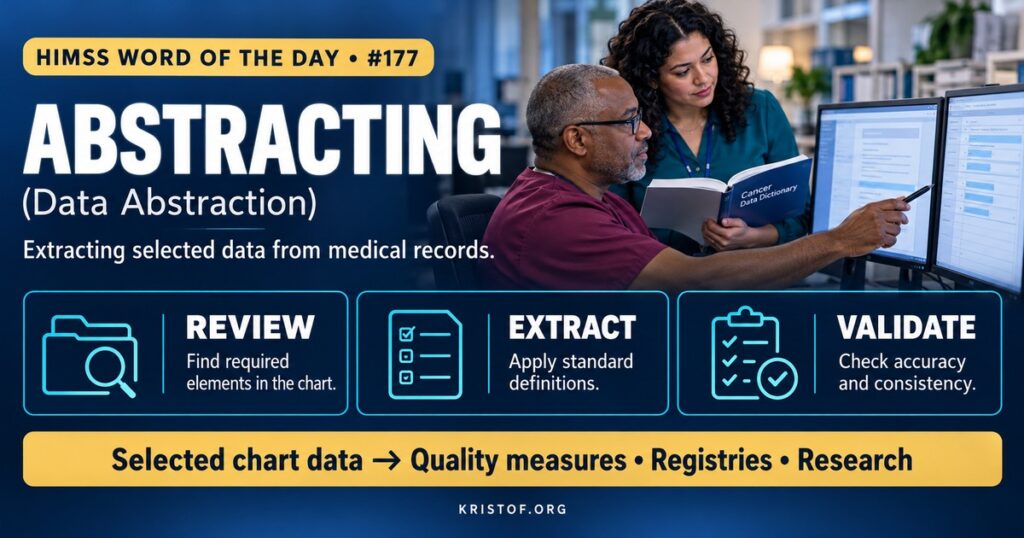
Abstracting is the process of reviewing medical records and extracting specific data elements, often in coded or standardized form, for use in reporting, quality measurement, registries, billing, and research.
The HIMSS Dictionary describes abstracting as an application that supports collecting and maintaining coded patient information, along with selected demographic, clinical, and admission data, from the medical record, typically after discharge. It notes that the information supports internal control, analysis, regulatory reporting, and research.
| Abstraction Use | What Is Abstracted | Example |
|---|---|---|
| Discharge Abstract | Demographics, diagnoses, procedures, disposition | Hospital discharge data for billing and state reporting |
| Quality Measures | Specific clinical data elements and timing | Sepsis bundle elements for a chart-abstracted measure |
| Disease Registries | Diagnosis, stage, treatment, outcomes | Cancer registry data collected by cancer registrars |
| Clinical Registries | Procedure details and outcomes | Cardiac procedure data for a national registry |
| Research | Study variables from records | Data for a retrospective outcomes study |
⚠️ Exam Alert: Abstraction extracts selected data from records. Coding assigns standard codes such as ICD-10 or CPT. Chart-abstracted measures require manual review; eCQMs are calculated automatically from structured EHR data. Inter-rater reliability checks whether different abstractors reach the same results.
🌐 Why It Matters: Real-World Healthcare IT Context
Many of healthcare’s most important data sets depend on abstraction. Hospital discharge abstracts feed billing, state databases, and national statistics. Quality programs require specific data elements, such as the time antibiotics were given. Registries track cancer, cardiac procedures, trauma, and other conditions. Research studies often rely on data pulled from records.
Manual abstraction is labor intensive. Trained abstractors, often nurses, health information management professionals, or certified registrars, read notes, flowsheets, orders, and results to find required elements and apply detailed specifications. A single complex case can take substantial time, and organizations may employ teams of abstractors.
Specifications are precise and change often. CMS publishes specifications manuals for chart-abstracted hospital quality measures through QualityNet, and registries publish their own data dictionaries. Abstractors must follow definitions exactly, such as what counts as the time of a diagnosis, which requires ongoing training.
Accuracy and consistency matter. Organizations use inter-rater reliability reviews, in which multiple abstractors review the same cases, along with validation audits to ensure data quality. External validation programs may check submitted data against records.
Cancer registries illustrate specialized abstraction. Certified tumor registrars collect detailed information on diagnosis, staging, treatment, and follow-up, following standards maintained by organizations such as NAACCR, and the data supports national cancer surveillance and research.
Automation is reducing the burden. Electronic clinical quality measures calculate results directly from structured EHR data, eliminating manual abstraction for many measures. Structured documentation templates capture required elements at the point of care. Natural language processing and AI tools can find information in free text and pre-populate abstraction forms for human review. Standards-based data exchange can send data directly from EHRs to registries.
Automation depends on documentation. When key information appears only in free text, scanned documents, or inconsistent locations, automated tools struggle and manual review remains necessary. Clear, structured documentation benefits both clinicians and abstractors.
Concurrent abstraction is an alternative to retrospective review. Some programs, such as stroke and sepsis initiatives, review cases while patients are still hospitalized, allowing teams to catch missed care elements in time to act and to clarify documentation while clinicians still remember the details. This approach turns abstraction into a real-time quality tool rather than only a reporting task.
The shift from manual to electronic measures also requires validation. Organizations compare electronic results with chart-abstracted results to confirm that workflows capture data correctly before relying on automated measures.
Privacy applies to abstraction as well. Abstracted data sent to external registries must be shared under appropriate agreements and legal authority, and abstractors access many records, so audit monitoring and minimum necessary principles apply.
Common abstraction challenges:
- Time-consuming manual review of complex records
- Key information buried in free text or scanned documents
- Frequent changes to measure specifications
- Inconsistent interpretation among abstractors
- Delays between care and data availability
- Shortages of trained abstractors and registrars
Practices that improve abstraction:
- Structured documentation of key data elements
- Regular training on current specifications
- Inter-rater reliability and validation audits
- Use of eCQMs and electronic registry submission where possible
- NLP-assisted abstraction with human review
- Feedback loops between abstractors and clinicians
🏥 The Nurse’s Perspective: Clinical, Bedside, & Workflow
Nurses both create the documentation abstractors rely on and often work as abstractors themselves.
At the Bedside
Precise documentation of times, such as when symptoms began, when antibiotics started, or when a patient was reassessed, is often critical for quality measures. Recording these details in structured fields makes them easy to find and reduces disputes about timing.
Documenting reasons for exceptions, such as why a medication was not given, allows abstractors to apply measure exclusions correctly, preventing care from being counted as noncompliant.
Clear documentation of when information was obtained, such as the time a patient was last known well, prevents abstractors from guessing or excluding cases.
In Clinical Workflow
Many quality abstractors are registered nurses whose clinical knowledge helps them interpret records. These roles offer nurses a path into quality and data work.
Feedback from abstractors can improve documentation. When abstractors notice recurring gaps, such as missing reassessment times, sharing findings with nursing units leads to targeted education or template changes.
Nurses participating in registries, such as stroke or trauma programs, may abstract data concurrently during the stay rather than after discharge, improving accuracy and timeliness.
Nurse informaticists help design documentation tools that capture required data elements without adding burden.
Abstraction findings shared in unit huddles, such as missed reassessment times, help nurses see how documentation affects the measures their units are judged by.
In EHR Implementation (Go-Live Perspective)
During an Epic Go-Live, quality and registry teams map required data elements to new documentation locations and update abstraction tools. Testing ensures that reports and electronic measures pull data correctly.
At-the-elbow support analysts can help nurses find structured fields for key quality elements, reinforcing documentation habits that support accurate reporting from the start.
🎓 CAHIMS / CPHIMS & HIMSS Perspective
CAHIMS Exam Domain Mapping
Abstracting appears in data quality, HIM, and quality reporting questions:
| CAHIMS Domain | How Abstracting Appears |
|---|---|
| Healthcare & Technology Environments | Quality reporting programs; registries; national data sets |
| Clinical Informatics | Documentation for measures, exceptions, structured data capture |
| Healthcare Information & Systems Management | Abstraction tools, eCQMs, NLP, registry submissions |
| Management & Leadership | Abstraction staffing, data validation, quality program management |
Key Terms to Know Alongside Abstracting
- Chart-Abstracted Measure — a quality measure requiring manual record review
- eCQM — an electronic clinical quality measure calculated from EHR data
- Inter-Rater Reliability — consistency of results among different abstractors
- Uniform Hospital Discharge Data Set (UHDDS) — standard data elements collected for inpatient discharges
- Cancer Registrar — a specialist who abstracts and manages cancer registry data
- Natural Language Processing (NLP) — technology that extracts information from free text
HIMSS Organizational Position
HIMSS supports reducing manual abstraction burden through structured data, interoperability, and digital quality measurement education and policy work. Members can find related education and research through the HIMSS Resource Center.
🔗 Explore Further: External References
- CMS QualityNet — Hospital Inpatient Specifications Manuals https://qualitynet.cms.gov/inpatient/specifications-manuals
- eCQI Resource Center — Digital Quality Measures https://ecqi.healthit.gov/dqm/about-dqms
- NAACCR — North American Association of Central Cancer Registries https://www.naaccr.org/
- National Cancer Registrars Association https://www.ncra-usa.org/
- AHIMA — American Health Information Management Association https://www.ahima.org/
- HIMSS — Nursing Informatics Community https://www.himss.org/networking/communities/nursing-informatics/
Term source: HIMSS Dictionary of Health Information and Technology Terms, Acronyms, and Organizations, 6th Edition (2025). All definitions in this series are paraphrased for editorial purposes. Readers are encouraged to consult the primary source for exact language.
Eric Andrew Kristof, RN, CAHIMS is a Healthcare IT professional and HIMSS Arkansas Chapter member based in Hot Springs Village, AR, with hands-on Epic Go-Live experience and a diverse healthcare and IT background. He writes at kristof.org at the intersection of clinical care and healthcare technology.
Leave a Reply