By Eric Andrew Kristof, RN, CAHIMS | Healthcare IT Professional | HIMSS Arkansas Chapter Member
About This Series: The HIMSS Word of the Day is a running blog series drawing from the HIMSS Dictionary of Health Information and Technology Terms, Acronyms, and Organizations, 6th Edition (2025) — the authoritative reference for healthcare IT professionals and the primary study resource for CAHIMS and CPHIMS certification. Each post paraphrases the term in plain language, grounds it in real-world healthcare IT context, and adds a bedside nursing perspective you won’t find in a textbook.
📖 The Term: Veterans Integrated Service Network (VISN)
Source: HIMSS Dictionary of Health Information and Technology Terms, Acronyms, and Organizations, 6th Edition (2025)
🔍 Plain-Language Definition
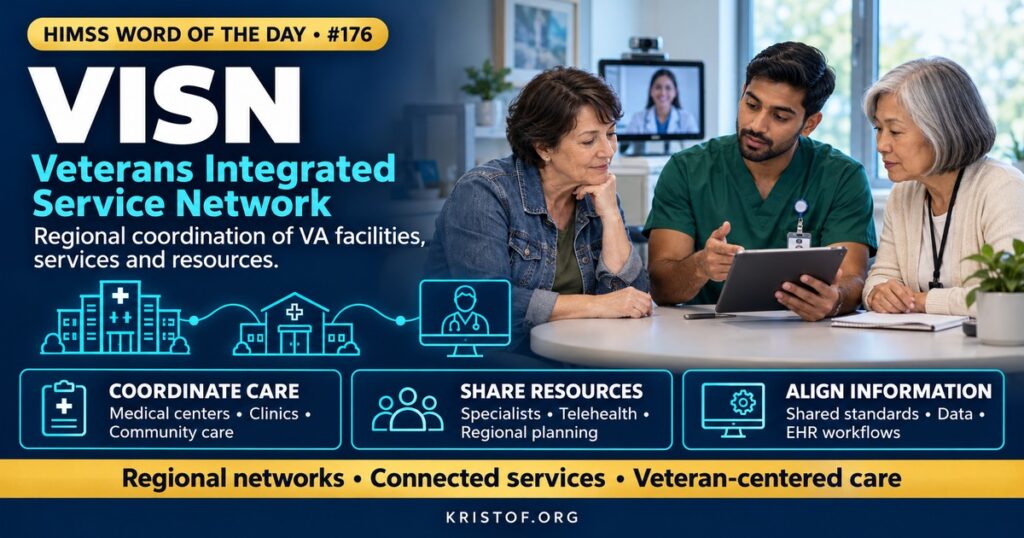
A Veterans Integrated Service Network (VISN) is a regional system of care within the Veterans Health Administration (VHA) that brings together VA medical centers, community-based outpatient clinics, and other services to coordinate care and manage resources across a geographic area.
The HIMSS Dictionary explains that the VHA is divided into regional areas called VISNs and describes them as regional systems of care working together to meet local needs and improve access. The dictionary cites 21 VISNs, but the structure has since changed: the VA’s VISN page now lists five networks following a reorganization announced in December 2025.
| VISN Era | Number of Networks | Context |
|---|---|---|
| Mid-1990s | 22 | VISNs created as part of a major VHA restructuring toward integrated, outpatient-focused care |
| Later Consolidations | 21, then 18 | Networks merged over time |
| Current Structure | 5 | VA consolidated 18 networks into five as part of a reorganization announced in December 2025 |
| Current VISN | Example States Included |
|---|---|
| VISN 1 | Northeastern and mid-Atlantic states, including New York, Pennsylvania, and Massachusetts |
| VISN 2 | Southeastern states, including Florida, Georgia, and Virginia, plus Puerto Rico |
| VISN 3 | Midwestern states, including Illinois, Michigan, Ohio, and Tennessee |
| VISN 4 | South-central and mountain states, including Arkansas, Texas, Louisiana, and Colorado |
| VISN 5 | Western states and Pacific territories, including California, Washington, and Hawaii |
⚠️ Exam Alert: A VISN is a regional network within the Veterans Health Administration. The VHA is the VA’s healthcare branch. VistA is the VA’s long-standing health information system, now being replaced by the Federal EHR. Dictionary counts of VISNs reflect earlier structures; check the VA’s current listing.
🌐 Why It Matters: Real-World Healthcare IT Context
VISNs were created in the mid-1990s as part of a major transformation of VA health care that shifted resources toward integrated, community-based, and outpatient care and gave regional leaders responsibility for budgets and performance. The model influenced thinking about integrated delivery networks more broadly.
Regional structure shapes how care is organized. VISNs coordinate services across facilities, manage budgets, share specialists, oversee quality, and implement national policies. Veterans may receive care at multiple facilities within a network, which makes shared records and coordinated scheduling important.
The structure has changed significantly. In December 2025, VA announced its largest reorganization of the VHA framework in decades, including consolidating 18 VISNs into five that report directly to the Under Secretary for Health. VA leaders said the existing structure created redundancies, fragmented data, and inconsistent application of national policy. Critics questioned whether consolidation would address underlying problems. The VA’s VISN page now lists five networks, each covering many states and territories.
Network structure matters for health IT. Larger networks can standardize clinical workflows, templates, and data definitions across more facilities, which supports analytics, quality comparisons, and EHR implementation. The VA’s transition from VistA to the Federal EHR has been planned and deployed facility by facility, and network leadership plays a role in coordinating training, staffing, and support during deployments.
Data consolidation is a stated goal. Consistent data across facilities makes it easier to measure access, quality, and outcomes, and to compare performance across regions. Achieving this requires governance, common definitions, and interoperable systems.
Community care adds complexity. Many veterans receive care from community providers paid by the VA, so VISNs must coordinate referrals, authorizations, and records exchange with non-VA organizations.
Veterans’ experience depends on these structures too. Access standards, travel distances, wait times, and the choice between VA and community care are shaped by how networks allocate staff, facilities, and specialty services. Transparent reporting of access and quality data at the network level helps veterans and oversight bodies see whether changes improve care.
Lessons extend beyond the VA. Large health systems face similar questions about how much to centralize decisions, how to standardize while respecting local needs, and how organizational structure affects data and technology.
Challenges for regional health networks:
- Balancing standardization with local needs
- Consolidating data from different facilities and systems
- Coordinating EHR transitions across many sites
- Maintaining access across large geographic areas
- Managing community care referrals and records
- Communicating structural changes to staff and patients
What supports effective network operations:
- Common clinical standards and data definitions
- Network-level analytics and performance monitoring
- Coordinated IT governance and implementation support
- Shared specialty services, including telehealth
- Strong relationships with community providers
- Clear lines of accountability
🏥 The Nurse’s Perspective: Clinical, Bedside, & Workflow
VISN-level decisions shape the policies, staffing, and technology that VA nurses work with every day.
At the Bedside
Standardized clinical practices and documentation across a network can make it easier for nurses who float or transfer between facilities, and for veterans who receive care at more than one site.
Network-wide quality initiatives, such as falls prevention or suicide prevention programs, often originate at the national or network level and are implemented by nurses at each facility.
In Clinical Workflow
Telehealth programs coordinated at the network level connect veterans in rural areas with specialists, often with nurses facilitating visits at community clinics or supporting home telehealth.
Care coordination across facilities and with community providers relies on nurses to manage referrals, track results, and ensure veterans do not fall through gaps.
Structural changes can affect reporting lines, policies, and support services. Clear communication helps nurses understand how changes affect their daily work.
Nurse leaders at the network level contribute to standardization decisions, workforce planning, and technology implementation.
Veterans themselves may notice changes when networks consolidate, such as new scheduling processes or referral pathways. Nurses who explain these changes help maintain trust.
In EHR Implementation (Go-Live Perspective)
As the VA deploys the Federal EHR, network-level coordination influences training schedules, super user programs, and support resources. Lessons learned at one facility can inform deployments at others in the same network.
At-the-elbow support during these transitions often includes staff from other VA facilities who have already gone live, sharing practical experience with nurses learning the new system.
🎓 CAHIMS / CPHIMS & HIMSS Perspective
CAHIMS Exam Domain Mapping
VISNs appear in health system structure and federal health IT questions:
| CAHIMS Domain | How VISNs Appear |
|---|---|
| Healthcare & Technology Environments | VA structure; integrated delivery networks; federal health systems |
| Clinical Informatics | Standardized workflows across facilities; telehealth coordination |
| Healthcare Information & Systems Management | Data consolidation, EHR transition coordination, network analytics |
| Management & Leadership | Organizational restructuring, governance, change management |
Key Terms to Know Alongside VISN
- Veterans Health Administration (VHA) — the VA’s healthcare system
- VistA — the VA’s long-standing health information system
- Federal EHR — the commercial EHR shared by the VA, the Department of Defense, and other federal partners
- Integrated Delivery Network (IDN) — a network of facilities and providers under shared management
- Community Care — care purchased by the VA from non-VA providers
- Standardization — adopting common practices and definitions across sites
HIMSS Organizational Position
HIMSS addresses federal health IT, including VA EHR modernization, through its public policy work and education on large-scale system implementation. Members can find related education and research through the HIMSS Resource Center.
🔗 Explore Further: External References
- U.S. Department of Veterans Affairs — Veterans Integrated Service Networks https://department.va.gov/integrated-service-networks/
- Military Times — VA to Launch Largest Reorganization of Health Care System in 30 Years (December 2025) https://www.militarytimes.com/veterans/2025/12/17/va-to-launch-largest-reorganization-of-health-care-system-in-30-years/
- U.S. Department of Veterans Affairs — EHR Modernization https://digital.va.gov/ehr-modernization/
- U.S. Department of Veterans Affairs — VA Health Care https://department.va.gov/vha/
- U.S. Department of Veterans Affairs — Find VA Locations https://www.va.gov/find-locations
- HIMSS — Public Policy & Advocacy https://www.himss.org/public-policy-advocacy-overview
Term source: HIMSS Dictionary of Health Information and Technology Terms, Acronyms, and Organizations, 6th Edition (2025). All definitions in this series are paraphrased for editorial purposes. Readers are encouraged to consult the primary source for exact language.
Eric Andrew Kristof, RN, CAHIMS is a Healthcare IT professional and HIMSS Arkansas Chapter member based in Hot Springs Village, AR, with hands-on Epic Go-Live experience and a diverse healthcare and IT background. He writes at kristof.org at the intersection of clinical care and healthcare technology.
Leave a Reply