By Eric Andrew Kristof, RN, CAHIMS | Healthcare IT Professional | HIMSS Arkansas Chapter Member
About This Series: The HIMSS Word of the Day is a running blog series drawing from the HIMSS Dictionary of Health Information and Technology Terms, Acronyms, and Organizations, 6th Edition (2025) — the authoritative reference for healthcare IT professionals and the primary study resource for CAHIMS and CPHIMS certification. Each post paraphrases the term in plain language, grounds it in real-world healthcare IT context, and adds a bedside nursing perspective you won’t find in a textbook.
📖 The Term: Business Intelligence (BI)
Source: HIMSS Dictionary of Health Information and Technology Terms, Acronyms, and Organizations, 6th Edition (2025)
🔍 Plain-Language Definition
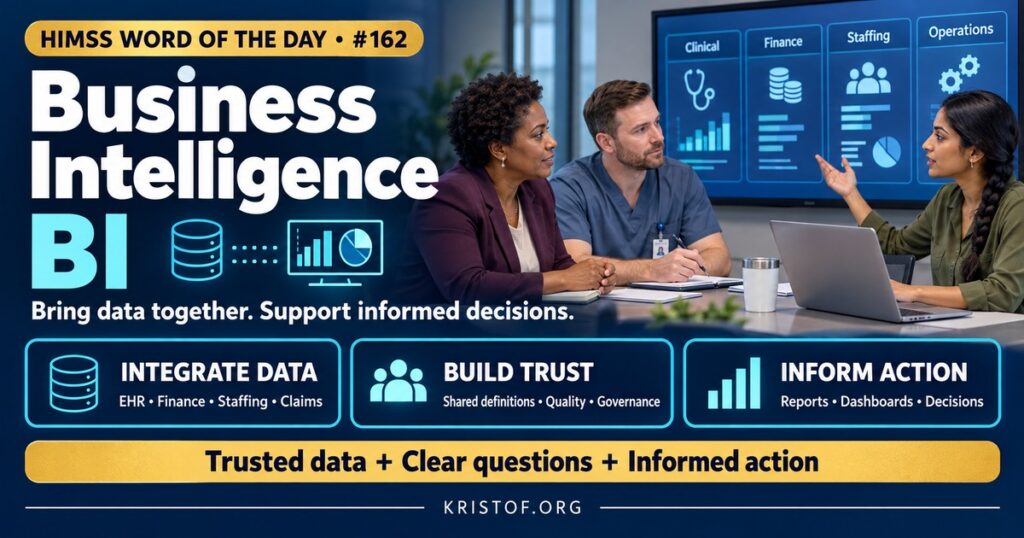
Business intelligence (BI) is the combination of technologies, processes, and practices used to collect, integrate, analyze, and present organizational data so that leaders and staff can make informed decisions.
The HIMSS Dictionary describes business intelligence as the tools and systems that are central to an organization’s strategic planning. It explains that these systems let a company collect, store, access, and analyze its data to support decision-making, and it points readers to decision support systems.
| BI Component | What It Does | Healthcare Example |
|---|---|---|
| Data Sources | Systems that generate data | EHR, finance, supply chain, staffing, claims |
| ETL or Data Pipelines | Extract, transform, and load data for analysis | Nightly loads of EHR data into a warehouse |
| Data Warehouse | Stores integrated, historical data for reporting | An enterprise clinical and financial warehouse |
| Semantic Layer | Standard definitions and business rules | One agreed definition of “readmission” |
| Reports and Dashboards | Present information to users | A daily census and staffing dashboard |
| Self-Service Analytics | Lets trained users explore data | Managers filtering quality data by unit |
⚠️ Exam Alert: Business intelligence focuses on describing what happened and what is happening using organizational data. Advanced analytics and predictive modeling focus on forecasting and explaining. A data warehouse is a storage foundation for BI. Clinical decision support guides patient-level care decisions, while BI usually supports organizational decisions.
🌐 Why It Matters: Real-World Healthcare IT Context
Healthcare organizations generate data in dozens of systems, but leaders often struggle to get timely, trustworthy answers. BI brings data together, applies consistent definitions, and delivers it in forms people can use, from executive dashboards to unit-level reports.
BI supports many areas. Operations teams monitor patient flow, bed capacity, emergency department wait times, and operating room utilization. Finance teams track revenue, denials, costs, and productivity. Quality teams follow measures such as infections, falls, and readmissions. Human resources and nursing leaders monitor staffing, overtime, and turnover. Population health teams track care gaps and risk across patient panels.
Data warehouses are the usual foundation. Data is extracted from source systems, cleaned, transformed, and loaded into a warehouse or modern cloud data platform designed for analysis. Many EHR vendors provide their own reporting databases, which organizations combine with financial and operational data. Larger big data platforms extend these capabilities to images, device data, and text.
Governance determines trust. Without agreed definitions, different reports may show different numbers for the same measure, eroding confidence. Data governance establishes definitions, ownership, data quality checks, and certification of key reports.
Self-service BI expands access. Trained users can explore data, filter dashboards, and answer questions without waiting for analysts. Organizations balance this flexibility with certified dashboards for official metrics and training in data literacy so users interpret results correctly.
Research highlights the importance of context. A scoping review in JAMIA Open of BI systems for population health management concluded that effective BI depends on a coherent data strategy and an understanding of users’ decision contexts and needs, not just on technology.
Timeliness matters. Some decisions need real-time data, such as bed management, while others can rely on daily or monthly data. Matching refresh frequency to decision needs avoids both stale information and unnecessary complexity.
AI is changing BI tools. Many platforms now offer natural language queries, automated insight detection, and AI-generated summaries of dashboards. These features can make data more accessible, but they also require validation, because an AI summary may misread definitions or overstate small changes. Governance frameworks increasingly address how AI features in BI tools are tested and labeled.
Security and privacy apply to BI environments, which often contain large volumes of PHI. Role-based access, de-identification where possible, and auditing protect data in reporting systems as well as clinical systems.
Measuring the value of BI keeps investment focused. Organizations can track whether dashboards are actually used, which decisions they informed, and whether metrics improved after leaders acted on them. Retiring unused reports frees analysts for higher-value work.
Common BI challenges in healthcare:
- Conflicting numbers from inconsistent definitions
- Data silos and difficult integration
- Reports that answer the wrong questions
- Delays between events and available data
- Too many dashboards and not enough action
- Large stores of PHI with weak access controls
What makes healthcare BI effective:
- Clear questions and decisions to support
- Strong data governance and certified metrics
- Integrated clinical, financial, and operational data
- Refresh timing matched to decisions
- Training in data literacy for users
- Security controls appropriate to sensitive data
🏥 The Nurse’s Perspective: Clinical, Bedside, & Workflow
Nurses both supply the data that feeds BI and rely on BI to manage units and improve care.
At the Bedside
Every documented assessment, intervention, and outcome becomes data that BI systems may use for quality and operational reporting. Structured, timely documentation makes reports accurate and reduces the need for manual chart review.
When unit reports show surprising results, such as a sudden increase in falls or missing documentation, nurses can help determine whether the cause is a real change in care or a data issue.
In Clinical Workflow
Nurse managers use BI dashboards to track staffing, overtime, patient acuity, quality measures, and patient experience. Combining these views helps managers make staffing decisions and target improvement efforts.
Charge nurses and house supervisors rely on near real-time capacity and flow information to place patients, plan discharges, and anticipate surges.
Nursing quality councils use BI reports to monitor nurse-sensitive indicators and evaluate whether practice changes are working.
Nurse informaticists often bridge clinical and analytics teams, translating questions from nursing leaders into precise data requests and validating that reports reflect real workflows.
Shared understanding of definitions prevents confusion. When a nursing dashboard and a finance report show different numbers for the same measure, comparing definitions often reveals the cause.
In EHR Implementation (Go-Live Perspective)
During an Epic Go-Live, reporting teams rebuild reports and dashboards for the new system and connect new data sources to the enterprise warehouse. Reports used for regulatory, quality, and staffing purposes must be ready and validated early.
At-the-elbow support analysts often hear from managers who cannot find familiar reports. Capturing these needs quickly helps reporting teams prioritize rebuilds and avoid gaps in operational oversight.
🎓 CAHIMS / CPHIMS & HIMSS Perspective
CAHIMS Exam Domain Mapping
Business intelligence appears in analytics and management questions:
| CAHIMS Domain | How BI Appears |
|---|---|
| Healthcare & Technology Environments | Data-driven healthcare; analytics trends |
| Clinical Informatics | Nursing quality reporting, documentation as data, unit dashboards |
| Healthcare Information & Systems Management | Data warehouses, ETL, reporting tools, access control |
| Management & Leadership | Performance management, data governance, strategic planning |
Key Terms to Know Alongside Business Intelligence
- Data Warehouse — a repository of integrated, historical data for reporting and analysis
- ETL — extract, transform, and load processes that prepare data for analysis
- Dashboard — a visual display of key metrics
- Key Performance Indicator (KPI) — a measure used to track progress toward goals
- Data Governance — the framework for managing data definitions, quality, and access
- Self-Service Analytics — tools allowing users to explore data without specialist help
HIMSS Organizational Position
HIMSS supports data-driven decision-making through analytics education, research, and resources on data governance and interoperability. Members can find related education and research through the HIMSS Resource Center.
🔗 Explore Further: External References
- Roorda et al. (2024), JAMIA Open — Business Intelligence Systems for Population Health Management: A Scoping Review https://pubmed.ncbi.nlm.nih.gov/39605928/
- NIST — Big Data Interoperability Framework, Volume 1: Definitions https://www.nist.gov/publications/nist-big-data-interoperability-framework-volume-1-definitions
- AHRQ — Data and Analytics https://www.ahrq.gov/data/index.html
- CMS — Data.CMS.gov https://data.cms.gov/
- AHRQ — Healthcare Cost and Utilization Project (HCUP) https://hcup-us.ahrq.gov/
- HIMSS — Nursing Informatics Community https://www.himss.org/networking/communities/nursing-informatics/
Term source: HIMSS Dictionary of Health Information and Technology Terms, Acronyms, and Organizations, 6th Edition (2025). All definitions in this series are paraphrased for editorial purposes. Readers are encouraged to consult the primary source for exact language.
Eric Andrew Kristof, RN, CAHIMS is a Healthcare IT professional and HIMSS Arkansas Chapter member based in Hot Springs Village, AR, with hands-on Epic Go-Live experience and a diverse healthcare and IT background. He writes at kristof.org at the intersection of clinical care and healthcare technology.
Leave a Reply