By Eric Andrew Kristof, RN, CAHIMS | Healthcare IT Professional | HIMSS Arkansas Chapter Member
About This Series: The HIMSS Word of the Day is a running blog series drawing from the HIMSS Dictionary of Health Information and Technology Terms, Acronyms, and Organizations, 6th Edition (2025) — the authoritative reference for healthcare IT professionals and the primary study resource for CAHIMS and CPHIMS certification. Each post paraphrases the term in plain language, grounds it in real-world healthcare IT context, and adds a bedside nursing perspective you won’t find in a textbook.
📖 The Term: Advanced APM (Advanced Alternative Payment Model)
Source: HIMSS Dictionary of Health Information and Technology Terms, Acronyms, and Organizations, 6th Edition (2025)
🔍 Plain-Language Definition
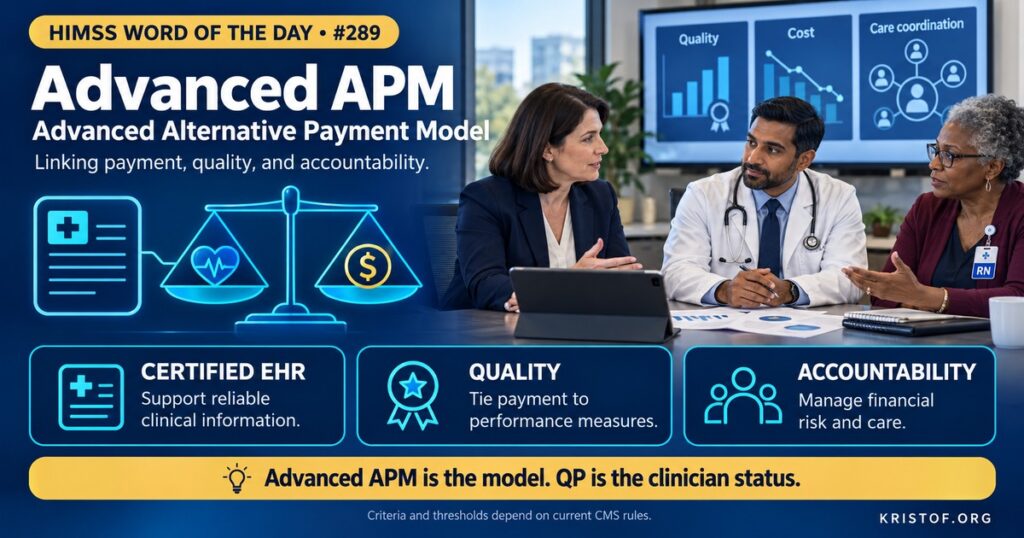
An Advanced APM (Advanced Alternative Payment Model) is a type of payment model recognized under the Medicare Quality Payment Program (QPP). The HIMSS Dictionary describes it as a QPP track in which eligible clinicians can earn an incentive payment by reaching a threshold share of payments or patients through a designated model. Clinicians who reach the threshold become Qualifying APM Participants (QPs) and are excluded from the reporting requirements and payment adjustments of the other QPP track, the Merit-based Incentive Payment System (MIPS).
The Dictionary mentions a 5 percent incentive. That figure has since changed. The regulation at 42 CFR 414.1450 sets the APM incentive at 5 percent for payment years 2019 through 2024, 3.5 percent for payment year 2025, and 1.88 percent for payment year 2026, each applied to estimated aggregate payments for covered professional services in the preceding calendar year.
To count as an Advanced APM, a model must meet criteria in 42 CFR 414.1415. First, it must require participants to use certified EHR technology (CEHRT). For performance periods beginning in 2025, the regulation refers to the definition of CEHRT at 414.1305. Second, payment must be based in part on quality measures, with at least one outcome measure unless CMS finds none applicable. Third, the model must expose participants to financial risk beyond a nominal amount, unless it is an expanded medical home model.
| Criterion | What the Model Must Do | Informatics Link |
|---|---|---|
| CEHRT use | Require certified EHR technology | Certified system, documentation, exchange |
| Quality measures | Tie payment to measures, including an outcome measure | Measure data, registries, reporting |
| Financial risk | Put participants at more than nominal risk | Cost and utilization analytics |
| Threshold | Clinician reaches QP payment or patient share | Attribution and claims data |
⚠️ Exam Alert: Advanced APM is a model (or a track); QP is a clinician status earned by meeting thresholds; MIPS is the other QPP track scored on four performance categories. An ACO can be an Advanced APM only when it carries the required two-sided risk; not every APM is an Advanced APM.
🌐 Why It Matters: Real-World Healthcare IT Context
Advanced APMs sit at the more demanding end of Medicare’s value-based payment spectrum. Instead of adjusting fee-for-service payments up or down according to reported performance, as MIPS does, these models change how an organization is paid and ask it to share in losses as well as gains. That makes information technology central: the organization has to measure cost and quality for a population, find patients who need care, and coordinate across settings.
The thresholds show how steep the climb is. Under 42 CFR 414.1430, the Medicare Option requires, for 2026, that at least 50 percent of payments or 35 percent of patients be attributable to the Advanced APM for QP status; the partial QP thresholds are 40 percent of payments or 25 percent of patients. For 2027 and later, the regulation sets the QP thresholds at 75 percent of payments or 50 percent of patients, and the partial QP thresholds at 50 percent and 35 percent. An all-payer combination option exists, with its own thresholds. Partial QPs may choose whether to be scored under MIPS, while full QPs are excluded from it.
Research on whether the track changes behavior is limited and mixed. A 2024 study in Inquiry compared Medicare Part B medical services payments for primary care clinicians in ACOs, which were the main Advanced APM participants, and in MIPS. It used public use files from 2014 to 2018 and difference-in-differences regressions on 254,395 observations from 50,879 clinicians, 37.86 percent in ACOs. ACO clinicians showed a significantly greater increase in payments, about 1,004 dollars (95 percent confidence interval 579 to 1,429), than MIPS clinicians after QPP began. The authors noted that this could reflect the higher payment adjustments for ACO clinicians, or a shift toward outpatient services to prevent costlier inpatient care, and urged policymakers to consider both explanations.
A 2025 study in Quality Management in Health Care used the same type of data from 2012 to 2018, with 508,144 observations from 72,592 primary care clinicians (25.78 percent ACO). Because some preventive measures are mandatory for ACOs and voluntary in MIPS, the authors compared preventive service use. ACO clinicians had higher rates of pneumonia vaccination (incidence rate ratio 1.25) and lower rates of colorectal cancer screening (0.69), with no difference in breast cancer screening or tobacco cessation interventions. The pattern suggests that ACOs may prioritize some measures over others. Both studies are observational and use public aggregate data, so they cannot prove cause.
For informatics teams, an Advanced APM changes the work. Data must be reliable enough to support financial risk: attribution lists, claims feeds, quality measure calculation, risk adjustment, and dashboards that show leaders where costs are rising. Care coordination tools, such as admission notifications, referral tracking, and transitions of care workflows, matter because avoidable utilization directly affects the bottom line. Compliance teams track the CEHRT requirement and whether the clinicians in the entity meet QP thresholds, which depends on accurate rosters and payment data. And because the rules, thresholds, and incentive amounts have changed repeatedly, organizations check the current regulation and CMS guidance each performance year.
Common Advanced APM challenges:
- Thresholds that clinicians cannot reach with the patients and payers they have
- Incentive amounts that are smaller than the cost of building the infrastructure
- Attribution disputes and incomplete claims data
- Quality measures that reward documentation more than outcomes
- Financial risk without enough analytic capacity to manage it
- Rules that change from year to year
What supports success in an Advanced APM:
- Reliable attribution and population data
- Care coordination workflows built into the EHR
- Dashboards for cost, utilization, and quality
- Governance that links clinical leaders with finance
- Tracking of QP status and CEHRT compliance
- Regular review of current CMS rules
🏥 The Nurse’s Perspective: Clinical, Bedside, & Workflow
Nurses carry out much of the care redesign that Advanced APMs depend on.
At the Bedside
Nurses see where avoidable utilization begins: a discharge without a follow-up appointment, a patient who cannot afford a medication, an emergency visit that a phone call could have prevented. Documentation of social needs, teaching, and discharge readiness helps the organization see and fix these gaps.
In Clinical Workflow
Care managers, transition nurses, and clinic nurses lead outreach, chronic disease management, and follow-up calls that reduce avoidable admissions. Nurse managers use utilization and quality reports to prioritize work, and nurse leaders help decide which patients receive intensive support.
Nurse informaticists translate quality measure specifications into documentation workflows, test whether measure reports match what is charted, and help build registries and outreach lists.
In EHR Implementation (Go-Live Perspective)
An Epic Go-Live for an ACO or similar entity must support risk and quality workflows from the first day: care gap lists, attribution, and measure capture. At-the-elbow support analysts hear when a required field is hard to find or a measure is not being credited, and those findings go back to the build team before reporting deadlines.
🎓 CAHIMS / CPHIMS & HIMSS Perspective
CAHIMS Exam Domain Mapping
Advanced APMs appear in payment, quality, and EHR requirement questions:
| CAHIMS Domain | How Advanced APMs Appear |
|---|---|
| Healthcare & Technology Environments | MACRA, QPP, payment models, regulation |
| Clinical Informatics | Quality measures, care coordination, population health tools |
| Healthcare Information & Systems Management | CEHRT, attribution data, analytics, reporting |
| Management & Leadership | Financial risk, governance, performance management |
Key Terms to Know Alongside Advanced APM
- Qualifying APM Participant (QP) — clinician who meets the payment or patient thresholds in an Advanced APM
- Merit-based Incentive Payment System (MIPS) — the QPP track that adjusts payment based on performance scores
- CEHRT — certified electronic health record technology
- Nominal Financial Risk — minimum level of risk a model must bear to qualify
- Accountable Care Organization (ACO) — provider group accountable for cost and quality of a population
- Attribution — assignment of patients to a clinician, group, or model
HIMSS Organizational Position
HIMSS supports value-based care and the health information infrastructure that makes it possible through its public policy work, research, and education. Members can find related resources through the HIMSS Resource Center.
🔗 Explore Further: External References
- eCFR — 42 CFR 414.1415, Advanced APM Criteria https://www.ecfr.gov/current/title-42/chapter-IV/subchapter-B/part-414/subpart-O/section-414.1415
- eCFR — 42 CFR 414.1430, Qualifying APM Participant Determination: QP and Partial QP Thresholds https://www.ecfr.gov/current/title-42/chapter-IV/subchapter-B/part-414/subpart-O/section-414.1430
- eCFR — 42 CFR 414.1450, APM Incentive Payment https://www.ecfr.gov/current/title-42/chapter-IV/subchapter-B/part-414/subpart-O/section-414.1450
- Shrestha et al. (2024), Inquiry — ACO Clinicians Have Higher Medicare Part B Medical Services Payments Than MIPS Clinicians Under the Quality Payment Program https://pubmed.ncbi.nlm.nih.gov/38515280/
- Shrestha et al. (2025), Quality Management in Health Care — Differences in Utilization of Preventive Services for Primary Care Clinicians Participating in MIPS and ACOs https://pubmed.ncbi.nlm.nih.gov/39499051/
- CMS Quality Payment Program — Advanced APMs https://qpp.cms.gov/eligibility-participation/apm/advanced-apms
Term source: HIMSS Dictionary of Health Information and Technology Terms, Acronyms, and Organizations, 6th Edition (2025). All definitions in this series are paraphrased for editorial purposes. Readers are encouraged to consult the primary source for exact language.
Eric Andrew Kristof, RN, CAHIMS is a Healthcare IT professional and HIMSS Arkansas Chapter member based in Hot Springs Village, AR, with hands-on Epic Go-Live experience and a diverse healthcare and IT background. He writes at kristof.org at the intersection of clinical care and healthcare technology.
Leave a Reply