By Eric Andrew Kristof, RN, CAHIMS | Healthcare IT Professional | HIMSS Arkansas Chapter Member
About This Series: The HIMSS Word of The Day is a running blog series drawing from the HIMSS Dictionary of Health Information and Technology Terms, Acronyms, and Organizations, 6th Edition (2025) — the authoritative reference for healthcare IT professionals and the primary study resource for CAHIMS and CPHIMS certification. Each post paraphrases the term in plain language, grounds it in real-world healthcare IT context, and adds a bedside nursing perspective you won’t find in a textbook.
📖 The Term: CA (Certificate Authority)
Source: HIMSS Dictionary of Health Information and Technology Terms, Acronyms, and Organizations, 6th Edition (2025)
🔍 Plain-Language Definition
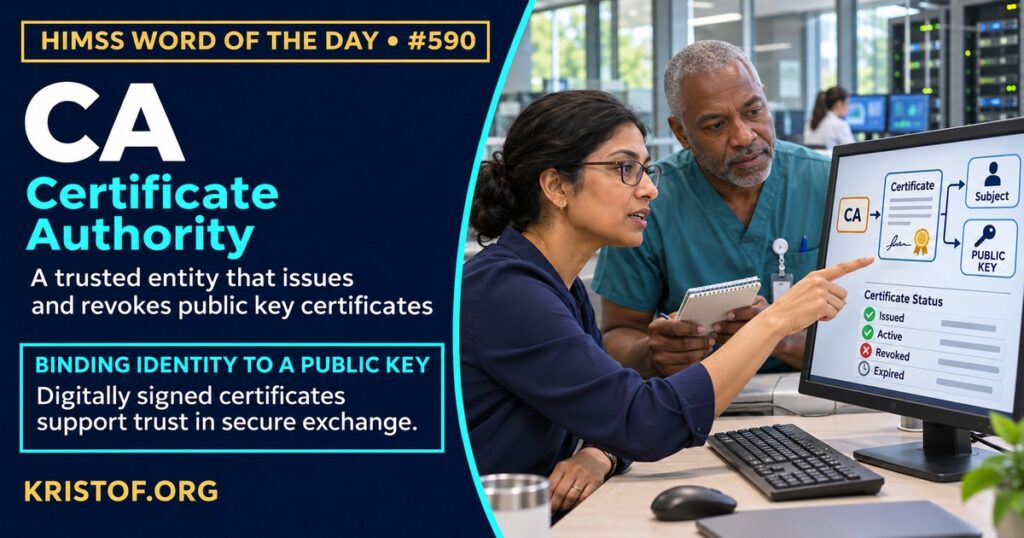
The HIMSS Dictionary describes a CA (Certificate Authority) as an independent party that vouches for an identity in encrypted communication. It compares the role to an electronic notary and says the authority handles a sender’s encryption keys and issues a digital certificate.
Standards sources describe the role a little differently. NIST‘s glossary gives several definitions drawn from its publications. One calls a certification authority a trusted entity that issues and revokes public key certificates. Others describe the entity in a public key infrastructure that is responsible for issuing certificates and enforcing compliance with a PKI policy. RFC 5280, the IETF profile for X.509 certificates, says certificates bind public key values to subjects, and that a trusted CA asserts the binding by digitally signing each certificate. It also says CAs are responsible for indicating the revocation status of the certificates they issue, and it describes a certificate revocation list as a time-stamped list identifying revoked certificates.
One detail in the dictionary entry deserves a check. It says the authority stores a sender’s public and private keys. As read through a fetch summary, RFC 5280 does not say that a CA holds a subject’s private key, though it mentions that user key material may optionally be backed up by a CA or a key backup system. Whether a particular organization’s CA keeps copies of private keys depends on its own design and policy, so the dictionary’s wording appears imprecise as a general statement. The entry also describes the authority as a licensing agency, which is not how the NIST definitions read.
| Item | Detail |
|---|---|
| Core role | Issues and revokes public key certificates, per NIST |
| What a certificate does | Binds a public key to a subject, per RFC 5280 |
| How trust is asserted | The CA digitally signs each certificate, per RFC 5280 |
| Revocation | CAs indicate revocation status, for example through certificate revocation lists |
| Related role | A registration authority verifies requests and tells the CA to issue, per DirectTrust’s glossary |
| Public statement | A certificate practice statement describes how a CA issues, renews, revokes, and validates certificates |
| Relation to HIMSS | None verified for this post, so none is claimed |
⚠️ Exam Alert: A CA is one component of a PKI, not the whole infrastructure, and it is different from a registration authority, which verifies requests, and from the certificate itself. The private key belongs to the certificate subject, not to the certificate. The standards sources use “certification authority” while the dictionary says “certified authority,” and DirectTrust writes “certificate authority,” so expect more than one spelling. CAHIMS and CPHIMS come from HIMSS, not from a certificate authority.
🌐 Why It Matters: Real-World Healthcare IT Context
Searches of PubMed run for this post turned up no studies on certificate authorities in health IT that could be verified, so no PubMed articles are cited. This section draws on the NIST glossary, RFC 5280, and DirectTrust’s own pages. DirectTrust’s statements are its own description of its programs, not an independent evaluation, and several of these pages were read through a summarizing fetch tool, so details are worth confirming at the source.
What a CA does. The NIST and RFC 5280 descriptions above agree on the core: a CA issues certificates, signs them, and keeps track of revocation. RFC 5280 also describes self-signed certificates as self-issued CA certificates used to convey a public key to begin certification paths, which gives certification paths a starting point.
Health IT example: Direct Secure Messaging. DirectTrust’s certificate issuance page calls digital certificates the foundation of trust across many of healthcare’s secure data exchange protocols. It says accredited CAs issue certificates to identity-proofed organizations and individuals, and that for Direct Secure Messaging these certificates support uses such as referrals, care coordination, and transitions of care. DirectTrust says it maintains and governs the Accredited Trust Anchor Bundle, which it describes as a vetted collection of trust anchors from accredited certificate authorities. The page gives no date, and it mentions a presentation at a 2025 event, so check for updates.
Query-based exchange and FHIR. The same page says a subset of accredited CAs issue certificates for participation in eHealth Exchange and Carequality, and that DirectTrust operates a Root CA for Facilitated FHIR, described as purpose-built to issue intermediate certificates to accredited CAs. It says these support API exchange between QHINs and participants under TEFCA, under the governance of the Recognized Coordinating Entity.
Accreditation. DirectTrust’s accreditation site describes a Certificate Authority Accreditation Program for healthcare entities involved in issuing digital certificates. The page read for this post says applicants must show HIPAA privacy and security compliance through a valid DirectTrust Privacy and Security accreditation, HITRUST certification, or WebTrust certification, and that the program covers policies, identification and authentication processes, certificate life-cycle management, and technical security controls. The page shows a September 2026 date.
Roles around the CA. DirectTrust’s glossary describes a registration authority as the party that verifies a user’s request for a certificate and then tells the CA to issue it. It describes a certificate practice statement as a public statement of the practices a certification authority uses to issue, renew, revoke, and validate certificates.
Common CA problems:
- Treating a CA as the whole PKI, or confusing it with the registration authority that verifies requests
- Assuming the CA holds every user’s private key, when the sources read for this post describe issuing and signing
- Trusting a certificate without considering which CA issued it and whether it has been revoked
- Overlooking the identity checking behind a certificate, since DirectTrust describes identity proofing and registration authorities as part of issuance
- Mixing up spellings and roles, such as certificate authority, certification authority, and root CA
What supports trust in a certificate authority:
- Defined roles in standards from NIST and the IETF
- Revocation mechanisms such as certificate revocation lists
- Published certificate practice statements
- Accreditation programs, such as DirectTrust’s program for healthcare certificate issuers
🏥 The Nurse’s Perspective: Clinical, Bedside, & Workflow
Nurses seldom deal with certificate authorities directly, but the secure connections that depend on them support everyday communication.
At the Bedside
Certificates can work in the background of secure messaging, device connections, and web sessions. A nurse might first notice a problem as a security warning on a screen or a device that cannot connect. Reporting the exact message, without patient details, helps the support team. Local security policy governs what to do with such a warning, and reporting it is the cautious choice.
In Clinical Workflow
Nurse informaticists who work on referrals, care coordination, and transitions of care may encounter secure messaging between organizations. DirectTrust describes certificates as supporting those uses, so a failed message can sometimes trace back to certificate or trust setup rather than to the clinical content.
In EHR Implementation (Go-Live Perspective)
During an Epic Go-Live, analysts at the elbow see connection problems on workstations, mobile devices, and interfaces. Certificate issues are one possible cause among many, and the infrastructure and security teams are the ones who can tell. Clear reports of what failed, where, and when speed that triage.
🎓 CAHIMS / CPHIMS & HIMSS Perspective
CAHIMS Exam Domain Mapping
A certificate authority connects security, identity, and trust:
| CAHIMS Domain | How CA Appears |
|---|---|
| Healthcare & Technology Environments | Secure exchange networks and trust frameworks |
| Clinical Informatics | Secure messaging for referrals and transitions of care |
| Healthcare Information & Systems Management | Certificate management, revocation, and security controls |
| Management & Leadership | Policy, accreditation, and governance of trust services |
Key Terms to Know Alongside CA
- Public Key Infrastructure (PKI) — the framework of roles, policies, and technology for managing public key certificates
- Digital signature — a value created with a private key that lets others verify who signed and whether data changed
- Encryption — transforming data so that only authorized parties can read it
- Direct Project — the standards-based approach to secure point-to-point exchange of health information
- Health Information Service Provider (HISP) — an organization that provides services for Direct exchange
- Trusted Exchange Framework and Common Agreement (TEFCA) — the federal framework for nationwide health information exchange
HIMSS Organizational Position
HIMSS offers education and research on health information and technology topics through its Resource Center. Members can find related information on the HIMSS Resource Center page.
🧭 More HIMSS Word of The Day Terms
Related terms in the Cybersecurity and Privacy series:
- Risk Assessment
- S/MIME (Secure Multipurpose Internet Mail Extensions)
- Nonrepudiation
- SSL (Secure Socket Layer)
Browse all Cybersecurity and Privacy terms or the A–Z glossary.
🔗 Explore Further: External References
- NIST — Computer Security Resource Center Glossary: certification authority https://csrc.nist.gov/glossary/term/certification_authority
- IETF — RFC 5280, Internet X.509 Public Key Infrastructure Certificate and Certificate Revocation List (CRL) Profile https://www.rfc-editor.org/info/rfc5280/
- DirectTrust — Certificate Issuance https://directtrust.org/certificate-issuance
- DirectTrust Accreditation — Certificate Authorities https://accreditation.directtrust.org/programs/certificate-authorities
- DirectTrust — Glossary https://www.directtrust.org/resources/glossary
- HIMSS — Resource Center https://www.himss.org/resource-center
Term source: HIMSS Dictionary of Health Information and Technology Terms, Acronyms, and Organizations, 6th Edition (2025). All definitions in this series are paraphrased for editorial purposes. Readers are encouraged to consult the primary source for exact language.
Eric Andrew Kristof, RN, CAHIMS is a Healthcare IT professional and HIMSS Arkansas Chapter member based in Hot Springs Village, AR, with hands-on Epic Go-Live experience and a diverse healthcare and IT background. He writes at kristof.org at the intersection of clinical care and healthcare technology.
Leave a Reply